Nofinity Logo
Onboarding

Welcome to Nofinity

Your premium hub to transform hours of YouTube video into concise, 5-minute text summaries. Build your custom expert feed!

1. Skip the Video

Save hours of watching. Read compact, AI-powered key takeaways in a premium magazine layout – completely ad-free.

2. Custom Feed

Subscribe to top experts in the Explore area to curate your personal, dynamically updating video feed.

3. Suggest Channels

Propose new YouTube channels. Once approved, our system automatically ingests and summarizes new uploads.

Latest Analyses(7)

The Clarity Act is in Trouble
Coin Bureau|10. Juni

The Clarity Act is in Trouble

The Illusion of Progress: A Committee Win is Not a Floor Win

The Digital Asset Market Clarity Act (Clarity Act) is the most significant crypto bill in a decade. It aims to end the SEC vs. CFTC turf war, provide clear rules for digital assets, and categorize them into three buckets. On May 14, 2025, it passed the Senate Banking Committee with a 15-9 vote.

However, behind the scenes, alarm bells are ringing. The committee win is merely the easy part. The bill has no scheduled floor vote yet—and that's exactly where many bills die. Even Democrat Ruben Gallego, who voted 'yes' in committee, said: "My vote there does not guarantee a vote on the floor." He even threatens a 'no' vote if the bill isn't softened.

The Brutal Math: 60 Votes to Beat the Filibuster
  • 53 Republican seats in the Senate – not enough to break a filibuster (60 votes needed).
  • 7 Democrats are required, but only two uncertain 'yes' votes exist: Gallego and Angela Alsobrooks – both have already hedged their support.
  • An election year (2026) makes a 'yes' vote politically toxic for Democrats: they would either be seen as helping the crypto industry or aiding the Trump family's personal finances (e.g., World Liberty Financial).
  • Crypto PACs spent over $271 million this cycle – but only 3% went to Democrats. No incentive to take the political risk.
The Landmine: Trump's Conflicts of Interest

Democrats Elizabeth Warren and Kirsten Gillibrand demand ethics guardrails (conflict-of-interest rules). These would bar top officials from holding private crypto stakes while in office. The target is World Liberty Financial, the Trump family's crypto venture.

  • The White House flatly refuses any rule singling out Trump: "Ethics rules must apply across the board."
  • Senator Cynthia Lummis warns: if the bill is used as a "cudgel against the President", he will veto it.
  • Result: Negotiations frozen. Neither side can move without losing face.
The Second Enemy: The Banking Lobby

After the committee vote, the American Bankers Association (ABA) launched an emergency campaign. Bank CEOs from JP Morgan (Jamie Dimon) to local lenders are attacking two key provisions:

  1. Stablecoin Yields: Crypto platforms could offer rewards that function like deposit interest but without bank regulations. Dimon calls it "fake bank deposits" – the ABA fears a massive deposit outflow.
  2. CFTC Jurisdiction: The bill would expand the CFTC's power, which banks see as a competitive disadvantage.

Ironically, JP Morgan is itself building a tokenized deposit platform called Kinexus. The banks don't want to stop the game; they want to be the only ones allowed to play. The White House's own economists debunk the panic: a full yield ban would reduce bank lending by only 0.02%.

The Worst Enemy: The Clock

The Senate has only four weeks in June remaining. Prerequisites for success:

  • Merging with the Senate Agriculture Committee's version
  • Resolving the ethics deadlock
  • Winning over five more Democrats
  • Surviving the banking blitz

Senate Majority Leader John Thune has not yet scheduled a vote. Analysts call a July 4th target highly ambitious. If the bill fails now, it could be delayed until 2030 – because the 2026 midterms could flip the crypto-friendly majority in the House.

Verdict and Signals to Watch

Realistic Paths Forward:

  1. Track 1 (Optimistic): Thune schedules a June vote. The ethics issue is spun off into a separate bill. The market structure bill moves on its own.
  2. Track 2 (Likely): The bill slips to fall, loses momentum in midterm chaos, and dies this Congress.
  3. Compromise: A narrower bill emerges, stripping out contested yield provisions. Less for the industry to love, but less for banks to fight.

Four Key Signals for the Next Weeks:

  1. Thune schedules floor time – otherwise, the bill is likely dead.
  2. Movement on an ethics carveout – Warren and Gillibrand signal a compromise structure.
  3. An uncommitted Democrat (e.g., Warner, Booker, Kim) goes public.
  4. 📉 Prediction markets: Polymarket at ~60% (retail hope), Kalshi at ~50% (institutional skepticism). When smart money is more pessimistic than the crowd – pay attention.

Bottom line: The Clarity Act is not dead, but no longer favored. The next three weeks decide whether 2026 becomes the year crypto got its rules – or whether we wait until 2030.

BERKSHIRE A SELL, VALUE INVESTING BLASPHEMY!
Value Investing with Sven Carlin, Ph.D.|20. Aug.

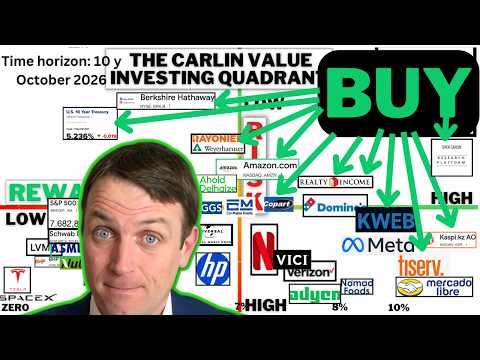
BERKSHIRE A SELL, VALUE INVESTING BLASPHEMY!

Summary: Berkshire Holdings & Value Investing Controversy

The speaker analyzes Berkshire Hathaway's current valuation and argues that selling might be a sensible choice for value investors. He highlights that future returns could be limited, even if the company remains fundamentally strong.

Key Points:

  • Past 10-year performance: Berkshire quadrupled, with earnings growth of ~6.2% per year (2015–2025).
  • Future outlook: At the current market cap of ~$1 trillion, moderate returns (4–7% p.a.) are expected based on conservative models (6% earnings growth, P/E 17).
  • Risks: Overvaluation of the stock portfolio (Apple, Coca-Cola), potential downturns, or acquisition mistakes could lead to losses.
  • Comparison with S&P 500: Berkshire is undeniably safer, but opportunity costs are high—other investments offer double-digit returns.

Conclusion for Different Investor Types:

  • Enterprising Investor (active): Sell to pursue better opportunities.
  • Defensive Investor (conservative): Hold for wealth preservation and long-term stability.

Key Quotes:

  • “Berkshire is and remains one of the safest investments—but it's no longer a quadruple.”
  • “Price is what you pay; value is what you get.” (Warren Buffett)
Essentials: How to Access Your Creativity | Rick Rubin
Andrew Huberman|20. Aug.

Essentials: How to Access Your Creativity | Rick Rubin

Podcast Summary: Unlocking Creativity with Rick Rubin

In this episode of Huberman Lab Essentials, Andrew Huberman talks with legendary music producer Rick Rubin about the nature of creativity. Rubin shares his unique perspective and practical methods for understanding and fostering the creative process. The core message: Creativity is not an intellectual process but an almost magical one that requires openness and presence.

The Essence of Creativity
  • Creativity is like a cloud or a dream: It is fleeting, constantly changing, and cannot be forced. It's about finding a feeling—like excitement, interest, or curiosity—within yourself.
  • Children are naturally more creative because they have no preconceived notions or rules. They are open and simply 'see what is'. Adults must relearn this unbiased attitude.
  • Language is often insufficient to capture the creative process. It's better to simply try things out than to talk about them.
Practical Methods and Rules in the Creative Process
  • Develop your own judgment: The most important skill for an artist is to know their own feeling and trust it – without being influenced by commercial ideas or the opinions of others.
  • Feedback is a tool, not a master: External feedback can be useful, but it shouldn't undermine your own connection to the work. The only control you have is over your relationship to the work.
  • Rules are a scaffolding that can be chipped away as needed. They are not set in stone.
Phases of Creative Work (according to Rick Rubin)

Rubin breaks down the creative process into four fluid, non-linear phases:

  1. Seed Collection Phase: Constantly collecting impressions, ideas, and interests without pressure or deadlines.
  2. Experimentation Phase: Playfully trying out the collected seeds without a specific goal in mind. You cannot force the growth.
  3. Crafting Phase: The experiments become concrete material that is shaped, combined, and refined.
  4. Completion Phase: The final editing and finishing. Only here can deadlines be helpful.
Dealing with Self-Doubt

Self-doubt is a balancing tool. It can either paralyze or serve as a helpful counterweight. Rubin encourages accepting doubts as part of the process rather than fighting them.

The Search for Clues
  • The universe supports creativity. You just have to pay attention to the clues – a word, an image, a random encounter.
  • Belief in your own ability is crucial. Those who believe they can create something great have a better chance.
  • The 'gifts' on the conveyor belt: All the elements for creative work are already present. You just have to notice them and have the courage to open them.
Further Insights
  • Meditation helps quiet the 'chattering mind'. Rubin practices both mantra and mindfulness meditation.
  • Presence in the moment is more important than your own mood. The question isn't whether you're happy or unhappy, but whether you're truly present with the work.
  • Pro Wrestling for Rubin is a perfect example of honesty in performance. It admits that it's a show – something the world often doesn't do.
Conclusion

Rick Rubin sees creativity as an open, almost spiritual process that requires attention, courage to experiment, and trust in one's own feelings. His approach demystifies the creative act while offering practical anchors for anyone looking to foster their own creativity.

The Real Reason Bitcoin EXPLODED Today
Coin Bureau|20. Aug.

The Real Reason Bitcoin EXPLODED Today

🔥 Bitcoin Surges 9% – The Real Reasons

On August 19, Bitcoin posted its largest daily candle since March, driven by a U.S. Treasury announcement doubling its liquidity support buybacks of long-dated bonds (from $2B to at least $4B). This pushed yields and the dollar lower, lifting risk assets across the board.

🏛️ White House Meeting: Trump and Three Regulatory Doors

Hours later, a meeting with Trump, SEC Chair Atkins, CFTC Chair Selig, and crypto leaders (Coinbase, Ripple, Robinhood) took place. Trump explicitly mentioned bringing Hyperliquid to the U.S. in a compliant manner. Supporting moves:

  • Digital Asset Market Clarity Act – Trump pushes for a vote (Senate closure on Sept 15)
  • SEC rulemaking – first crypto-specific registration exemptions in the agency’s 90-year history
📈 Hyperliquid: The Surprise Winner

Despite geo-blocking U.S. IPs, Hyperliquid (HYPE) surged over 20% to $70. The CFTC is working on a framework to license U.S. access to the venue without regulating its decentralized matching engine. Markets are pricing a legal on-ramp for on-chain perpetuals.

💥 Market Dynamics: Shorts Wiped Out
  • $1.1 billion in short liquidations – new record for crypto
  • Over 90% of all liquidations were shorts
  • Open interest rose 5.4% to $52B – fresh shorts got crushed
  • Largest single liquidation: $48.4M BTC short on Hyperliquid
🔍 Takeaway

The explosive move combined a Treasury backstop, a presidential catalyst, and regulatory progress. Markets are pricing real policy shifts, not just speculation. Whether this marks a turnaround or just a short squeeze remains to be seen.

Bitcoin explosion: Is this the start of the new crypto bull market?
Bitcoin2Go|20. Aug.

Bitcoin explosion: Is this the start of the new crypto bull market?

📈 Bitcoin Price Explosion: Reasons and Outlook

Bitcoin surged above $71,000, up 11% at the time of recording. It saw the largest short liquidation in history. The key question: Is this the start of a new bull market?

🔍 Main Reasons for the Surge

  • US Treasury: Doubling buybacks of long-term bonds (10–30 years). Not quantitative easing (QE), but signals looser monetary policy. Beneficiaries: scarce assets like Bitcoin, gold, silver.
  • White House Meeting: Trump, SEC, and crypto leaders discussed the Clarity Act and potential Bitcoin purchases for the US Treasury. Hyperliquid was explicitly mentioned – chance to launch a decentralized exchange in the US.
  • BlackRock & Van Eck: Reaffirm Bitcoin as digital gold and a hedge against money debasement. Van Eck sees 12 indicators pointing to a bottom.
  • Altcoin Winners: Hyperliquid (#10 by market cap) benefits from CFTC discussions. Ethereum also rises.

⚠️ Caution and Outlook

  • Short-term: Resistance at $74,000, then $78,000–$82,000. A sustained break above the 200-day EMA would be bullish.
  • Risks: Rising oil prices (geopolitics), inflation could hinder rate cuts. The speaker expects a lower low (e.g., $50,000) in the base scenario.
  • Strategy: No new purchases planned, but cash reserve ready for possible corrections.

💡 Conclusion

The party continues, but cautiously. Bitcoin remains the Plan B against fiat debasement. Fundamentals (limited supply, institutional adoption) remain intact.