
Lance Hedrick
3 min read
Coffeejack V2: Did They Redeem Themselves? (+ A V1 DISASTER)
Coffeejack V2: Did They Redeem Themselves? (+ A V1 Disaster)
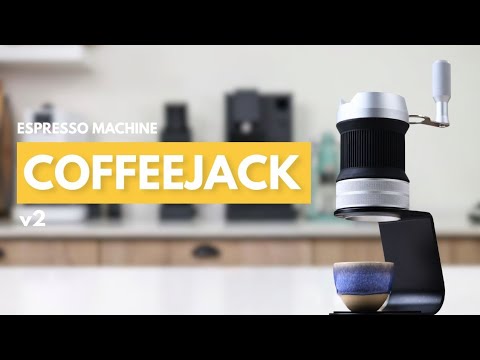
Lance Hedrick tests the Coffeejack V2, a manual espresso maker with a planetary gear system. The device weighs around 1.4 kg and is extremely sturdy. He compares it to its catastrophic predecessor, the Coffeejack V1, to see if the promised improvements hold up.
Design and Build
- The V2 has no hydraulic jack; instead, a planetary gear system drives a piston.
- Made of solid stainless steel, ensuring no microplastics in the water path.
- Its weight of ~1.4 kg makes it a heavy but robust companion, less suited for a backpack.
- Uses a 54mm portafilter. An adapter is included for the stand, which was carried over from the V1.
Heating and Temperature
- Preheating is mandatory. Without preheating, only about 70°C is reached.
- A single preheat with hot water (≈30 sec) is recommended.
- After one preheat, temperatures reach about 85-88°C – good for dark and medium roasts.
- With a proper rolling-boil kettle, up to 91°C is possible.
- A major advantage: The bottom-up filling creates no air gap between the piston and water.
Brewing Process and Workflow
- Workflow is upside-down: portafilter down, fill water, then flip.
- Pressure is generated by turning the handle. Maintaining constant pressure is more difficult than with a lever machine.
- The planetary gears provide smooth force transmission without pump pulses.
- Initial squeaking noise should subside after about 100 shots.
- Maximum water capacity is 90 ml, enough for standard shots (e.g., 18g coffee to 36g espresso).
- The workflow requires careful cleaning, as the silicone seal attracts grime.
Price and Alternatives
- The Coffeejack V2 costs approx. £198 (≈ $250 MSRP) or was cheaper on Kickstarter.
- Lance notes that cheaper devices like the Flair Neo (36% cheaper) or the Cafelat Robot (similar price) can produce equally good results.
- The V2 is cleverly engineered, but its workflow and weight are not ideal for everyone.
The V1: A Disaster
- The V1 was a hydraulic press and one of the biggest Kickstarter flops (raised ≈£1.8 million).
- It is mostly plastic, with a glass chamber that is extremely fragile.
- The portafilter design leads to channeling, as water concentrates in the center.
- The V1 is hard to use, impractical, and is a do-not-buy recommendation from Lance.
- During testing, the glass chamber of the V1 shatters, highlighting its fragility.
Bottom Line: The Coffeejack V2 is a major improvement over the V1. It makes good espresso but is heavy and requires practice. There are better alternatives at the price point. The V1 is a clear no-go.
Note: This is a condensed and structured summary of the original transcript.