Nofinity Logo

Latest Analyses(7)

Trump, Saylor, And Bitcoin’s ENDGAME
3 min read

Trump, Saylor, And Bitcoin’s ENDGAME

🏛️ The Political Turn: From Enemy to Strategic Asset
  • For most of its history, Bitcoin faced heavy government regulation (e.g., China, India) and was often associated with money laundering and crime.
  • Donald Trump's transformation is a prime example: from harsh criticism ("Bitcoin is a scam") to a pro-Bitcoin stance, driven by campaign donations, NFTs, and geopolitical considerations.
  • The U.S. establishes a Strategic Bitcoin Reserve (Executive Order on March 6, 2025), built on already-seized BTC. The goal: to hold long-term rather than sell.
🏢 Companies as Bitcoin Fortresses: The MicroStrategy Model
  • Michael Saylor and his company (now "Strategy") developed an extreme treasury strategy: raising capital through equity, convertible bonds, and preferred shares to buy massive amounts of Bitcoin.
  • By the end of 2025, the company holds over 670,000 BTC, setting new standards—but not without risks, as seen in forced sales during price drops.
  • More and more companies are following the trend: over 198 public firms now hold Bitcoin as a reserve asset.
⚡ Mining, Energy, and Geopolitical Interests
  • Bitcoin mining has become a political tool: Trump wants Bitcoin "mined, minted, and made in the USA".
  • The focus is on cheap energy and strategic advantages—a stark reversal from earlier regulatory policies.
⚖️ The Price of Mainstream Adoption: Centralization vs. Freedom
  • ETFs and regulated custodians (like BlackRock) make Bitcoin accessible to institutions, but users often don't control the private keys—a contradiction to the original ethos of decentralization.
  • Satoshi's vision of peer-to-peer cash is diluted by intermediaries, yet the software remains resistant: no government can rewrite the rules running on users' computers.
🔮 The Endgame: Winning by Survival?
  • Bitcoin has survived its trials (e.g., Mt. Gox, regulatory crackdowns) and now sits at the table with nation-states, corporations, and central banks.
  • The core question remains: Can Bitcoin preserve its decentralized identity once banks and states integrate it? Or will it adapt to the traditional financial world?

Conclusion: Whether as digital gold or a political symbol—the world has taken notice of Bitcoin. The fight for the future of money is still open, but Bitcoin has already proven it cannot be beaten.


Would you like to dive deeper into a specific aspect (e.g., Strategy's sales strategy or mining developments)?

The Bond Squeeze's Consequences for Stocks, Gold, and AI | Jan van Eck
2 min read

The Bond Squeeze's Consequences for Stocks, Gold, and AI | Jan van Eck

Macro Framework with Jan van Eck

In this episode of Monetary Matters, Jan van Eck breaks down the current market. His framework focuses on four key drivers: Fiscal, Monetary, and Regulatory Policy, and Technology.

🔴 The 'Bond Squeeze'

  • Rising 10-year yields are creating a "Bond Squeeze", putting downward pressure on stocks, gold, and most other assets in the short term.
  • The primary driver is strong economic growth (raising credit demand), not necessarily inflation or deficits alone.
  • U.S. fiscal spending is a massive long-term risk. The deficit remains high at 6.2%.

🤖 AI & Tech: The Rotation

  • AI is the dominant megatrend, but it's cyclical. AI 1.0 (chips/semiconductors) thrives, while AI 2.0 (data centers, nuclear power) is correcting.
  • Tokenomics: Demand is real. Companies like Anthropic are already profitable.
  • Bear Case: The biggest concern is competition from China (cheaper electricity).

🥇 Gold & Tangibles

  • Gold benefits structurally from loose fiscal policy. A short-term consolidation is normal after a strong rally.
  • Gold miners are in much better financial shape (lower debt) than a decade ago.

🌏 India & Private Credit

  • India: Van Eck is bullish. Massive deregulation and digitization make it a strong structural growth story with cheap valuations.
  • Private Credit: The market panic is overdone. It remains a secular growth trend offering value.
Conclusion

Van Eck advises staying fully invested. He is bullish on equities (U.S. & India) and advocates hedging with tangible assets (Gold, Bitcoin). He remains bearish on long-term Treasuries.

The Cruel End of a Great Love and the Plan for the "Perfect Murder" ... The Case of Greg Mulvihill
2 min read

The Cruel End of a Great Love and the Plan for the "Perfect Murder" ... The Case of Greg Mulvihill

The Case of Greg Mulvihill: A Murder Plot Born from Jealousy and Greed
  • Background: Greg Mulvihill, a 45-year-old software engineer and father, is shot and severely wounded on the night of September 1, 2016, in Carlsbad, California.
  • Events: A fake private detective lures Greg to a remote location with false documents about child custody. There, a camouflaged shooter ambushes him.
  • Investigation: Police trace a prepaid cell phone to Greg's estranged wife, Diana Lovejoy, and find DNA evidence linking shooter Wheldon McDavid to the scene.
  • Motives: Diana aimed to secure sole custody of their son and avoid paying $120,000 as part of their divorce settlement.
  • Trial: Diana and Wheldon are convicted of conspiracy to commit murder and attempted murder. Diana is sentenced to 26 years to life, Wheldon to 50 years to life.
  • Outcome: Greg survives the attack and is granted sole custody of his son.

My Take: This case underscores how far Diana was willing to go to eliminate Greg from her son's life—through false accusations and a calculated murder plot. The evidence was overwhelming.

And The Greatest Performance Car Of The Year Is…. | 4K
2 min read

And The Greatest Performance Car Of The Year Is…. | 4K

The Battle in Portimão
  • Top Gear puts four incredible machines to the test at the Autódromo do Algarve:
    • Ferrari 296 Speciale
    • Bentley Supersports
    • Aston Martin Valhalla
    • Porsche 911 GT3 SC (the roofless version)
  • The test includes lap times with The Stig, drag races, and deep dives into the driving experience.
The Contenders

Porsche 911 GT3 SC

  • The benchmark. Lightweight construction (carbon fiber bonnet, magnesium wheels), 503 bhp, 6-speed manual.
  • Lap Time: 1:57.21
  • Verdict: Brilliant, but the loss of roof rigidity is felt. The standard coupe is the better buy. Not the winner.

Bentley Supersports

  • The wildcard. 657 bhp, massively reduced weight for a Bentley (under 2,000 kg), Trofeo RS tires, aggressive aero (300 kg of downforce).
  • Lap Time: 2:01.43 (too heavy for the track).
  • Verdict: Hilarious and impressive, but not a pure track star. Not the winner.

Ferrari 296 Speciale

  • The firebreather. 868 bhp, 1,410 kg, FXX-inspired aero (435 kg downforce).
  • Lap Time: 1:50.80 (even without the stickiest tires!)
  • Drag Race: Dominated all, doing 0-60 mph in 2.78 seconds.
  • Verdict: Relentless, wild, scary fast, and incredibly exciting. Pure, raw entertainment.

Aston Martin Valhalla

  • The challenger. 1,064 bhp, carbon tub, e-axle (4WD), 600 kg downforce, 8-speed DCT.
  • Lap Time: 1:50.56 (re-done in the dark after limping issues).
  • Drag Race: Lost to the Ferrari despite the massive power advantage.
  • Verdict: Incredible interior and balance, but technical niggles prevented a clean victory. A great car falling just short.
The Champion
  • Ferrari 296 Speciale.
  • It perfectly balances cutting-edge technology with the raw, emotional thrill of driving.
  • Verdict: It is magic. This is Top Gear's Performance Car of the Year. Forget the rest.
Can You Regrow an Aging Brain? The 95% Cellular Reset
2 min read

Can You Regrow an Aging Brain? The 95% Cellular Reset

The Challenge: Replacing Lost Neurons
  • The adult brain cannot regenerate neurons after stroke or in Parkinson's disease.
  • Two existing cell therapy approaches have critical drawbacks: embryonic-like stem cells (iPSCs) risk teratomas; direct conversion preserves the donor's biological age, leading to fragile cells.
The Innovative Middle Ground
  • A 2026 study by Professor Olive Brüstle’s team at the University of Bonn introduced induced neural stem cells (iNSCs).
  • They used only two factors (Sox2 and c-Myc) – not the full Yamanaka set – converting blood cells directly into neural stem cells without passing through an embryonic state.
  • This avoids teratoma risk while enabling dramatic epigenetic rejuvenation: cells from a 101-year-old donor reached a clock age under 5% of the original.
  • The vectors are non-integrating Sendai viruses, later cleared by temperature shift, leaving no genomic trace.
Key Discoveries
  • Age reversal is an active process: it does not require cell division; blocking division still allows the clock to reset.
  • Neural identity (Pax6) appears in ~12 days, but full epigenetic reset takes ~7 weeks.
  • Rejuvenated cells show young-like nuclear structure, low senescence markers (p16, p21), active autophagy, and healthy mitochondria.
  • In mouse brain transplants, cells survived 24 weeks, generated neurons and astrocytes, integrated with host circuits, and formed no teratomas.
Remaining Translational Hurdles
  • Mouse experiments used immunodeficient animals; the aged human brain is inflamed, posing survival challenges.
  • No functional restoration (e.g., in Parkinson's models) has been demonstrated yet.
  • c-Myc is an oncogene; long-term cancer risk remains under investigation.
  • Custom cell manufacturing is complex and time-intensive.
Final Thoughts

This study uncovers a new mechanism of epigenetic reset and paves the way for personalized neural stem cell therapy. However, clinical application is still years away. The video ends by asking: Would you consider an autologous cell transplant for neurological conditions?

How difficult it is to be prudent when others aren’t!
4 min read

How difficult it is to be prudent when others aren’t!

Core Message: The Challenge of Being Prudent in an Irrational Market

In this video, Sven Carlin analyzes the current market situation through the lens of Warren Buffett's 1989 letter. He emphasizes that it is exceptionally difficult to be cautious when everyone else is reckless and profiting from it.

Criticism of AI Overvaluation: CoreWeave, OpenAI & Co.
  • CoreWeave (data center operator): Despite huge revenue and backlog growth and adjusted earnings, the operating business is not profitable. Net income is negative, interest expenses eat up operating profit. Carlin argues the company is subsidizing customers and that depreciation reveals the true costs.
  • OpenAI & Anthropic: Both are likely burning cash despite revenue increases (OpenAI at $10B). Carlin sees a circular system: AI firms buy NVIDIA chips, NVIDIA books profits – but the end customers (e.g., OpenAI) may never generate sustainable profits.
  • General Thesis: After four years of the AI boom, the entire industry is not profitable. If the tide turns, massive losses await, similar to those seen 15–25 years ago.
Tesla: Bear Thesis Confirmed?
  • Carlin remains a Tesla bear for a decade. His thesis: Tesla does not generate large profits.
  • Facts: Over 20 years, cumulative profits (excluding credits) are only $25B, averaging $2.5–4B per year. At a P/E of 15, this implies a fair market cap of $60B – current price $390 per share (vs. $15 fair).
  • Conclusion: The $390 price reflects only promises and future fantasies (robotaxis, humanoid robots), not fundamental earnings.
Market Situation: Concentration on AI & ETF Record Inflows
  • The top 10 companies in the S&P 500 make up 47% of the index – almost all AI-related (except Eli Lilly and Apple).
  • Record inflows into equity ETFs this year, while China ETFs (Tencent, Alibaba) have fallen sharply.
  • Carlin sees a dangerous bubble: Everyone is chasing AI profits, ignoring the competitive intensity and lack of fundamental profitability.
China: Strategic Shift as a Long-Term Threat?
  • China is investing heavily in high-tech manufacturing (AI, humanoid robots, shipbuilding). This could dramatically change the competitive landscape for Western firms in 5–10 years.
  • Carlin cites an interview with investor Li Lu: China is replacing real estate investments with technology investments – a long-term strategy that could surprise the West.
Lesson from History: Berkshire vs. Nasdaq 1998–2000
  • Appeal to Warren Buffett: Own businesses, not stock prices. Between June 1998 and March 2000, Berkshire fell 50% while the Nasdaq rose 170%.
  • Those who believed in the business and held on were later rewarded. Carlin urges: Focus on long-term business quality, not short-term price fluctuations.
Conclusion & Call to Action
  • "If something cannot go on forever, it will eventually end." (Herb Stein) – The current AI euphoria could collapse.
  • Strategy: Buy good companies at fair prices and ignore market noise.
  • The tone is informative and demanding: Carlin warns against the danger of being blinded by price gains.

Note: No imperial units were present in the text, so no conversion was needed.

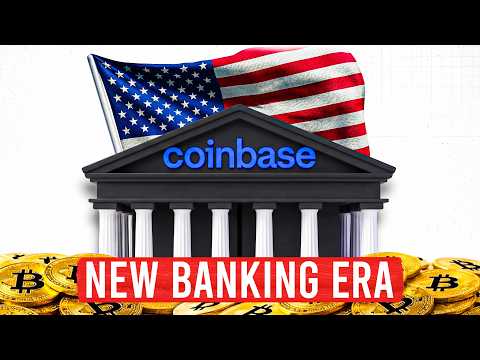
Coinbase Just Became a BANK (Here's What It Means For You)
2 min read

Coinbase Just Became a BANK (Here's What It Means For You)

Coinbase Gets a National Trust License – But Not a Traditional Bank

Coinbase now holds a National Trust Bank charter from the OCC, the federal bank regulator. However, it is not a full-service bank:

  • No accepting deposits, no lending
  • No FDIC insurance
  • Focus: custody of digital assets for institutions (e.g., BlackRock's IBIT ETF)
  • Staking, trading, and financing remain in separate Coinbase entities
Why Bank Lobby Is Suing

The Independent Community Bankers of America (ICBA) sued the OCC, calling the license a "backdoor for crypto into the banking system." The case is pending.

What the License Enables
  • Coinbase can now act as trustee for retirement accounts (IRA/401k) – a massive market
  • Institutional custody will shift from its New York charter to the federal charter within three years, boosting trust among pension funds
  • Similar licenses have been granted to Circle, Ripple, Anchorage, BitGo, and soon Paxos & Fidelity
Remaining Limitations
  • No Federal Reserve account, hence no direct access to Fed payment systems
  • Customer fiat still held at other banks
  • No deposit insurance for crypto assets held in custody
Bottom Line

Coinbase is not becoming a conventional bank, but it has secured a regulated foothold in the U.S. banking system – a remarkable turnaround after years of legal battles with the SEC and other agencies.