
Lance Hedrick
4 min read
The Internet's Trendiest Coffee Recipe... On an Aeropress
The Zupalonga: A Percolation-Based Coffee Brew on the Aeropress
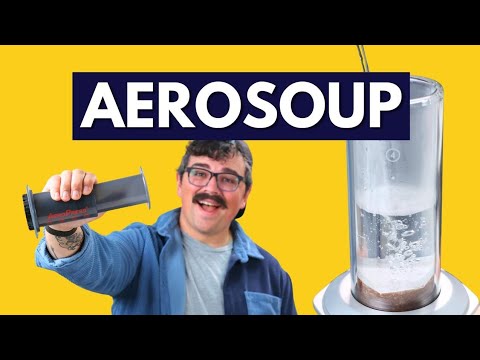
Lance Hedrick demonstrates how to replicate the popular "Soup" or "Zupa" coffee, typically made with specialized brewers like the OXO Rapid Brewer, using only a standard Aeropress and no additional gadgets. The goal is a clean, percolation-dominant extraction, similar to an espresso but with less pressure.
The Challenge: Immersion vs. Percolation- In a standard Aeropress brew, pouring water creates agitation and mixing of the coffee grounds. This leads to immersion, where most extraction occurs while the coffee is in contact with water.
- The "Zupa" method, however, relies on pure percolation: a calm column of water is pushed through a compact coffee puck for maximum clarity and controlled extraction.
Lance introduces a technique that uses only the Aeropress's included parts, avoiding expensive attachments:
- Insert filter: Place a paper filter into the cap and screw it onto the Aeropress.
- Add coffee: Add 15 g of finely ground coffee.
- Tap to level: Gently tap the Aeropress on the counter to level the coffee bed.
- Add a top filter: Place a second paper filter on top of the coffee grounds.
- Tamp with the plunger: Carefully set the rubber plunger on the top filter. Pushing down tamps the coffee puck and folds the filter into the chamber.
- Note: Push down slowly and evenly to avoid disturbing the puck.
- Remove plunger: To extract it, twist and pull gently to break the vacuum. The top filter will stick to the plunger; push it back into the chamber (e.g., with the Aeropress stirrer).
- Pour water: Gently pour 150 g of water (93°C/200°F) onto the top filter. The water column stays clear because the filter protects the coffee bed.
- Crucial for very fresh coffee: CO2 release can lift the top filter. In this case, lower the water temperature (e.g., to 70°C/160°F) or use a heavier (e.g., 3D-printed) filter screen.
- Percolate: Insert the plunger and press very slowly and evenly through the puck. Slow pressure maintains the clarity of the final drink.
Lance compares his method (15 g / 150 g water) directly with an OXO Rapid Brewer (22 g / 220 g water) using the same grind size and temperature:
- TDS Measurement: Both drinks had nearly identical TDS values (1,79 and 1,81), indicating similar extraction efficiency.
- Blind Taste Test: The two drinks were nearly indistinguishable. Lance slightly preferred the Aeropress version for its brighter acidity and more pleasant finish.
- Conclusion: This method is a great alternative for Aeropress owners who don't have a specialized brewer (like the OXO) but still want to enjoy a clear, percolation-based coffee ("Soup"/"Zupa").
- If the top filter floats up during pouring, the brew becomes a mix of immersion and percolation.
- The resulting coffee will be cloudier, with more body and less clarity – similar to a standard Aeropress brew. The taste isn't ruined, but it won't have the clean "Zupalonga" profile.
- Coffee: Use well-rested coffee beans (not too fresh) as they release less CO2 and keep the filter stable.
- Ratio: The recommended ratio is 1:10 (15 g coffee : 150 g water), but for a stronger or weaker brew, adjust the ratio between 1:3 to 1:13.
- Temperature: 93°C (200°F) is a good starting point. If the filter lifts with fresh coffee, lower the temperature to 70-80°C (160-175°F).
- Pressure: An even, slow press is the key to clarity and controlled extraction.