Nofinity Logo

Latest Analyses(7)

Realty Income Stock Is Getting Interesting!!! (Intrinsic Gives 10% Return)
3 min read

Realty Income Stock Is Getting Interesting!!! (Intrinsic Gives 10% Return)

Realty Income Stock – Is It Getting Interesting?

Realty Income is back on investors' radars as the stock has been flat for years while the business itself remains solid. With rising interest rates, the dividend yield has climbed to 5.8%, making the stock increasingly attractive.

Business Model & Diversification
  • Focus on retail with strong tenants (grocery, convenience, home improvement, restaurants).
  • Expanding into data centers, industrial, senior housing, and Europe.
  • Occupancy remains stable, even through crises (lowest at 96%).
  • Since its IPO, the stock has outperformed the S&P 500 by a wide margin – dividend aristocrats beat AI hyperscalers over the past 32 years.
The Interest Rate Shift
  • Falling rates from 1980 to 2021 were the biggest tailwind for REITs.
  • The recent spike in 10-year Treasury yields to 5.2% is putting pressure on the stock as investors demand higher yields.
  • If rates stay elevated, the required dividend yield could rise to 7%, implying another 15–20% downside.
  • Long-term, this is an opportunity: entering now locks in a high yield, and if rates eventually fall, the stock could rally 50% to $70–80.
Financial Health
  • Moderate leverage: 5x interest coverage, net debt/enterprise value at 34% (not overly risky).
  • Interest expenses are rising from $550M to $600M – that eats into dividend growth.
  • Management is adapting via convertible bonds (3.5%) and joint ventures (Apollo), but higher interest costs are a headwind.
  • The market wants higher yields – rising rates will keep pressure on the stock, but the dividend cushions the downside.
Intrinsic Value Calculation
  • Current dividend of $3.00 with a conservative growth rate of 2% yields a fair value close to the current price when requiring a 10% return.
  • In a scenario with falling rates and a 4% dividend yield, the upside is substantial.
  • Expected total return is 8–10% annually – solid, but not a deep value opportunity.
Conclusion & Strategy
  • Key risk: a real recession or prolonged high-rate environment (stagflation).
  • Realty Income is not a bargain, but a 'hold' with an attractive yield and inflation protection through rent increases.
  • Strategy: Start building a position, add on weakness, and wait for the rate cycle to turn.
  • For European investors, REITs may be less interesting due to withholding taxes (up to 40%) – but in the US (e.g., tax-deferred accounts), now could be the right time to start looking.
€10,000 → €100,000 Challenge: THIS Stock Exploded Like a Rocket! HERE's What We're Buying NOW!
2 min read

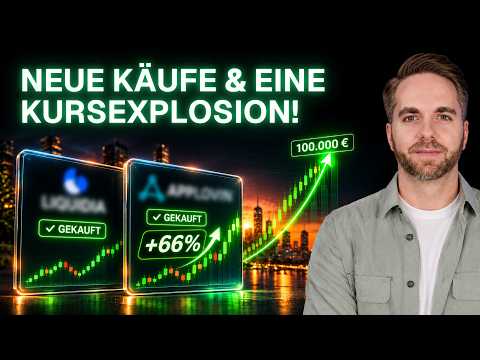
€10,000 → €100,000 Challenge: THIS Stock Exploded Like a Rocket! HERE's What We're Buying NOW!

📊 Portfolio Challenge Update: 23.6% Invested – Battling a Tough Market Environment
  • Current Status: Starting capital of €10,000 at ±0% (slight gains after fees). Benchmark Bitcoin is −15%, so the portfolio is outperforming.
  • New Purchases: AppLovin (bought more after strong earnings, +60% pre-purchase gain), Liquidia (missed earlier entry, now bought in, focusing on biotech turnaround).
  • Existing Positions: ServiceNow (weak quarterly results, turnaround uncertain, Q4 will decide), Circle (in the red due to crypto downturn), Hai Group (small position, Chinese risk, slightly positive).
  • Watchlist & Limits: Chronos (limit order active), Critical Metals (rare earths, high risk, max €250), Uranium Energy (downtrend, waiting), Monday.com (new, under analysis).
  • Strategy: Cash is king – only 23.6% invested. Discussing stop-loss rules (35% vs. 50% for moonshots). AI stocks under watch after the crash, but no purchase yet.
  • Community: New Discord channel for fast updates and exchange. Key upcoming events: Nvidia earnings, Entropic IPO.
  • Conclusion: Despite a challenging environment, the portfolio holds its ground. Next buys will be carefully considered – stay tuned!
Buy Nvidia After the Crash? My Decision + Our Additional Purchases // BRIEFING
2 min read

Buy Nvidia After the Crash? My Decision + Our Additional Purchases // BRIEFING

Market Sentiment: Like the Corona Crash of 2020
  • Nvidia collapses, Jensen Huang resigns. The atmosphere mirrors March 2020 – yet the speaker remains optimistic and bought Nvidia during the dip.
Winners & Losers of the Week
  • Winners: Singulus (+100%, SpaceX order), Broadcom, AMD, Cerebras, Modine (Samsung acquisition rumors), Sanmina (+20%).
  • Losers: Nvidia (CEO resignation, -30% from peak), Hims and Hers, Corteva (Brazil -31%), Rheinmetall (peace hopes), Super Micro (Justice investigation).
Bears vs. Bulls: Inflation & AI
  • Bears: Hot inflation data, December rate hike 100% priced in (even 50bps on the table). The AI party is finally over.
  • Bulls: Oil price falling, strong economy (retail +10.1% YoY), retail investor sentiment so negative it historically signals a buy signal. AI has been called dead “100 times” over three years but fundamentals remain strong.
Dossier: Anthropic & Nvidia Decision
  • Anthropic IPO (ANTX): Six times oversubscribed, valuation up to $1.4 trillion. First trading day on November 19th.
  • Nvidia Decision: Pros: Fundamentals are explosive (13× expected earnings), chips in high demand, geopolitical relevance. Cons: Without Huang, the strategist is missing, political risks (chip smuggling). My verdict: Despite high risks, I bought Nvidia on Friday – the market has already released a lot of pressure (Tech P/E nearly halved, similar to March 2020 buying opportunity).
Personal Purchases & Outlook
  • My Buys: TSMC, Broadcom (+20%), Celestica (+17%), SpaceX (new entry).
  • Team Portfolio: TSMC, Fujikura, Creador, Samsung, Air Test Systems (all in the green).
  • Promotions: Advent Calendar (prizes >€6,000), 13F Holding Strategy (free report coming shortly), Daily Briefing free trial until Nov 30th.
  • Next Week: Anthropic deep dive, exciting interview, and 13F update.
Should Ethereum Tax Its Apps to Prove Its Security Is Worth It?
2 min read

Should Ethereum Tax Its Apps to Prove Its Security Is Worth It?

This transcript puts a provocative idea on the table: Should Ethereum tax the apps built on it to prove its security is actually worth the cost? The speaker challenges the foundational value propositions of the ETH token.

Challenging the "Store of Value" Thesis
  • The speaker dismisses Vitalik Buterin's vision of ETH as a Store of Value as a fallacy. Bitcoin is framed as a one-in-a-billion fluke ("immaculate conception"), not a replicable standard. Without assuming the dominance of Ethereum over all other blockchains, the store of value argument for ETH collapses.
The Call for Quantification
  • A major critique targets the inability of Ethereum proponents to quantify the value of the token. The fundamental question is asked: How many apps, transactions, or stablecoins need to exist on Ethereum before the token itself gains intrinsic value? Answers allegedly remain vague, focusing on protocol quality rather than token value accrual.
The Hyperliquid Model and the Tax Solution

Hyperliquid is highlighted as a successful L1 model because it captures value directly through its native DEX and stablecoin distribution.

  • Hindsight Option: Ethereum should have built its own native stablecoin and DEX.
  • Current Proposal: Tax the apps. If Ethereum's security is as invaluable as claimed, applications should be willing to pay a tax to use it.
  • The Litmus Test: The tax rate determines reality. If apps stay and pay, security is proven. If they migrate to cheaper chains, the security premium is exposed as a commodity.
Conclusion

The proposal serves as a financial litmus test for the value creation of the Ethereum network. It moves the debate from philosophical visions to raw market consent.

Why One Startup Banned All of Indonesia to Stop Free AI Inference Abuse
2 min read

Why One Startup Banned All of Indonesia to Stop Free AI Inference Abuse

The Problem of AI Token Arbitrage
  • Subscription services like Spotify always have a barbell of low-usage and high-usage users.
  • Tokens are much easier to resell than streamed music – a huge incentive for arbitrage.
Market Dynamics and Countermeasures
  • OpenAI actively tries to close this arbitrage through continuous optimization (lowering API costs, adjusting token amounts).
  • As long as arbitrage exists, users will exploit it – the market is too efficient.
Example: A Startup Bans All of Indonesia
  • A DevOps startup offered a 15-minute free trial (requiring a credit card).
  • Abuse via stolen credit cards led to the entire country of Indonesia being banned.
  • The head of engineering described it as a „nightmare“ („I‘m ready to kill myself“).
Conclusion: Free Inference Is Extremely Risky
  • Tokens are so fungible that optimal users systematically steal and resell them.
  • Once free inference is offered, „a whole swarm of people rushes in to exploit it“ – inference leads to more inference.

This clip is from Uneasy Money, airing every Wednesday at 4:00 PM Eastern Time.

Ledger and the Metadata Your Hardware Wallet Sends After You Sign - Uneasy Money
2 min read

Ledger and the Metadata Your Hardware Wallet Sends After You Sign - Uneasy Money

Summary: Ledger and the Metadata Your Hardware Wallet Sends

In this episode of Uneasy Money, the hosts discuss a controversial topic: the metadata that Ledger sends to its servers after signing a transaction.

The Problem: Post-Signing Telemetry

  • Ledger's signing SDK sends metadata (addresses, transaction data) to Ledger's servers every time you sign a transaction.
  • This happens after the signing process – without any necessity for the process itself.
  • The V2 API removes some data but still allows address-to-user correlation.

The CTO's Contradiction

  • The Ledger CTO claims this data is needed for Clear Signing (ensuring users only sign what they intend).
  • The hosts debunk this as factually false or misleading because the metadata is sent after signing – not before.
  • Quote: "Why the hell do you sign the transaction first and then send the metadata?"

Clear Signing: An Unsolved Problem

  • Clear Signing is a standard (~§330 or §7730? 7730) that shows users exactly what they are signing.
  • Ledger argues their devices have too little memory for Clear Signing.
  • Critics: "They could have just added more memory – 256 GB is possible!"
  • Instead, they offload the analysis to external servers, creating a security risk.

Security Concerns

  • Telemetry is sent even for failed transactions – an unnecessary attack surface.
  • Example: Bybit was compromised due to an attack on the pre-transaction API.
  • Conclusion: "You can't just start blasting telemetry data."

Bottom Line: Hardware Wallets Not for End Users

  • The hosts view hardware wallets as YubiKey equivalents – just an interface to a secure device.
  • Irony: "We're just using them wrong."
  • Recommendation: Clear Signing and dynamic data (e.g., ENS or proxy contracts) need a trusted server to sign the information.
⚡I Ran the TSLA + SPCX Merger Math on My Retire-On Bags 💰 V Surprising
3 min read

⚡I Ran the TSLA + SPCX Merger Math on My Retire-On Bags 💰 V Surprising

🧮 The Merger Math: Tesla & SpaceX Combined

The speaker analyzes the impact of a potential Tesla-SpaceX merger on his investment strategy ("Retire-On Bag"). The core question: What happens to a holding of 323 Tesla shares if the merger occurs?

📊 Current Situation & Probabilities
  • Merger Probability: Prediction markets estimate a 70-81% chance by end of 2027, with high probability already in Q1 2027 (56%).
  • Current Exchange Ratio: 1 Tesla share = 2.83 SpaceX shares (as of analysis).
💡 Scenarios & Exchange Ratios
  • Floor Price: Minimum exchange ratio: 3.3x (Tesla valuation: ~$490).
  • Likely Zone: 3.65x - 3.85x (Tesla valuation: $490 - $520).
  • Super Bull Case: 4.1x - 4.45x (Tesla valuation: $550 - $600, approval probability >90%).
🎯 Impact on Your Retire-On Bag (323 Tesla Shares)
  • Without Merger: Value in 2032: ~$1.31 million (Tesla bag).
  • With Merger (3.75x):
    • You receive 1,211 SpaceX shares.
    • Value in 2032: ~$1.56 million (Tesla bag).
    • Surprise: The SpaceX bag (655 shares) drops to ~$843,000 due to dilution.
  • Conclusion: In a merger, Tesla shareholders benefit more than SpaceX shareholders. Buy Tesla when under $350.
🔍 Sum-of-the-Parts Valuation
  • SpaceX (sandbagged):
    • Starlink (Direct-to-Cell): $2.75 trillion TAM.
    • Elon Web Services (EWS, Compute): $7 trillion.
    • Total value (sandbagged): $18.45 trillion (Bull Case Compute: $2,128/share).
  • Tesla (sandbagged):
    • FSD, Robotaxi, Optimus, Energy, Vehicles: $15.97 trillion ($4,043/share, 8-ways-to-8,000: $8,000/share).
  • Combined (X Corp): $34.42 trillion market cap, $1,287/share (sandbagged).
⚠️ Risks & Key Notes
  • No Dividends: Wealth is built through price appreciation & compound interest.
  • Avoid Taxes: The merger is tax-neutral – no sale event.
  • Control: Elon Musk would hold 56% control post-merger (Tesla: 20%, SpaceX: 82.4%).
  • Starship Flight 15: Success could increase SpaceX shares by $10-20.
  • Warning: Selling SpaceX shares before the announcement risks being locked out by arbitrage traders.
💎 Conclusion
  • Ideal Strategy: Buy Tesla under $350, buy SpaceX under $135.
  • Hold Long-Term: Until 2032 or later, let compounding work.
  • Target: $1 million+ with 323 Tesla shares or 777 SpaceX shares.