Nofinity Logo
Onboarding

Welcome to Nofinity

Your premium hub to transform hours of YouTube video into concise, 5-minute text summaries. Build your custom expert feed!

1. Skip the Video

Save hours of watching. Read compact, AI-powered key takeaways in a premium magazine layout – completely ad-free.

2. Custom Feed

Subscribe to top experts in the Explore area to curate your personal, dynamically updating video feed.

3. Suggest Channels

Propose new YouTube channels. Once approved, our system automatically ingests and summarizes new uploads.

Latest Analyses(6)

Can Relieving Stress Actually Reverse Biological Age? | Dr Martin Picard
Modern Healthspan|11. Okt.

Can Relieving Stress Actually Reverse Biological Age? | Dr Martin Picard

Core Message: Stress Relief Enables Healing and May Reverse Aging Processes

Dr. Martin Picard, director of the Mitochondrial Psychobiology Lab, explains that stress isn't inherently harmful; rather, the capacity for recovery is the key to longevity. The body has an innate healing ability that is activated through rest periods.

Key Insights from the Conversation:
  • Gray hair is reversible: Graying linked to stress can actually reverse – a visible example of the plasticity of aging.
  • Allostatic load: Chronic anticipation of stress consumes energy, leading to wear and tear. The solution isn't avoiding stress but finding intentional rest and regeneration times.
  • Focus on mitochondria:
    • Stress (e.g., cortisol) increases cellular energy consumption by up to 60%.
    • Chronic stress diverts energy from repair processes like DNA repair and telomere maintenance, accelerating aging.
    • Hypermetabolism in aging cells drains energy from the body, similar to cancer or sepsis.
  • Mind-body connection: Emotions and thoughts directly affect mitochondria – via cortisol, blood sugar levels, and mitochondrial DNA leaks that trigger inflammation.
  • Practical steps: Mindfulness, meditation, and exercise help to be present in the moment, enabling healing. The goal isn't a stress-free life, but balancing stress with recovery.
  • Marker for mitochondrial stress: GDF15 (growth differentiation factor 15) indicates energetic stress – ideally low at rest.
Conclusion:

Dr. Picard encourages proactive rest, not passive stress avoidance. The body heals itself when given the chance – this is the foundation for a healthy lifespan.
Oracle's $500 Billion AI Bet Is BREAKING
Coin Bureau|11. Okt.

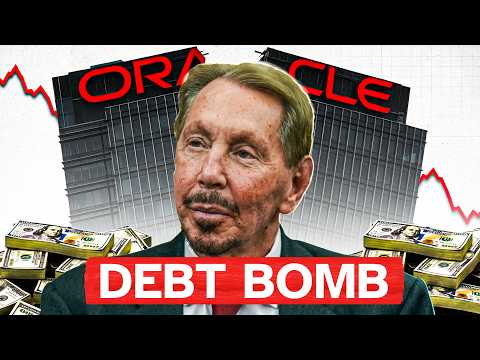
Oracle's $500 Billion AI Bet Is BREAKING

Stargate Project in Trouble

The Stargate project – a joint venture by Oracle, OpenAI, and SoftBank with up to $500 billion in planned investment – aims to build massive AI infrastructure in the US. However, its flagship site Project Jupiter in New Mexico faces delays, not from chip shortages, but from a natural gas pipeline.

  • Issue: The 27 km "Green Chile Project" pipeline for fuel cell power is stuck in regulatory battles. State land office denied rights, pushing completion from August 2025 to February 2027.
  • Oracle's response: Oracle issued a force majeure notice to operator Stack Infrastructure, seeking the right to halt lease payments for up to 3 years if the site isn't ready by 2028.
  • Financial ripple effect: The site relies on $18 billion in construction loans; Oracle itself carries $156 billion in debt with negative free cash flow. Its credit rating was downgraded to BBB (S&P), just above junk.
  • Founder risk: Larry Ellison pledged over 430 million Oracle shares as collateral for personal loans – more than a third of his stake. Oracle's stock dropped 56% from its peak, and a planned sale of 50 million shares was abruptly canceled.

Conclusion: Stargate was meant to validate the AI boom, but it highlights how fragile the massive debt structures are when facing mundane obstacles like a pipeline. A single local delay could unravel the entire chain from lenders to founder wealth.

Optimize your savings rate for maximum subsidies in <10 min.
Finanzfluss|11. Okt.

Optimize your savings rate for maximum subsidies in <10 min.

1. Build a Financial Foundation
  • Pay off expensive debt: Overdrafts (~9.4%) and consumer loans (~8.7%) first – risk-free, tax-free return.
  • Emergency fund: 3–6 months' salary in a savings account for unexpected expenses.
2. Split Your Savings Rate for Maximum Subsidies
  • Up to €30/month into the retirement deposit (AVD): 50% state subsidy (€15 bonus). Even better if you have children (up to €65 bonus) or are under 25 (one-time €200). Minimum: €10/month.
  • €30–150/month into AVD: 25% subsidy. Example: With €100 contribution you get €32.50 bonus. Maximum €150/month for full subsidy (€45 bonus). Plus possible tax benefits.
  • Important trade-off: AVD money is locked until retirement; withdrawals are fully taxed. Only worthwhile if costs are low and you truly save for retirement.
  • Free ETF savings plan for everything above €150/month: Flexible for other goals or early retirement.
3. Check Employer Subsidies
  • Employee savings scheme (VL): Employer bonus + possibly 20% state bonus (max €80/year) if income below €40,000. Transferable to a free depot after 7 years. Only few providers offer VL with ETFs (e.g. comdirect, Fidelity, Finvesto).
  • Company pension scheme (BAV): Often inflexible and expensive. Only worth it if employer adds at least 20–30%. Anything beyond better in AVD or free depot.
4. Special Case: Saving for a Property
  • You can withdraw from the AVD tax-free for a self-occupied home. But don't invest in stock ETFs – use short-term government bonds or money market ETFs to avoid market volatility before purchase.

Conclusion: First pay off debt and build emergency fund. Then invest up to €150/month in AVD for maximum subsidies, everything else in a free depot. Only take employer subsidies if they truly benefit you.

Lelit Elizabeth 3 knocks our socks off – for 1650 euros
Kaffeemacher|10. Okt.

Lelit Elizabeth 3 knocks our socks off – for 1650 euros

What is the Lelit Elizabeth 3?
  • Dual boiler espresso machine with a 0.2 L espresso boiler and a 0.6 L steam boiler, weighing 15 kg, with a 2.5 L water tank and 58 mm portafilter.
  • Price: €1,650 (€1,700 in black/white); it is just about to hit the market.
  • Included: wooden-handled tamper, various filter baskets, blind basket, cleaning kit and water filter.
Updates and build quality
  • Beautiful new wooden details on the portafilter, steam knob and Pagaia paddle – the overall feel is noticeably more premium.
  • Very quiet in use: 56 decibels; the testers describe the brewing acoustics as genuinely pleasant.
The core feature: pressure and flow control
  • Electronic pressure profiles with up to five programmable stages, set directly via the display – no app needed.
  • Additionally, there is the Pagaia lever for manual flow control during extraction.
  • No flow meter; instead, time-based control with a pressure sensor – remarkable at this price point.
  • Example from the test: espresso at 3 bar for the first 8 seconds, then 8.5 bar until 45 g – cleanly repeatable.
Espresso quality and steam
  • Tested with an Indian robusta: strong, sweet, with dark, almost peaty notes – overall espresso potential is rated very high.
  • Steam power and milk texture are much better than the predecessor; 30 seconds for steaming, good microfoam quality.
  • Weakness: temperature stability during consecutive shots. From the third shot onward, the temperature drops by about 2–3 °C.
  • With a 2-minute gap between shots, temperature settles around 91 °C – stable values with only 1 °C offset.
Daily use and energy consumption
  • Heat-up time: 20 minutes – not particularly fast, but efficient once up to temperature.
  • Energy use: approx. 0.075 kWh for heating plus one espresso; 0.154 kWh with steam – about a third of a GS3.
  • Large drip tray with 1200 ml capacity; the manual is solid but not particularly deep.
Verdict
  • An absolute value-for-money wonder: for €1,650 you get electronic pressure profiles usually found only on much more expensive machines.
  • Ideal for home use, less for heavy café duty; if entertaining guests, plan for 2-minute gaps.
  • Clear recommendation from the testers if you like the cube-shaped design.
How Blockchain ACTUALLY Works (Zero Jargon)
Coin Bureau|10. Okt.

How Blockchain ACTUALLY Works (Zero Jargon)

Blockchain Explained Simply

In this video, Lewis from The Coin Bureau explains the fundamentals of blockchain technology – without jargon. He starts with a familiar example: a bank transfer. The bank keeps a private ledger of all transactions, meaning we must trust the bank. But what happens when you remove this central control?

The Concept of a Ledger

  • Ledgers are lists of ownership and payments, used for millennia (e.g., clay tablets in Mesopotamia).
  • Problem: Whoever holds the book controls it – they can make mistakes or alter entries (like the TSB Bank example).

The Solution: A Village Notebook

  • Instead of one bookkeeper, everyone keeps an identical notebook.
  • Every payment is announced to all and recorded by all.
  • If someone cheats (e.g., changes a transaction), the discrepancy is immediately noticed.
  • A blockchain is essentially this village notebook, maintained by computers worldwide.

How the Chain Works: Blocks and Hashes

  • A block is a page in the notebook, filled with transactions.
  • A hash is a digital fingerprint: data is turned into a unique code that changes completely with any alteration.
  • Each block contains the hash of the previous block – creating the chain. If you change an old block, the connection to all subsequent blocks breaks, and the forgery is instantly detected.

Consensus: How Nodes Agree

  • Nodes are computers that run the blockchain software and store copies of the notebook.
  • They must agree on new blocks – this is called consensus.
  • Proof of Work: Computers compete to solve puzzles (mining); the first to solve it adds the next block and is rewarded.
  • Proof of Stake: Participants deposit coins as collateral; the right to add blocks is allocated based on stake; cheaters lose their deposit.

The Problem Bitcoin Solved: Double Spending

  • Digital files can be copied infinitely – that would be disastrous for money.
  • Double spending means spending the same digital dollar twice.
  • Satoshi Nakamoto published a paper in 2008 for digital cash without banks; the blockchain prevents double spending because all copies of the notebook are synchronized.

From Bitcoin to Ethereum: Smart Contracts

  • In 2015, Ethereum introduced smart contracts – code on the blockchain that automatically executes agreements (like a vending machine).
  • This enabled new applications:
    • Tokens: Digital units on existing blockchains.
    • Stablecoins: Tokens pegged to fiat currencies (e.g., 1 USD).
    • NFTs: Unique digital proof of ownership.
    • Supply chains: Products can be tracked tamper-proof (example: Walmart tested tracking mangoes in seconds instead of days).

Practical Use: Wallets and Keys

  • A wallet does not store coins but keys – the coins reside in the blockchain.
  • Public address: Like an email address, used to receive payments.
  • Private key: Like a password – anyone with it controls the coins; there is no reset (example: James Howells lost his hard drive with keys).
  • If you lose keys and recovery phrase, the coins are permanently inaccessible.
Conclusion

Blockchain is a shared, chained, and tamper-proof ledger that works without a central authority. It started with Bitcoin and has evolved into a platform for many applications. The technology shows that trust is possible without a single controlling entity.

Gold to $10k By 2030 - But How Much To Own Now?
Value Investing with Sven Carlin, Ph.D.|10. Okt.

Gold to $10k By 2030 - But How Much To Own Now?

This video analyzes the role of gold in a $1 million portfolio, especially in light of the US debt crisis and potential economic collapse.

Historical Performance of Gold
  • Since the Nixon Shock (1971), gold has delivered an average 9 % return in dollars (nominal) and 5–6 % inflation-adjusted.
  • It serves as an inflation hedge but is highly volatile, with euphoric peaks (e.g., 2011) followed by long downturns.
The Debt Crisis and Ray Dalio's 15% Rule
  • The US is heading toward a debt crisis: currently $40 trillion in debt, projected $50 trillion by 2030, with annual interest costs of $1–2 trillion.
  • Ray Dalio recommends at least 15 % of assets in gold as a hedge against a collapse of the dollar system.
  • The speaker compares this to his own experiences with hyperinflation and currency reforms.
Problems and Risks of Gold
  • Only partial protection: In a $100 portfolio with $15 in gold and $85 in stocks that drop 50 %, even a tripling of gold's value yields only $65 – a 35 % loss.
  • No value creation: Gold produces nothing, incurs storage costs (e.g., 0.4 % ETF fees annually), and is subject to government confiscation (e.g., US gold ban in 1933 with prison sentences).
  • Dependence on market sentiment: Retail investors often buy at euphoria peaks and sell in panic.
Alternatives to Gold
  • Land: Provides rental income (e.g., 2.6 % yield) and can build more wealth over time through appreciation and reinvestment.
  • Value Investing: Owning businesses with a margin of safety and dividends creates real added value – unlike a static gold coin.
Personal Opinion and Strategy
  • The speaker prefers value stocks and land over gold, as they offer higher long-term returns (15 % p.a. over the past 8 years).
  • Short-term gut feeling: After the recent decline, gold is a buy again – medium-term targets of $6,000–8,000 are possible if interest rates fall and central banks print money.
  • Rebalancing strategy: Maintain a fixed gold allocation of 15 %, selling when overweight and buying when underweight – but watch out for tax implications.
  • Conclusion: Every investor must consider their personal situation and opportunity costs. Broad diversification (AI, value, bonds, gold) is recommended.