Nofinity Logo

Latest Analyses(7)

🚹 Markets Peaking? AI & Crypto Trades I’m Watching NOW 👀
5 min read

🚹 Markets Peaking? AI & Crypto Trades I’m Watching NOW 👀

🔍 Market Overview & Strategy

The analyst provides a detailed insight into current markets, focusing on Bitcoin, cryptocurrencies, and AI stocks. He emphasizes that all discussed charts represent his own positions. The goal is to identify real alpha, not just to reflect on past predictions.

📈 Bitcoin and Crypto Analysis
  • Bitcoin (BTC):

    • Currently around $81,000. Key level is $82,000, which must be surpassed to move toward $85,000–$90,000.
    • Bottom at $60,000–$64,000 has been confirmed.
    • Top and Bottom Indicator shows a deep blue value zone, similar to January 2023 and April 2024.
    • Optimized Trend shows an uptrend since mid-April.
    • Key Insight: The Bitcoin vs. Gold chart suggests a new Bitcoin bull market in gold pairing.
  • MicroStrategy (MSTR):

    • 200-week moving average acted as perfect support. Buy signal at $119 in early April.
    • Tracks Bitcoin, but NAV premium has increased.
    • CEO Michael Saylor mentioned potential Bitcoin sales – seen as a market inoculation measure.
  • Solana (SOL):

    • Buy signal at $78–$80 („Kill Zone“). Currently around $97, with resistance expected at $200 within a year.
    • Clarity Act could boost Solana. Solana is positioned as the credit card for AI agents.
    • Impressive metrics: Most users, revenue, profit – at just 17% of Ethereum’s (ETH) market cap.
  • Ethereum (ETH):

    • 40% below its level from 5 years ago. Analyst remains skeptical, favoring Solana as the layer-1 solution.
đŸ€– AI Stocks: Tesla, Nvidia & Co.
  • Tesla (TSLA):

    • Target: $500 in 6 months (driven by robotaxi progress). Currently at $400.
    • Strategy: Buy on dips into the „Confluence Cloud“ (e.g., $330–$340), as price always reverts.
    • Safest risk-reward ratio compared to risky AI stocks.
  • Nvidia (NVDA):

    • After breakout from the green box ($170–$200), new all-time high at $217.
    • Resistance becomes support around $195–$196. New range ($195–$217) ideal for covered calls.
    • Pair trading with NVDA/NVDS (short ticker): Uses standard deviations (e.g., 2.25) for long/short signals. 98% win rate in backtests.
  • Other AI Names (IA 13):

    • AMD: From $187 to $420 in 5 weeks. Mean reversion shows overheating (red dot) – do not buy.
    • Micron (MU): +844% in 12 months. Similarly overheated – do not add.
    • Broadcom (AVGO): Moderate, not extreme. Hedging not recommended.
    • Marvell (MRVL): +126% in 60 days, but mean reversion at only 0.5 – no hedge needed.
    • Alphabet (GOOGL): +155%, but trend strong.
    • ARM: +136%, average compared to others.
    • Palantir (PLTR): In range ($128–$159). Buy signal at $128–$132 for bounce.
    • EchoStar (SATS): SpaceX proxy; analyst’s hedging mistake: Didn’t trust the model, causing position loss.
📉 Risk Warnings and Lessons
  • Mean reversion as warning signal: For AMD, Micron, and Alab, rubber bands are extremely stretched – no buying after large moves.
  • Top buyer trap: Costliest mistake for investors. Bottom fishing is safer.
  • Range rider strategy: Nvidia, Alab, ISRG (Intuitive Surgical) show: Old resistance becomes new support. Ideal for covered calls.
  • Copper: Only commodity in portfolio (besides Bitcoin). Long-term stable due to undersupply. Strategy: Buy at $5.87, sell at $6.20.
  • Meme stocks (e.g., CarMax): Short, perfect short (from $863 to $4) – example of signals of buyer exhaustion and ATM.
  • Zcash (ZEC): Shows clean charts without overheating (mean reversion not stretched). Potential for further run.
  • Warning against yield shares (e.g., YTSL): “Garbage” – loss of 60% in 3 years. Selling covered calls yourself is better.
  • SpaceX/space exploration: Only SpaceX is relevant – others lose long-term.
🧠 Final Wisdom
  • FA for WHAT (Fundamental analysis for selection), TA for WHEN (Technical analysis for timing).
  • Don’t lose money – the golden rule.
  • Patience is key: Don’t jump out of positions due to greed; trust the models.
📚 Recommended Links & Resources
  • Patreon: Detailed post on MicroStrategy and STRC.
  • Backtesting tools: For pair trading (NVDA/NVDS) and range riders.
  • Community thanks: To mods and viewers.
Why Did 67 Companies Opt Out of Tokenized Stock Trading on OKX ICE?
2 min read

Why Did 67 Companies Opt Out of Tokenized Stock Trading on OKX ICE?

Background and Controversy
  • 67 companies opted out of tokenized stock trading on OKX ICE's Tokenized Stock Venue (TSV), leaving mostly crypto-related firms as participants.
  • Reasons: lack of understanding, short 30-day opt-out deadlines, and legal warnings from law firms pushing hasty rejections.
  • Negative past experiences with unregulated offshore tokenization (e.g., AMC/Robinhood) fueled distrust.
SEC's Innovation Exemption
  • Effective September 17, 2025: a 5-year conditional exemption allowing TSVs to trade tokenized listed stocks via permissioned Automated Market Makers (AMMs) without registering as exchanges.
  • Key design choices:
    • Issuer consent (30-day opt-out) – issuers can opt back in later.
    • Volume caps: 25 bps for liquid stocks, 2.5% for less liquid ones.
    • No synthetic derivatives – all original rights (dividends, voting) must be preserved.
  • Goal: controlled innovation, followed by permanent rulemaking by 2027.
Differences in Tokenization Models
  • Securitize (Brett Redford): Custodial model using broker-dealers and best execution – similar to traditional trading, no opt-out. Benefits: 24/7 trading, DeFi utility, direct investor visibility.
  • TSV model (e.g., OKX ICE): Enables peer-to-peer trading without intermediaries, but different pricing mechanisms (AMMs). Requires issuer consent.
  • Offshore synthetics: Offer no voting or dividends, not SEC-regulated – carry counterparty risk (total loss if issuer fails).
Current Market Developments
  • First TSV: Canton (Nov 4) with only one stock – likely a PR move.
  • OKX ICE: Launching Nov 23 with over 70 assets, including Strategy, Coinbase, Robinhood, and 59 ETFs.
  • Other players: DTCC (tokenization service), NASDAQ (Avalanche), Formation Securities (Solana) – a competitive landscape.
  • SEC is monitoring pricing, arbitrage, and compliance (e.g., OFAC rules).
Future Outlook
  • ETFs are prime candidates for tokenization; SEC is open.
  • Rulemaking expected by 2027 – possibly allowing synthetic forms.
  • SEC's Jamie Celway emphasizes: competition drives innovation – aim is a sustainable, regulated ecosystem.
Stock Market: The Breakdown Continues
2 min read

Stock Market: The Breakdown Continues

Current Market Situation: The Breakdown Continues

The S&P 500 has fallen another 1% and remains in a correction. Top-building processes (phases where a market high forms) often take weeks, while lows are reached more quickly. The current pattern shows repeated recoveries and renewed declines.

Targets and Potential Downside Moves
  • Short-term target: Testing the low below 7,200 points.
  • A 10% decline would bring the S&P to around 7,000 points, while a 20% decline would target about 6,200 points.
  • A 20% drop would be comparable to the 2025 tariff crash.
Nasdaq: Stronger Losses and Historical Patterns
  • The Nasdaq is over 15% below its highs and hit a new local low on November 17, 2026.
  • Historically, midterm years (e.g., 2018, 2022, 2014) often see a correction at the beginning and another at the year-end. This pattern is repeating in 2026.
  • A comparison with 2018 shows similarities: sell-offs in January, a recovery, and renewed sell-offs in Q4.
Influencing Factors: Interest Rates, Dollar, and Metals
  • Rising 10-year yields and a strong US dollar weigh on markets, especially long-duration assets.
  • The Fed raises rates in a strong economy, which often triggers corrections (similar to 1997).
  • Metals (gold, silver) continue to weaken, hitting new lows. Historically, stock markets only find a bottom after metals.
Outlook and Risks
  • The correction may last until the December FOMC meeting.
  • 2026 is described as a
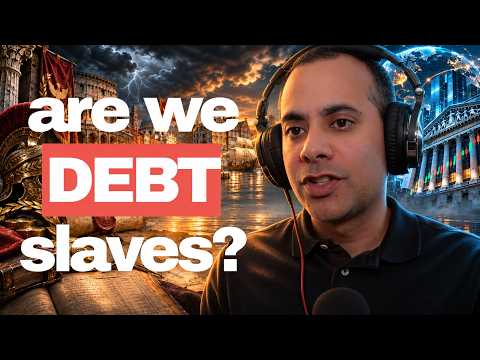
Today’s Debt Crisis Started In 1694 with E.M. Burlingame
5 min read

Today’s Debt Crisis Started In 1694 with E.M. Burlingame

Introduction to E.M. Burlingame
  • E.M. Burlingame has an unusual background: from tech investing and financial analysis (focusing on fraud detection in China) to serving in the Green Berets and completing doctoral studies in computational engineering.
  • He deeply explores how the world works and who the real power players are.
The Three Fundamental Archetypes of Power
  • Burlingame distinguishes three fundamental archetypes found across all mammalian and even single-celled life:
    • Resentfuls (those motivated by envy)
    • Responsibles (those motivated by gratitude)
    • Adoptables (the 50% in between, motivated by a mix of both)
  • The eternal conflict is the struggle between Responsibles and Resentfuls over the Adoptables.
  • Modern forms of Resentfuls are Marxists and National Socialists. The Responsibles are everyone else.
Financialists: The System of Debt
  • Financialists are those who see the world only in numerical values and seek to convert everything into financial assets ("Financialization of everything").
  • Their goal is the extraction of value through a complex system of debt and derivatives.
  • Burlingame views Financialism as a religion that replaced Christianity in the 17th century (Peace of Westphalia 1648, "Inglorious Revolution" 1688).
Historical Roots: Rome and the Praetorians
  • Julius Caesar and Augustus created the Praetorian Guard as a security apparatus.
  • After Augustus, the Guard became the real power in the empire, manipulating and killing emperors (e.g., four emperors in one year).
  • They developed sophisticated derivatives and financial instruments to conceal their wealth and plunder the Roman Empire.
  • The fight against the Praetorians led to the division of the Roman Empire (East/West) and the Battle of the Milvian Bridge (312 AD).
Byzantium and the Fight Against the Praetorians
  • The Eastern elites tried to free themselves from Praetorian influence by retreating to Byzantium (Constantinople).
  • The Praetorians took revenge through the Fourth Crusade and the sacking of Constantinople.
  • Burlingame sees the direct successor of Byzantium in modern Russia (Rurik dynasty, Orthodox Church). The war in Ukraine is a remnant of this ancient conflict.
Venice: The Birthplace of Modern Financialism
  • After the fall of the Western Roman Empire, the Praetorians fled to the lagoons of Venice.
  • There, they developed a new financial system based on debt and contracts to replace the Roman slave economy.
  • Venice used maritime trade, maritime insurance, and admiralty law (Roman contract law) as tools of power.
  • The Peace of Westphalia (1648) formalized the power of Financialism in Europe.
The Rise of England and the Struggle for Sovereignty
  • Alfred the Great created Common Law, based on individual sovereignty, private property, and separation of powers – as a bulwark against Rome.
  • The Financialists tried to infiltrate England, first through joint-stock companies (VOC, British East India Company), then through the Glorious Revolution (1688).
  • In 1694, the Bank of England was founded, establishing state debt as sovereign. This effectively enslaved the English-speaking peoples.
The Present: The Fight Against Financialism
  • The struggle remains the same: Slavers vs. Anti-Slavery.
  • According to Burlingame, Russia and China have freed themselves from Financialism.
  • America is in the midst of a liberation process, but the outcome is uncertain.
  • Hope lies in the unique history and legal structures of the English-speaking peoples (Common Law).
Actionable Advice
  • Think locally: Focus on your community, your neighborhood, and your state.
  • Understand the laws: Learn your state's constitution and your rights.
  • Build relationships with your neighbors.
  • Ignore the global stage: The big world is mostly irrelevant to your life.
  • Reading: Read Burlingame's own works ("The Eternal War", "The Sovereignist Essays") and Japanese koans to liberate your mind.
  • Have faith: Your ancestors have won this fight for over 1,200 years, time and again.
Conclusion

The current debt crisis is the result of a 2,000-year-old power struggle between those who wish to enslave people (Financialists) and those who defend freedom and sovereignty. Understanding the historical roots provides the strength to fight for a better world in your own environment.

Extreme Fear đŸ˜± Worst Crypto November Since 2018. Where's the Bottom?
2 min read

Extreme Fear đŸ˜± Worst Crypto November Since 2018. Where's the Bottom?

Market Sentiment: Extreme Fear 🚹

The Fear & Greed Index hit 12 (Extreme Fear). Crypto is experiencing its worst November since 2018, down 17.6%.

Crypto Carnage: Bitcoin & Ethereum
  • Bitcoin (BTC): Dropped to ~$64k. Long-term holders are dumping (74k BTC). Supply in Profit is at bear market lows – a classic bottom signal.
  • Ethereum (ETH): Absolute bloodbath. Massive ETF outflows, MVRV stuck below 1.0 (average coin held at a loss). Tom Lee's wallet (BitMine) lost 46%, amounting to a staggering $9.3 billion loss.
Liquidity and Contagion
  • Stablecoins: Total supply dropped $4 billion. Ethereum alone saw outflows of $3.12 billion in a week. Liquidity is fleeing the system.
  • Silver: Adjusted for inflation (M2 growth), silver has lost 92% of its purchasing power since 1980.
  • Tech & Semis: The Semiconductor index dropped 4.8% (double the S&P 500's volatility). Fear of rising rates and slowing AI capex is weighing heavily on the sector.
Bright Spots: Solana, Nvidia & SpaceX
  • Solana (Breakpoint): Huge adoption. Firedance V1 went live on Mainnet. Solana handles 70% of all crypto transactions. Partnerships with DTCC (stock settlement) and Western Union.
  • Nvidia: Beat earnings estimates ($2.68 EPS vs. $2.47 est.). The underlying demand for compute remains insatiable.
  • SpaceX: CFO Brett Johnson confirmed zero slowdown in compute demand. Orbital data centers (targeting 2027) are projected to be 50% cheaper per watt than terrestrial alternatives ($30 vs. $60).
Bottom Line

Despite the grim numbers, multiple bottom signals are emerging. The AI infrastructure cycle (Nvidia, Solana, SpaceX) shows no signs of stopping. The fuse for a recovery might be closer than the fear suggests.

New Corvette Grand Sport: Don’t Buy A Porsche 911 GT3! | 4K
3 min read

New Corvette Grand Sport: Don’t Buy A Porsche 911 GT3! | 4K

New Corvette Grand Sport: The Best Sports Car Bargain?

Dive into the world of the new Corvette Grand Sport (C8), a car not officially sold in Europe, yet potentially one of the best value propositions in the automotive world, according to Top Gear.

Background & Positioning

  • The Grand Sport is the middle variant of the C8 generation: more power than the base Stingray, but less extreme than the Z06 or ZR1.
  • Starting price: approx. $86,000. The fully loaded test car costs $131,000 – still less than a base Porsche 911 in the US.

Engine & Performance

  • New 6.7-liter naturally aspirated V8 (LS6) producing 535 hp – no turbochargers, pure character.
  • Performance on par with a Porsche 911 GT3, but for significantly less money.
  • Standard electronic limited-slip rear differential and revised suspension.
  • Optional Z52 packages with semi-slick tires (Cup 2R) and carbon-ceramic brakes.

Driving Feel & Handling

  • Surprisingly agile and responsive for a car weighing approx. 1.7 tons.
  • Tremendous grip (especially with the optional slick tires).
  • The gearbox works well with the engine.
  • Despite its sportiness, it remains comfortable and livable on the highway.
  • Only criticism: The drive mode selector is somewhat complicated and less intuitive than in a Porsche or Ferrari.

Design & Interior

  • Exterior: The striking blue color (Admiral Blue) with white stripes is a homage to the 1995 original. The quad-exit central exhaust (option, $2,000) looks spectacular.
  • Removable roof (Targa top) can be easily stowed in the large trunk (behind the engine). No compromise on rigidity.
  • Interior: Significantly improved – the annoying 'wall of buttons' has been replaced with standard switches. The sport seats (option, $1,995) are comfortable and supportive.
  • Character is key: The car feels honest and passionate.

Conclusion & Key Takeaways

  • The Corvette Grand Sport is the complete package: exciting, fast, livable, and affordable.
  • Best-sounding production supercar – the V8 sounds incredible.
  • For the price of a base 911, you get a near-GT3 competitor.
  • Available without a VIP list – a high-quality, 'no-nonsense' sports car.

Core Message: The Grand Sport is the best surprise of the year – an American muscle car that makes European supercars look overpriced.

Anthropic-IPO: I'm Subscribing! // The Big Analysis of the Claude Stock
2 min read

Anthropic-IPO: I'm Subscribing! // The Big Analysis of the Claude Stock

The Biggest AI IPO of All Time

Anthropic, the creator of Claude, is going public on November 19th, with a valuation of $1.4 Trillion. Mario Lochen and Sinan Krieger break down the massive opportunities and risks.

The Brutal Growth Story
  • Revenue: $17 Billion in Q3 (12x YoY growth).
  • Customer Stickiness: $1M clients now spend an average of $9M – a net revenue retention of 900%.
  • Profit Warning: A net loss of $104 Billion, mostly a book loss from convertible bonds.
Significant Risks
  • Infrastructure: Commitments totaling $900 Billion for data centers.
  • Politics: Conflicts with the Pentagon and increasing regulatory scrutiny.
  • Stock Price: The IPO price can rise from $70-$78 to as high as $120.
Why This Investment? (Sinan Krieger's Perspective)

Sinan (Beating Beta), a strict ETF investor, is making an exception. The reason: Claude as a truly disruptive technology. In his company, Claude cut the layout process for reports from one week down to 12 minutes.

Historical Insight: Disruptive tech (Auto, Internet) always wins eventually, but 90% crashes (like Amazon/Nvidia) are a real possibility.

The Three Stock Price Scenarios (2030)

Analysis based on an issue price of ~$74:

  • 🟱 Base Case: $108
  • 🟱 Bull Case: $247
  • 🔮 Bear Case: $19 (a 74% loss)
Conclusion

There is immense potential from productivity leaps, but a strong warning against hype and FOMO. A strategic, long-term entry is recommended, but investors must be prepared for the very real risk of losing their entire investment.