Nofinity Logo

Latest Analyses(7)

Jev + Claude Opus 5.5 = The Most INSANE AI Trading Bot Ever
2 min read

Jev + Claude Opus 5.5 = The Most INSANE AI Trading Bot Ever

This video shows how to build an extremely fast AI trading bot using Jev and Claude. The author (Miles) demonstrates a live high-frequency trading bot running on Hyperliquid.

What is Jev?
  • Jev is not a traditional LLM, but a System One model.
  • It doesn't generate text; instead, it evaluates states and returns structured decisions with probability scores.
  • This enables fast classification at a fraction of the cost of Claude.
Why combine Claude and Jev?
  • Claude (the LLM) handles strategy development, backtesting, and open-ended analysis.
  • Jev takes care of fast decision-making during execution – ideal for high-frequency trading with low latency (~300–500 ms).
The Setup
  • The full setup prompt is available for free in the school community.
  • Jev is deployed via Vercel, with Claude Code acting as the control center.
  • The bot can run on paper trading or live accounts – the architecture is identical.
Strategy discovery
  • There is no magic strategy: 99% of strategies lose money.
  • Use backtesting (e.g., custom engines, Quantedia, NFX) and test strategies on paper first.
  • Only switch to a live account after successful forward tests.
News trading with Jev
  • Jev can read live headlines (e.g., Bloomberg, Reuters, Yahoo Finance) and classify them as bullish, bearish, or neutral within milliseconds.
  • This makes it possible to build automated news trading systems.
Connecting to exchanges
  • Alpaca: Simple, supports stocks and crypto, paper and live trading via API.
  • Bybit: Better for crypto with lower fees; connect via VPS, MCP, or Trigger Trade.
  • Important: set risk rules (max position, daily loss, kill switch) and use alerts or manual approvals for large trades.
Conclusion

Jev is not a replacement for an LLM, but a powerful complement for fast decisions. The technology is useful not only for trading, but also for business workflows (e.g., data classification). Early adopters can gain a real edge.

Bets Update - Buy and Forget: KSPI, maybe MELI, most is blah (even BRK)...Apart some crazy bets...
3 min read

Bets Update - Buy and Forget: KSPI, maybe MELI, most is blah (even BRK)...Apart some crazy bets...

Introduction: Portfolio Update in the Value Quadrant

In this video, Sven reviews the remaining positions in his Value Investing Quadrant, providing an update on his current bets.


1. Mercado Libre (MELI): Value Case or Deep Dive?
  • The operating cash flow is massive ($12B per year), making the stock look incredibly cheap at first glance.
  • Analysts are already predicting an EPS of 75, leading to a P/E ratio of 20.
  • Caveat: Sven warns of the "StoneCo syndrome" (down 90%). He requires a deep dive before making any recommendation.
  • Verdict: Interesting, but no buy recommendation yet.

2. Kaspi (KSPI): The Undisputed Favorite
  • Sven is highly bullish: "The best fintech in the world."
  • Growth of 17% with strong dividends ($2.2/share).
  • The strategy is Buy and Forget: Trust CEO Lomtadze and let it ride for 5–10 years.
  • Sven owns KSPI and relies on the portfolio theory (Pabrai style): A few massive winners will offset the losses from other bets.

3. Berkshire (BRK): Safety Comes at a Price
  • BRK is a business fortress (+18% in the last month, $45B in operating income).
  • BUT: The market cap of $1.24 trillion far exceeds the intrinsic value of ~$800 billion. Sven considers it expensive.
  • Critique: The aggressive EBITDA calculations at Bending Spoons (including expected cost savings) raise eyebrows ("Charlie Munger is spinning in his grave").
  • Verdict: Great business, but currently unattractive for value investors (5–6% yield vs. 10% historically).

4. The Bets: Turnarounds and Risk
  • Nike, Lululemon, Deckers: Fallen stocks with solid P/E ratios. More of a bet on a recovery than a clear value investment.
  • China (Kuaishou, Alibaba, PDD, Q Fin): Sven describes the sector as "ugly." Political risks and regulatory uncertainty make it a gamble.
  • Charter Communications: A classic turnaround bet. A free cash flow of $5B could mean a double-up. Failure to meet targets means debt takeover.
  • Pabrai & Oil: Being watched closely.

Conclusion & Portfolio Strategy
  • Sven is working on a diversified portfolio of roughly 15 positions.
  • The current market makes it hard to find true certainty; many stocks are still in the research phase.
  • The video reinforces the philosophy that risky bets can eventually evolve into solid value investments.
Should Ethereum Tax Its Apps Like a Nation? Arca's Jeff Dorman Says It Has To
2 min read

Should Ethereum Tax Its Apps Like a Nation? Arca's Jeff Dorman Says It Has To

This discussion centers on the fundamental valuation of Ethereum: Should ETH be treated like a corporate stock or the currency of a nation?

Vitalik's Stance: Decentralization over Fees
  • Vitalik Buterin warns against optimizing solely for fee burning.
  • He argues that prioritizing fees would require compromises on censorship resistance and decentralization.
  • A drop in ETH's price would also diminish the profits of applications built on top (e.g., the Otherdeed NFT sale), as users would have less capital.
  • If Ethereum were run purely to maximize revenue, it would function like a global conglomerate (rank 55, L'OrĂ©al), losing its core innovation.
Jeff Dorman's Counterpoint: The Blockchain as a Nation
  • Dorman reframes the debate: Is a blockchain a corporation or a nation?
  • The Nation Model:
    • A new island has purely speculative value.
    • Real value comes from investing in infrastructure, businesses, and citizens.
    • The key driver of value for a nation is tax revenue derived from this economic activity.
  • The Blockchain Dilemma:
    • Ethereum and Solana host massive economic activity but fail to tax the applications generating this value.
    • In a closed ecosystem, the value of the currency wouldn't matter much.
    • However, the reality is an open ecosystem where projects, liquidity, and users fluidly migrate between different chains (e.g., RWA tokenization happening across multiple platforms).
  • The Consequence:
    • If the native token cannot extract value from the network's economic growth (no taxation), its valuation behaves like a speculative stock.
    • Dorman concludes that a mechanism for value capture (analogous to taxes) is necessary for the token's value to be sustainably tied to the network's success.
Conclusion of the Debate

The conversation highlights a fundamental tension in blockchain economics. Vitalik prioritizes network freedom and openness (decentralization). Darman argues that without economic coupling between network success and token value, the native currency remains purely speculative.

€10,000 → €100,000 Challenge: THIS Stock Exploded Like a Rocket! HERE's What We're Buying NOW!
2 min read

€10,000 → €100,000 Challenge: THIS Stock Exploded Like a Rocket! HERE's What We're Buying NOW!

📊 Portfolio Challenge Update: 23.6% Invested – Battling a Tough Market Environment
  • Current Status: Starting capital of €10,000 at ±0% (slight gains after fees). Benchmark Bitcoin is −15%, so the portfolio is outperforming.
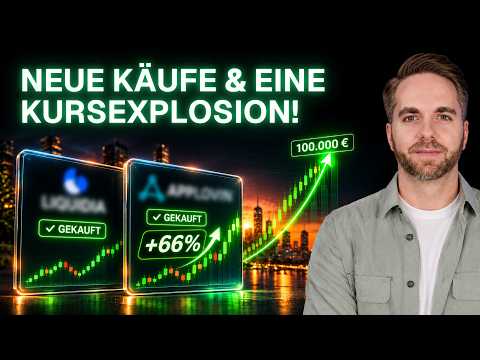
  • New Purchases: AppLovin (bought more after strong earnings, +60% pre-purchase gain), Liquidia (missed earlier entry, now bought in, focusing on biotech turnaround).
  • Existing Positions: ServiceNow (weak quarterly results, turnaround uncertain, Q4 will decide), Circle (in the red due to crypto downturn), Hai Group (small position, Chinese risk, slightly positive).
  • Watchlist & Limits: Chronos (limit order active), Critical Metals (rare earths, high risk, max €250), Uranium Energy (downtrend, waiting), Monday.com (new, under analysis).
  • Strategy: Cash is king – only 23.6% invested. Discussing stop-loss rules (35% vs. 50% for moonshots). AI stocks under watch after the crash, but no purchase yet.
  • Community: New Discord channel for fast updates and exchange. Key upcoming events: Nvidia earnings, Entropic IPO.
  • Conclusion: Despite a challenging environment, the portfolio holds its ground. Next buys will be carefully considered – stay tuned!
Buy Nvidia After the Crash? My Decision + Our Additional Purchases // BRIEFING
2 min read

Buy Nvidia After the Crash? My Decision + Our Additional Purchases // BRIEFING

Market Sentiment: Like the Corona Crash of 2020
  • Nvidia collapses, Jensen Huang resigns. The atmosphere mirrors March 2020 – yet the speaker remains optimistic and bought Nvidia during the dip.
Winners & Losers of the Week
  • Winners: Singulus (+100%, SpaceX order), Broadcom, AMD, Cerebras, Modine (Samsung acquisition rumors), Sanmina (+20%).
  • Losers: Nvidia (CEO resignation, -30% from peak), Hims and Hers, Corteva (Brazil -31%), Rheinmetall (peace hopes), Super Micro (Justice investigation).
Bears vs. Bulls: Inflation & AI
  • Bears: Hot inflation data, December rate hike 100% priced in (even 50bps on the table). The AI party is finally over.
  • Bulls: Oil price falling, strong economy (retail +10.1% YoY), retail investor sentiment so negative it historically signals a buy signal. AI has been called dead “100 times” over three years but fundamentals remain strong.
Dossier: Anthropic & Nvidia Decision
  • Anthropic IPO (ANTX): Six times oversubscribed, valuation up to $1.4 trillion. First trading day on November 19th.
  • Nvidia Decision: Pros: Fundamentals are explosive (13× expected earnings), chips in high demand, geopolitical relevance. Cons: Without Huang, the strategist is missing, political risks (chip smuggling). My verdict: Despite high risks, I bought Nvidia on Friday – the market has already released a lot of pressure (Tech P/E nearly halved, similar to March 2020 buying opportunity).
Personal Purchases & Outlook
  • My Buys: TSMC, Broadcom (+20%), Celestica (+17%), SpaceX (new entry).
  • Team Portfolio: TSMC, Fujikura, Creador, Samsung, Air Test Systems (all in the green).
  • Promotions: Advent Calendar (prizes >€6,000), 13F Holding Strategy (free report coming shortly), Daily Briefing free trial until Nov 30th.
  • Next Week: Anthropic deep dive, exciting interview, and 13F update.
Should Ethereum Tax Its Apps to Prove Its Security Is Worth It?
2 min read

Should Ethereum Tax Its Apps to Prove Its Security Is Worth It?

This transcript puts a provocative idea on the table: Should Ethereum tax the apps built on it to prove its security is actually worth the cost? The speaker challenges the foundational value propositions of the ETH token.

Challenging the "Store of Value" Thesis
  • The speaker dismisses Vitalik Buterin's vision of ETH as a Store of Value as a fallacy. Bitcoin is framed as a one-in-a-billion fluke ("immaculate conception"), not a replicable standard. Without assuming the dominance of Ethereum over all other blockchains, the store of value argument for ETH collapses.
The Call for Quantification
  • A major critique targets the inability of Ethereum proponents to quantify the value of the token. The fundamental question is asked: How many apps, transactions, or stablecoins need to exist on Ethereum before the token itself gains intrinsic value? Answers allegedly remain vague, focusing on protocol quality rather than token value accrual.
The Hyperliquid Model and the Tax Solution

Hyperliquid is highlighted as a successful L1 model because it captures value directly through its native DEX and stablecoin distribution.

  • Hindsight Option: Ethereum should have built its own native stablecoin and DEX.
  • Current Proposal: Tax the apps. If Ethereum's security is as invaluable as claimed, applications should be willing to pay a tax to use it.
  • The Litmus Test: The tax rate determines reality. If apps stay and pay, security is proven. If they migrate to cheaper chains, the security premium is exposed as a commodity.
Conclusion

The proposal serves as a financial litmus test for the value creation of the Ethereum network. It moves the debate from philosophical visions to raw market consent.

Why One Startup Banned All of Indonesia to Stop Free AI Inference Abuse
2 min read

Why One Startup Banned All of Indonesia to Stop Free AI Inference Abuse

The Problem of AI Token Arbitrage
  • Subscription services like Spotify always have a barbell of low-usage and high-usage users.
  • Tokens are much easier to resell than streamed music – a huge incentive for arbitrage.
Market Dynamics and Countermeasures
  • OpenAI actively tries to close this arbitrage through continuous optimization (lowering API costs, adjusting token amounts).
  • As long as arbitrage exists, users will exploit it – the market is too efficient.
Example: A Startup Bans All of Indonesia
  • A DevOps startup offered a 15-minute free trial (requiring a credit card).
  • Abuse via stolen credit cards led to the entire country of Indonesia being banned.
  • The head of engineering described it as a „nightmare“ („I‘m ready to kill myself“).
Conclusion: Free Inference Is Extremely Risky
  • Tokens are so fungible that optimal users systematically steal and resell them.
  • Once free inference is offered, „a whole swarm of people rushes in to exploit it“ – inference leads to more inference.

This clip is from Uneasy Money, airing every Wednesday at 4:00 PM Eastern Time.