Nofinity Logo

Latest Analyses(7)

Is €250,000 enough to live off dividends?
2 min read

Is €250,000 enough to live off dividends?

Video Summary: Is €250,000 enough to live off dividends?

This video explores how much capital is required to achieve financial freedom through dividends, using everyday expenses as examples. The narrator has quit his job in pursuit of this goal.

Key Calculations: A Daily Life Example

  • Daily Espresso (€3): Requires €36,500 at a 3% dividend yield.
  • Daily Carbonara (€12): After accounting for capital gains tax (approx. 18.46% after the partial exemption), the needed capital rises to €178,490.
  • Daily Cake (€5) and Newspaper: Push the total capital needed for this entire daily routine to €330,000.

Optimization via Higher Yield?

  • An ETF with a 10% yield would reduce the required capital to about €100,000.
  • Warning: Such high yields are often unsustainable. If the ETF underperforms, its price drops, shrinking your capital over time.

Comparison with Median Income

  • The median net monthly income in Cologne is about €2,300.
  • Required capital to generate this:
    • MSCI World (1.5% yield): €2.2 million
    • Dividend ETF (3% yield): €1 million
    • Higher Yielding ETF (7%): €333,000

Core Takeaways

  • Dividends are not guaranteed; payouts can be cut.
  • Always plan a financial buffer.
  • Dividends are essentially withdrawals: Whether you take dividends or sell shares for income, the principle is the same. Withdrawing too much will deplete your capital too quickly.
  • Conclusion: €250,000 is generally insufficient to live off dividends comfortably unless you live a very frugal lifestyle or take on significant risk. At the end of the video, the narrator even calls to ask for his old job back.
Is the Year-End Rally Starting NOW? Why Trump's Defeat Is a Blessing for Investors! // Folker Hellmeyer
2 min read

Is the Year-End Rally Starting NOW? Why Trump's Defeat Is a Blessing for Investors! // Folker Hellmeyer

Key Takeaway
  • After the midterms, Trump suffered a heavy defeat – but Hellmeyer sees this as positive for investors: Democracy is working, and the Trump administration is being checked at home.
  • Trump is not a lame duck, but the Democratic Congress can use its budget authority to force more rationality and predictability.
Trump & the Iran War
  • In Hellmeyer's view, Trump's main mistakes lie in foreign policy, especially the Iran war and rising energy prices.
  • The election defeat is the consequence of that. He does not expect a quick end to the war, but sees a growing chance of a diplomatic solution over the medium term, because the US also wants out of the conflict.
AI Stocks & Market Situation
  • The AI rally is not over, but further downside is possible – market technicals and momentum are negative for now.
  • Long term, Hellmeyer remains bullish: AI and robotics are the Fourth Industrial Revolution, and every company will eventually use AI.
  • The current rotation into old-economy stocks is a good sign, not money leaving the market.
Year-End Rally
  • A year-end rally is possible if geopolitics de-escalate and diplomacy gains momentum in November/December.
  • Oil prices are artificially suppressed by strategic reserves – a sharp upward breakout remains a risk.
Single Stocks
  • Hellmeyer recently bought Vonovia and Thyssen – out of conviction.
  • Vonovia trades well below book value; he outlines an unconventional takeover idea for Berlin.
Precious Metals & China
  • Gold and silver remain attractive at current levels despite rate pressure and negative market technicals.
  • China is economically stable, but in equity markets Hellmeyer prefers satellite countries that benefit from China.
Europe & Germany
  • Germany is dramatically behind in AI – not just in ambition, but in energy, grids, and infrastructure.
  • France and Belgium face massive budget problems in Hellmeyer's view; markets will eventually punish policymakers if no reforms come.
€10,000 Gift at Birth: Is That Enough for Retirement?
2 min read

€10,000 Gift at Birth: Is That Enough for Retirement?

The Idea: Retirement Gift for a Newborn

Carmen wants to give her child a one-time gift at birth so that the child never has to save for retirement. Goal: cover a pension gap of €1,500 per month in today's purchasing power.

The Calculation
  • Assumptions: Child retires at 70, enjoys 30 years of retirement.
  • Pension gap of €1,500/month (today's value) → required capital at retirement: €439,000 (after taxes, 3% withdrawal rate).
  • With 2% inflation, nominal value is €1.76 million.
  • To achieve €439,000 (real) after 70 years, with 5% real return (after inflation), a lump sum of €13,000 today is needed.
  • Alternatively, at 4% real return, the required gift is €27,000.
The Rule of Thumb

For every €10,000 gifted at birth, the child can later withdraw about €1,124 per month (in today's purchasing power).

Comparison: Without the Gift

If the child starts saving at age 30 (40 years of contributions), they would need to invest €288 per month – total contributions of €138,000, ten times the gift amount. This highlights the power of compound interest.

5 Things to Consider Before Gifting
  1. Potential BAföG issues: Assets over €15,000 may reduce student aid; the depot would be around €47,000 when the child turns 18.
  2. Keep the money in your own depot: It grows almost identically, and young parents often need flexibility.
  3. Gift tax exemption: €400,000 every 10 years; at 7% growth, the depot surpasses this when the child is 48.
  4. Uncertain own expenses: Children are expensive – gifted money is gone.
  5. Child might squander the money: At 18, the entire depot could be spent on a car or similar.
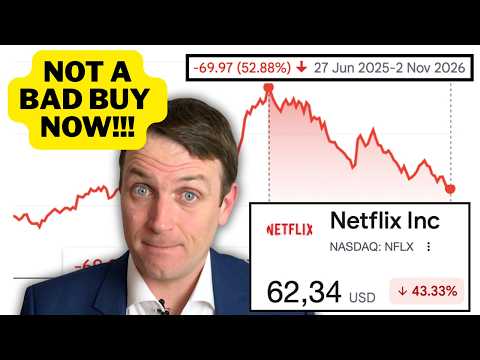
Netflix Stock NFLX Deep Dive Analysis & Intrinsic Value
2 min read

Netflix Stock NFLX Deep Dive Analysis & Intrinsic Value

Netflix at a Glance
  • Fallen FANG angel: The stock has dropped sharply, but the business remains solid; market cap around $255B, P/E about 18.
  • Compounder with pricing power: nearly 1B viewers/households, low churn, regular price increases; ad tier ramping (target $3B, achieved $2.7B).
  • Growth is slowing: revenue +11%, net margin ~25%, FCF $10–11B, huge buybacks ($11B).
Opportunities & Risks
  • Opportunities: member growth, pricing, advertising, AI for recommendations/targeting, global expansion.
  • Risks: declining engagement/playback time (Wells Fargo: -9% or -8% daily usage), intense competition (YouTube, Disney, Prime, TikTok/Shorts), expensive live/sports rights, management change (new Chief Content Officer Peter Rice), ad execution.
Management & Financials
  • Three revenue levers: member growth, pricing, advertising; goal: double-digit revenue growth through 2027, then 15–20% EPS growth via buybacks.
  • Content spend ~$20B, amortization ~$17.5B; margins rising, balance sheet solid.
Bulls vs. Bears
  • Bill Ackman (bull): P/E ~19 with about 20% earnings growth; 5% position.
  • Bears/Wall Street: disappointment over engagement and valuation multiples; Netflix has ~60% underperformance vs. Disney; P/E of 40 is history.
Intrinsic Value & Decision
  • Base case: 15% FCF growth, P/E 20, expected return ~10% → fairly valued.
  • Ackman case: 17% growth, P/E 12 → undervalued.
  • Worst case: 12% growth, P/E 15 → downside risk.
  • Conclusion: positive risk/reward; in the 10% quadrant, but not in the conservative model portfolio; would need a lower price to buy. Watchlist, overall thumbs up.
1 AI Agent To Automate 99% of Your Life
3 min read

1 AI Agent To Automate 99% of Your Life

Introduction: The One Agent to Manage Them All

Instead of drowning in multiple AI tools that require constant management, this talk introduces the concept of a personal AI agent based on the ACT principle:

  • Autonomous: Set a goal, and it finds the way to achieve it.
  • Continuous: It keeps working even when you close your laptop.
  • Tailored: It learns your preferences, goals, and context over time.

1st Force: Fragmentation – The Hour Thief

We switch between apps and websites 1,200 times per day, costing roughly 40 minutes of lost focus and breaking our concentration.

  • Solution: Your agent becomes the central hub connecting your scattered data islands.
  • Example: Preparing for a dream job interview. Instead of manually gathering your resume, notes, and emails, you prompt the agent: "Help me be the best-prepared candidate." The agent researches the company and simulates a live interview with you.

2nd Force: Information Overload – The Attention Thief

The average worker battles 117 emails and 153 chat messages daily, plus complex documents.

  • Solution: The agent filters the noise and simplifies complexity.
  • Example: A focus prompt instructing the agent to only interrupt you for critical decisions or deadline changes. Everything else goes into a 5 PM summary.
  • Bonus: Complex documents (like a lease agreement) are instantly distilled into what costs you money or limits your freedom.

3rd Force: Frequency – The Memory Thief

Infrequent but important tasks (taking vitamins, returning a package) are easily forgotten because they lack the repetition to become a habit and don't have a trigger.

  • Solution: The agent becomes your external memory and personal trigger.
  • Example: A reminder that your cell phone trade-in kit expires today. Or asking the agent: "Make sure I see my doctor every 3 to 4 months."

4th Force: Future – The Years Thief

The most dangerous force of all: "I'll do it later." This is what eats away at your years and long-term goals.

  • Solution: Use the agent to track your long-term priorities and purpose.
  • Task: Write down 3 things you keep postponing. Instruct your agent to review your calendar weekly and tell you if you made progress on those priorities.

Conclusion: Productivity is only worth it when it serves a higher purpose. The agent gives you time back—what you do with it is entirely up to you.

Is The AI Selloff A Buying Opportunity? | Warren Pies
4 min read

Is The AI Selloff A Buying Opportunity? | Warren Pies

In this episode of Forward Guidance, Warren Pies of 314 Research provides a deep dive into the current market turbulence. Although he remains fundamentally convicted in the AI revolution, he has recently downgraded his equity allocation to manage technical risks. His core methodology is "Build conviction on fundamentals, manage risk with technicals."

Why the Risk-Off Stance?
  • Market Consolidation: The market entered a strict trading range without new highs or lows, signaling a loss of momentum and a high potential for a trend change.
  • Lead Rotator Flashing Red: The market is being led by Staples (Consumer Non-Durables) . Historically, a market led by staples lacks the tailwinds needed for a sustained bull run in equities.
  • Credit Market Stress: Hyperscaler credit spreads are rising again past the levels seen in July. This signals that the leverage-heavy phase of the AI buildout is starting to feel the heat of high interest rates.
AI Sector: Bubble or Fundamentals?

Warren Pies dissects the recent AI selloff, concluding it is a technical/liquidation shock rather than a failure of the AI thesis.

  • Fundamentals Remain Strong:
    • GPU Scarcity: Availability is extremely tight (B200 at zero), and rental prices continue to rise. The Contango in the GPU market (higher forward prices) is interpreted as a positive signal of capacity hedging.
    • Strong Unit Economics: Hyperscaler cloud revenues are accelerating, and AI model profitability is surging (Anthropic saw revenue per compute dollar skyrocket from $0.57 to over $2.08).
    • The Logic Deficit: It is logically inconsistent to have rising GPU prices and falling Hyperscaler/Semiconductor stocks. This can only happen during a panic liquidation driven by leverage and sentiment, not a fundamental shift in supply/demand.
The Fed & Macro Risks
  • The New Inflation Driver: The primary driver of inflation has shifted from Oil to Tech/AI Capex. This makes it harder for the Fed to pivot to rate cuts.
  • Choking the Boom: The Fed risks choking off the supply side of the AI buildout by keeping rates high, as it is now heavily dependent on debt markets.
  • The Geopolitical Backstop: The AI race is a national security priority. A newly confirmed Fed chair might be reluctant to let rate hikes sabotage this crucial technological race.
The Energy Landscape
  • Geopolitical Stalemate: Pies analyzes the four US strategies (Targeted Bombing, Indiscriminate, Ground Invasion, Blockade). The Blockade is working but requires patience. The next move (Deal or Escalation) determines the oil price.
  • Explosive Crack Spreads: Margins for middle distillates (diesel) are extremely high. This will normalize over time through refinery switching and demand destruction. It is a sticky, but temporary, structural issue.
Conclusion & Outlook

Warren Pies advocates for discipline and patience. The AI conviction remains high, but the path is currently dominated by macro risks. The right strategy is not to force a trade, but to wait for the consolidation to break towards either a clear breakout or extreme capitulation.

Follow Warren on X (@WarrenPies) and explore his research at 314research.com.

The Fed Will Have To Print Bigger This Time
2 min read

The Fed Will Have To Print Bigger This Time

Bottom line
  • Nick Batia argues the Fed may return to liquidity injections sooner than many expect via reserve management purchases / T-bill QE / “QE light”, even while fighting inflation.
  • He watches three under-the-radar money-market signals that show whether the system has enough liquidity.
1) Repo/SOFR spread
  • SOFR is the secured overnight repo rate. If it pushes above the Fed’s policy corridor (e.g., IORB), it signals collateral/liquidity tightness.
  • The spread has widened to 5 bps, the highest since tax day. Month-end, quarter-end, Thanksgiving and year-end rolls are likely pressure points.
  • Similar spikes previously preceded the Fed’s T-bill purchases. That tool remains ready.
2) T-bill supply
  • There are more than $7 trillion in T-bills, about 22% of marketable Treasuries.
  • This could rise toward $10 trillion / roughly one-third. Short-term government debt must be funded in the cash/repo market.
  • Banks may hoard reserves during stress rather than absorb more bills.
3) Bank reserves/GDP
  • Reserves are about 9% of GDP, low versus much of the past decade outside COVID.
  • Excess reserves barely existed before 2008; since then they are a trust/liquidity buffer. The 2019 repo crisis occurred near lows, followed by major QE.
  • With GDP rising and reserves flat, the system needs more Fed liquidity over time.
Bonus: TGA
  • The Treasury is rebuilding its TGA, implying more bill issuance. Batia sees this as a funding need, not a grand rate-manipulation scheme, though buybacks may help at the margin.
Takeaway
  • If the Fed resumes T-bill purchases, they may need to be larger this time because Treasury issuance is larger.
  • This is a key early signal for liquidity-sensitive assets like Bitcoin.