3 min read
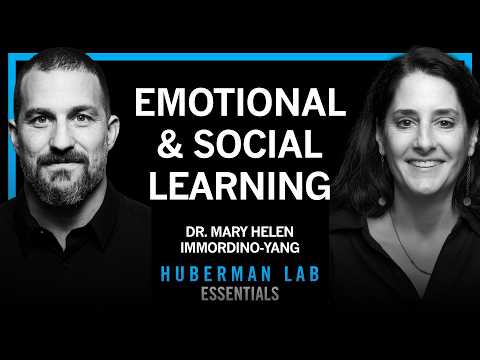
Essentials: How Emotions & Social Factors Impact Learning | Dr. Mary Helen Immordino-Yang
Summary of the YouTube Transcript: Essentials: How Emotions & Social Factors Impact Learning
Core Message: Emotions are the drivers of learningDr. Mary Helen Immordino-Yang argues that emotions and social factors are the foundation for deep learning and personal development. The brain is not an isolated organ but part of the body, connected to the environment and other people through emotions.
Key Points:1. The Connection of Body, Mind, and Emotions
- The brain is specialized to control the body and represent its states. Consciousness and thought emerge from this bodily feeling.
- Emotional states are not simply 'primitive' but form the basis for complex mental concepts, beliefs, and narratives.
- Example: A two-year-old expresses love physically ("I love your arm"). By age four, this becomes an abstract idea ("I love you more than I am glad there is a day").
2. How Stories (Narratives) Shape Our Learning
- We constantly construct stories about ourselves and the world to make sense of our experiences.
- These stories are heavily influenced by culture, social environment, and personal experiences.
- Projection: We do not perceive the world objectively but project our expectations and cultural values into every experience (e.g., differences in scene perception between Japanese and American individuals).
- Danger: Negative narratives (e.g., dehumanization) can suppress compassion and lead to terrible acts (e.g., genocide).
3. Fostering Learning through Curiosity and Meaning-Making
- The current education system overemphasizes learning outcomes ("What have you learned?") and standardized tests instead of focusing on personal development.
- The real question should be: How does the person change through learning?
- Emotions are the lever: You think about what you feel an emotion about. If the emotion focuses on the test result, you learn how to take tests. If it focuses on the idea itself (e.g., "Why does the ball roll down the ramp?"), you learn the underlying science.
- Practical Recommendation: Instead of giving children pre-formed answers, create rich, meaningful problem sets that spark their natural curiosity. The development of the person is the goal; learning is the means.
4. The Adolescent Phase is Crucial
- In adolescence, children have the neural capacity for complex meaning-making, but the system often becomes stricter and more controlling ("Now it gets serious"). This suppresses their natural search for meaning.
- The solution is not to shield adolescents from risks but to support them in questioning their own beliefs and developing intellectual humility.
- Emotions are the drivers of all thinking, decision-making, and relationship building. They do not absolve us from responsibility but challenge us to systematically question and reevaluate our own narratives.
- The purpose of education should be personal development. Learning content is just the tool along the way. The quality of the 'horse' (the person) is more important than the content of the 'cart' (the knowledge).