Nofinity Logo
How it works

YouTube Insights in 5 Minutes Instead of 3 Hours

Compact AI summaries & key takeaways from leading experts in longevity, crypto, finance, and more – ad-free, research-backed, and concise.

Latest Analyses(7)

DAX-Check LIVE: Commerzbank, Lufthansa, SAP, Sartorius Vz., Siemens Energy, Thyssenkrupp im Fokus
DER AKTIONÄR TV
2 min read

DAX-Check LIVE: Commerzbank, Lufthansa, SAP, Sartorius Vz., Siemens Energy, Thyssenkrupp im Fokus

DAX Under Pressure: Oil Prices and Interest Rates Weigh

On Monday, May 18, the DAX opened sharply lower, losing 118 points and falling below the 24,000 mark. The 200-day moving average is breached again. The main drivers are rising oil prices (above $110) due to tensions in the Middle East. Yields are climbing: the German 10-year bund reaches 3.18%, the US 10-year at 4.62%, putting pressure on equities.

Technical Analysis

  • Resistance: 24,500 points (closing basis)
  • Support: 23,100 points (strong), possible gap at 23,400
  • Trend: Short-term bearish; recovery only above 24,500
Key Stocks
  • Commerzbank: Downgraded by Kepler Cheuvreux. Higher rates benefit banks but recession risks (loan defaults) are concerning. Stock at €36.26, next support at €34.
  • Lufthansa: Up on Ryanair's earnings, but rising oil prices and poor chart (200-day line broken) weigh. Possible drop to €7 support.
  • SAP: Reaffirmed AI strategy at Sapphire conference. Jefferies rates as buy (target €230). Stock slightly recovering but overall market weak.
  • Sartorius: Rumors of Elliot investing in Biorad support the stock. Support at €203–204, resistance at €240.
  • Siemens Energy: Profit-taking after approaching €200. Next support at €160 (50-day line). Long-term attractive due to AI data centers; a dip to €150 could be a buying opportunity.
  • ThyssenKrupp: Restructuring plans: closing a US plant, moving to Hamilton. Stock trades between €10 and €11, key support at €10.
Market Outlook

Sentiment is cautious. A recovery depends on positive news from the Middle East and falling oil prices. Until then, caution is advised.

What Is a Smart Contract?
Coin Bureau
2 min read

What Is a Smart Contract?

Introduction
  • Smart contracts are programs on a blockchain that automatically execute agreements when conditions are met.
  • They replace trusted intermediaries (banks, lawyers) and rely on an “if-this-then-that” logic.
How Smart Contracts Work (5 Steps)
  1. Developer writes code – typically in Solidity, compiled into bytecode.
  2. Deployment on the blockchain – the contract receives its own address.
  3. Immutability – once deployed, the code cannot be changed (except via upgradeable proxies).
  4. Triggering – a transaction from a wallet or another smart contract initiates execution.
  5. Consensus – thousands of computers (nodes) execute the identical code and agree on the result.
Example: Alice and Bob Swap
  • Alice deposits ETH into the contract; Bob deposits Token X.
  • The contract checks if both have paid.
    • Yes: tokens go to Alice, ETH to Bob.
    • No (deadline expired): both get their deposits back.
  • No trust needed between the parties – only trust in the code.
Importance and Use Cases
  • DeFi (Decentralized Finance): lending, trading – over $95 billion locked in smart contracts (TVL).
  • Stablecoins (e.g., USDT, USDC) – over $300 billion, based on the ERC-20 standard.
  • NFTs (ERC-721) – ownership recorded via smart contract.
  • DAOs – collective management of funds through voting.
  • Tokenized Real-World Assets (RWAs) – e.g., BlackRock’s BUIDL fund with over $2 billion.
Risks and Limitations
  • Code bugs – e.g., Reentrancy bug (The DAO 2016) caused loss of 3.6 million ETH. In 2025, exploits led to $3.4 billion in losses.
  • Oracle dependency – smart contracts cannot access external data; they rely on oracles (e.g., Chainlink). Manipulation of these data (e.g., Mango Markets 2022) can cause losses.
Conclusion
  • Smart contracts are not perfect but offer a transparent, automated alternative to traditional intermediaries.
  • They operate 24/7 without office hours and enable trust between strangers.
  • Nick Szabo coined the concept in 1994; Ethereum made it reality in 2015. Today, smart contracts manage hundreds of billions of dollars.
$1,000,000 Portfolio Asset Allocation Final Take
Value Investing with Sven Carlin, Ph.D.
2 min read

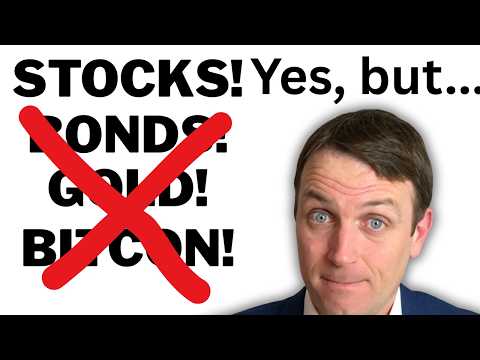
$1,000,000 Portfolio Asset Allocation Final Take

Introduction
  • The speaker summarizes his four‑part series on allocating a million‑dollar portfolio and presents his personal conclusion.
  • Money is a personal matter – individual circumstances, risk tolerance, and goals are crucial.
Evaluation of Asset Classes
  • Bitcoin & Gold: Both are considered unproductive assets. Bitcoin is pure gambling with zero value; gold offers no cost‑effective risk mitigation and incurs high opportunity costs. Unsuitable for long‑term wealth building with safety.
  • Bonds: Currently more attractive (around 5 %), but long‑term bonds are too risky – inflation could destroy real returns. Short‑term Treasury bills (3 months) are acceptable for money needed soon.
  • Stocks: The only solution for long‑term growth if returns of 10 % or more can be achieved with a margin of safety. All other asset classes dilute capital growth.
The Value Investing Approach
  • Introduction of a quadrant model to classify companies by risk and return (e.g., Palantir, Zoetis, Lululemon, Berkshire Hathaway).
  • Timing and patience are essential: The market is in the second most expensive phase in history (AI bubble), so caution is advised.
  • It is not about a fixed portfolio but a process: Buy companies when the purchase is risk‑appropriate and value‑oriented.
Conclusion
  • Every investor must consider their personal situation, knowledge, and risk appetite.
  • Recommendation: The new handbook „The Value Investing Handbook“ (500+ pages) as a starting point for long‑term, secure wealth building.