Nofinity Logo

Latest Analyses(7)

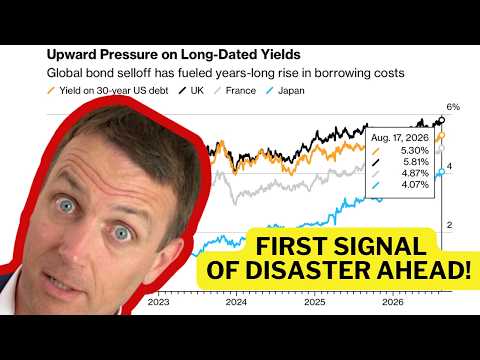
This Is Big - Interest Rates Up, Interest Costs Up!
3 min read

This Is Big - Interest Rates Up, Interest Costs Up!

Rising Bond Yields – The Key Risk for the Next Decade

The speaker argues that higher long-term interest rates (e.g., US 30-year Treasury at 4–5 %) will dominate the next 5–10 years, not AI. The era of ultra-low rates (2002–2021) is over, and debt levels have exploded.

The Long-Term Debt Cycle
  • According to Ray Dalio, we are approaching the painful phase: when debt service becomes unsustainable, deleveraging is inevitable.
  • Currently, governments, private equity, and real estate keep refinancing rather than repaying debt – a Ponzi scheme.
US Deficits & Interest Costs
  • The average deficit is now 6 % of GDP (sustainable would be ~3 %).
  • Net interest payments have tripled from $0.5 trillion to $1.5 trillion in four years. By 2030, they could reach $2 trillion (100 % of the current deficit).
  • The US is essentially borrowing to pay interest – a textbook pyramid.
Inflation as a „Solution“? Costly Side Effects
  • Inflation erodes debt nominally but hurts the poor most. The promised 2 % inflation has not been achieved in the last six years.
  • Politicians hope AI will solve the debt problem – the speaker calls this delusional.
Risks: AI Bubble & Systemic Crisis
  • Massive AI capex (data centers etc.) mirrors the 2007 subprime bubble. If it bursts, GDP could collapse because AI investments are currently propping up the economy.
  • Scenario: If the S&P 500 dividend yield rises from 1 % to 2 % (as in 2012), that implies a 50 % drop; at 4 % a 75 % drop.
  • Mark Spitznagel warns of an 80 % crash. The speaker notes the bull market started in 1982 (44 years old) and is overdue for a major correction.
What Investors Can Do
  • Safety: 5-year Treasuries (~4.3 %) or 2-year (~4 %) offer nominal stability.
  • Check your own risks: Is your mortgage fixed? Would your business survive a spike to 15 % rates?
  • Focus on value investing: Solid companies that can weather a crisis.
  • If uncertain: just wait until panic erupts – but be prepared to act.

Bottom line: Record debt, rising rates, and an overheated AI bubble could trigger the biggest debt crisis in decades. Investors should make their portfolios crisis-proof.

BITCOIN: It's Getting Really Tight Now! - Buy NVIDIA & Anthropic Stock?
3 min read

BITCOIN: It's Getting Really Tight Now! - Buy NVIDIA & Anthropic Stock?

Bitcoin: Crash or Opportunity?

Bitcoin is under heavy pressure below $64,000. After failing to break above $100,000, sentiment is worn down. Key insights:

  • Support levels: $62,000 tested multiple times, below that $57,000 (low) and $50,000 (fundamental value zone).
  • Mining costs: Near breakeven – if prices fall further, miners may sell more.
  • Open interest: Leverage largely flushed out, but long-squeeze drove prices down.
  • Short-term holders: Many are in loss – a capitulation zone has been reached. Historically a sign of a forming bottom.
  • Lack of demand: Spot market shows little buying; rallies were pure short-squeezes.
  • Strategy: Personal buy order at $50,000 (tax-free for 2025). Risk: further sell-offs, but long-term cheap entry.
Nvidia: Record Profits Despite Crisis

Nvidia reported $65.3 billion profit in Q3 – $717 million per day. Yet the stock falls due to:

  • CEO resignation: Jensen Huang stepped down; interim CEO runs, but return is expected.
  • AI bubble burst: Market prices in declining demand, despite excellent fundamentals (revenue, cash).
  • Valuation: Forward P/E is low; I believe fair value is above current price.
  • Long-term: Chips are essential for robotics, AI, and other technologies. Bought 50% of planned position.
Tropic IPO: Biggest Ever

Tropic launches at $83 per share with a $1.5 trillion valuation – the largest IPO in history. Forecast:

  • Short hype: Price may spike initially, then sell off (disappointment).
  • Long-term: Only after 3–4 quarters of good results will the AI story be believed again.
  • Correlation with Bitcoin: Practically zero (0.16).
  • Trading hack: OKX offers a $50 voucher (loss covered) to trade pre-IPO futures with up to 3x leverage.
Crypto Tax Update

The proposed crypto tax is not off the table: Cabinet meeting on Dec 9 is on the agenda. Important:

  • Grandfathering: Purchases until Dec 31, 2024, are likely tax-free; after that, a 10-year holding period may apply.
  • Strategy: Buy this year to secure tax-free status – even if prices are higher.
  • Tool: Website has a holding period calculator and tax checklist.
Macro & Outlook
  • Strong US dollar: Bad for risk assets like Bitcoin, gold, and stocks. Gold already 30% below ATH.
  • Rate hike: 93% probability of a hike in December – curbs borrowing.
  • S&P 500: Correction due to AI bubble, but many companies beat expectations (31.9% above estimates).
  • Expectation: Bitcoin remains sideways; a break below $60,000 could test $57,000. Long-term (2025) rate cuts and new all-time highs are possible.
Conclusion

The market is exhausting, but great opportunities lie in capitulation. Nvidia and Tropic offer long-term potential, while Bitcoin can be bought cheaply with tax advantages. Discipline and patience are key now.

Why Companies That Refused to Tokenize With OKXICE Have Done So With Securitize
2 min read

Why Companies That Refused to Tokenize With OKXICE Have Done So With Securitize

Summary: Why Companies Prefer Securitize's Tokenization over OKX's Offer

This interview explains why major companies like Apple, Microsoft, NVIDIA, and Tesla embrace tokenizing their stocks through Securitize, while rejecting a similar offer from OKX (linked to the TSV program).

Key Differences Between Approaches

  • No TSV Participation Required: Securitize does not ask companies to join a "Tokenized Security Vehicle" (TSV). Instead, they tokenize the shares independently within existing regulatory frameworks.
  • Proactive Communication: Securitize proactively contacts issuers to explain the tokenization process and handling of corporate actions (e.g., dividends), reducing misunderstandings and resistance.
  • No Legal Disputes: While some companies initially send reflexive objection letters (as with TSV), Securitize clarifies it is not a TSV issue, leading to a more positive reception.

Market Model and Pricing

  • Trading Mechanism: Securitize uses a Single-Dealer RFQ model (Request for Quote) with Jump Trading as a partner. This differs from the AMM liquidity pools used by TSVs.
  • Best Execution: The model aims for best execution, though it is harder on weekends when traditional exchanges are closed. Jump Trading provides a proprietary AMM to facilitate trading.
  • Price Discrepancies: The model minimizes the risk of price differences between tokenized versions and exchange rates, though challenges remain on weekends.

Current Status

  • Securitize recently added 22 new stock tokens and aims to reach 50 tokens within the next one to two weeks (currently at 47).
  • Tokenized companies include not only tech giants like Apple, Microsoft, NVIDIA, Alphabet, Tesla, Meta, and Amazon but also traditional firms like Exxon Mobil, GameStop, Salesforce, and Disney.

Conclusion

Securitize's key advantage lies in its compliance with existing regulatory frameworks (broker-dealer, Reg NMS, best execution) and no requirement for TSV participation. This makes the offer more appealing to companies with fewer legal and operational hurdles.

Senator Bernie Sanders: Iran Wasn't Trump's Idea. Someone Else Pushed Him Into It!
2 min read

Senator Bernie Sanders: Iran Wasn't Trump's Idea. Someone Else Pushed Him Into It!

The Crisis of Democracy

Bernie Sanders frames the 2022 midterms as a fundamental fight for the survival of American democracy against an authoritarian, pathological liar as president.

The Rigged System
  • Economy: 60% of Americans live paycheck to paycheck. A massive transfer of wealth to the top 1% has hollowed out the middle class.
  • Politics: A 'legal but corrupt' system. Super PACs and lobbyists (e.g., 1,500 for the pharma industry) effectively write legislation to serve the wealthy.
Sanders' Solutions
  • Medicare for All: Healthcare as a human right to break the power of insurance and drug companies.
  • Wealth Tax: 5% annual tax on billionaires to generate ~$400B yearly for education, housing, and ending child poverty.
  • Minimum Wage: Raise the federal minimum wage to $20/hour.
AI and Existential Threats

He strongly advocates for a pause on superintelligence, viewing AI as the most transformative and potentially dangerous technology. He criticizes the unchecked power of tech oligarchs and calls for public ownership stakes in major AI companies.

Foreign Policy & Iran

In a controversial statement, Sanders claims the war with Iran wasn't Trump's idea but was actively pushed by Israel/Netanyahu. He harshly criticizes endless wars based on lies (Vietnam, Iraq).

Personal Drive

His political convictions stem from his family being wiped out by Hitler and his upbringing in a working-class family. This background has fueled his remarkably consistent fight for justice and the working class for over 70 years.

Why the First Tokenized Stock Venue Under the SEC's Exemption Launched With One Stock
2 min read

Why the First Tokenized Stock Venue Under the SEC's Exemption Launched With One Stock

Summary of the YouTube Transcript

The video discusses the launch of the first tokenized stock trading venue (TSV) under a SEC exemption. Here are the key points:

  • Launch on November 4: TSV went live with only one company – Canton Strategic Holdings. Host Laura Shin and panelists speculate about the motives.
  • PR Move or Proof of Concept?: One panelist suspects it was a PR stunt to claim the 'first mover' status, with no evidence of other companies being contacted.
  • Canton Community Theory: Another theory suggests the launch was crucial for demonstrating the viability of the Canton blockchain – especially for Automated Market Makers (AMMs) and as a public permissioned chain under the exemption standard.
  • OKX as a Pioneer: Panelist Brett notes that OKX (via OKX Ice TSV) clearly announced and executed the launch, possibly as a test run for a five-year program.
  • Outlook: More companies are expected to join in the future, despite the surprising start with only one stock.

Conclusion: The tokenized stock venue launched with a minimalist approach, either for PR benefits or as a proof of concept for the Canton blockchain. Time will tell if more companies will follow.

A Liquidity Crunch Is Breaking Every Market
2 min read

A Liquidity Crunch Is Breaking Every Market

Widespread Market Weakness
  • Bitcoin: Lost its 200-day average, broke below multiple trendlines ($75,000–$76,000, $82,700). Looks very weak.
  • Gold: Down 3.2%, below 50- and 200-day averages. Gave up uptrends in June and September. November candle is bearish.
  • S&P 500: Closed below 200-day average, lost trendline dating back to 2022 (end of Fed's rate hikes).
  • HYG (High Yield Corporate Bond ETF): Yearly low, trendline broken since September 2025.
  • Oil: Lost 200-day average, indicating weak demand despite Middle East conflict.
  • DXY (US Dollar): Strong near 104, highest since April 2025. Key driver of liquidity crunch.
  • Euro: Breaking down, losing trends, capital flowing into the dollar.
  • British Pound: Declining 0.45%, threatening to break multi-year lows.
  • Bloomberg Commodity Index: Lost 200-day average and uptrend since August 2025.
Causes of the Crisis
  • Liquidity Crunch: High rates, strong dollar, liquidity drained by AI IPOs.
  • Fed: Further rate hikes expected in December.
Special Features
  • Bitcoin as a Liquidity Asset: Highly sensitive to liquidity; suffers when tight, benefits from government liquidity injections.
  • Webinar: Jordy Visser and Simple Mining on Bitcoin, AI, and energy. Link: simplemining.io/tbl.
Conclusion
  • Gloomy outlook for all markets. The next liquidity injection could strongly revive Bitcoin.
AI And Crypto Crash: What Held, What Broke, What's Next???
4 min read

AI And Crypto Crash: What Held, What Broke, What's Next???

Summary: AI and Crypto Crash – What Held, What Broke, What's Next?

This analysis examines the recent market crash in the AI and crypto sectors, focusing on which companies and assets held up, which broke, and potential bottom formations and future trends.

Market Overview
  • General Sentiment: Extremely tense and fearful. The VIX (Volatility Index) shows unusual double spikes, indicating major uncertainty.
  • Macro Factors: The Federal Reserve (FOMC) is considering a 50 basis point rate hike, which pressures risk assets like tech and crypto. The yield on the 10-year US Treasury note has risen above 5% again.
  • Seasonal Anomaly: Q4 is typically strong for tech stocks but has been weak this year.
What Held – The Winners of the Crash
  • SpaceX: Strong performance after the successful Starship test. Major investors like Stanley Druckenmiller continue to buy. Showing strength.
  • Tesla: Holds above its 200-day moving average and shows signs of bottoming. Its connection to SpaceX (physical AI) is a plus.
  • AMD: Benefits as a direct competitor to Nvidia's weakness. AI demand (custom GPUs) remains high.
  • Broadcom: Shows stability and is one of the few winners in the current environment.
  • Google (Alphabet): Considered cheap and also profits from Nvidia's downturn.
  • ALAB: Suggests a double bottom pattern and appears to be recovering.
What Broke – The Biggest Losers
  • Bitcoin: Fell to ~$62,400 (down 4% on the day) and trades below previous lows. However, a buy signal (triple bottom pattern) is emerging, suggesting a possible recovery. The risk-reward ratio is considered good.
  • Ethereum (ETH): Sharply lower, below its 200-day moving average, with no buying interest. ETF selling continues. Seen as overvalued. A potential buy point would be below $1,500.
  • Nvidia: Despite strong quarterly earnings (a beat), the stock fell. The main reason is uncertainty about the CEO succession following Jensen's misconduct. Loss of IP (designers) is feared.
  • MicroStrategy (MSTR): Clear downtrend ("death spiral"). Criticism of its exclusion from the MSCI index and capital-destructive strategy (selling shares to buy Bitcoin).
  • Precious Metals (Copper): Sharp decline, influenced by Stanley Druckenmiller's short position. However, a long-term shortage is expected.
  • Memory Stocks (Micron, SK Hynix, SanDisk): Despite being sold out for the next 5 years and having low P/E ratios (e.g., 7–8), prices fall due to "Fear, Uncertainty, Doubt" (FUD).
What's Next – Outlook and Signals
  • Bottom Formation: Several assets (Bitcoin, ALAB, Palantir) show double or triple bottom patterns, a potential sign of an upcoming recovery.
  • Buy Signals: Bitcoin shows a historically reliable green buy signal. Tesla and SpaceX have positive technical indicators.
  • Macro Risks: The upcoming Fed rate decision and the Anthropic IPO (considered high risk) could further pressure markets. A weak Anthropic IPO would be a negative signal.
  • Long-Term Trend: AI and computing power (compute) remain the defining themes. SpaceX and Tesla are seen as long-term strong plays in the field of physical AI.
Key Takeaways
  • Nvidia: Weak short-term due to CEO issues but fundamentally solid long-term. Entering below $150 is seen as possible but risky.
  • Crypto: Bitcoin and Solana show relative strength compared to Ethereum. Signs of a bottom are present.
  • Trading Strategy: Focus on strength (SpaceX, AMD, Broadcom) and avoid falling knives (MicroStrategy). Use technical indicators like the "Optimized Trend" and "Mean Reversion."
    Disclaimer: This is not financial advice (NFA).

The analysis emphasizes that investing is a "blood sport" with no safe havens. The focus should be on companies with strong fundamentals and clear AI exposure.