Nofinity Logo

Latest Analyses(7)

Bitcoin Just Broke the Bear Market! But There’s a Problem?
4 min read

Bitcoin Just Broke the Bear Market! But There’s a Problem?

📊 Bitcoin Breaks Bear Market Structure

The weekly and monthly Bitcoin candle closed above the May high – a clear sign for the early bull market. The bearish market structure is broken, confirmed by a second close above the 50-week moving average (76.8k).

⚠️ Macro Paradox: Inflation Drops, Yields Skyrocket

  • Inflation came in cooler than expected (3% vs 3.3%), but 10-year yields hit 5.3% (highest since 2002).
  • Reason: Distrust in inflation data („Soviet-style accounting“) and AI capital expenditures competing with Treasuries.
  • Ben Hunt warns: „Something in the financial world is going to break“ – the MOVE Index (bond volatility) is spiking dangerously.
  • Paradox: Good inflation should lower yields, but they are rising faster than ever.

🔄 Altcoins: Cooling Off After Hype

  • Some altcoins like Lighter (-30%), Morpho (-17%), UNI (-17%) are correcting after massive gains.
  • 96% of the top 50 tokens beat Bitcoin in the last 30 days – natural mean reversion.
  • David sees a healthy breather, not an end to the bull market.

🏦 Robin Hood Hood Summit: New Tools for Speculators

  • 24/7 Trading – enabled by Bitstamp integration and tokenization.
  • Earnings Prediction Markets – purely financial derivatives.
  • Perpetuals for US customers: 8 markets (BTC, ETH, SOL, XRP, DOGE, ADA, LINK, HYPE) via Bitstamp (CFTC-licensed), not Lighter.
  • Social Trading (similar to FOMO) and AI agents for automated trading.

🔒 BitGet Hack & Near Intents Debate

  • $387M hack on BitGet (hot wallets) – biggest exploit of 2026. Users are made whole from protection fund.
  • Hackers tried to launder funds via Near Intents – the protocol‘s firewall blocked $53k but let $166k through.
  • Debate: Should cross-chain infrastructure have such filters? Near Intents is not fully permissionless – a conscious trade-off for security.

⚖️ Regulation: Prediction Markets Head to Court

  • New York sues Polymarket for illegal gambling.
  • Kalshi loses against Ohio/Tennessee (6th Circuit) – path to Supreme Court is clear.
  • Coinbase receives CFTC clearing license – enabling its own prediction markets, similar to Robin Hood.

🧠 Ethereum: From Blockchain to „Cryptographic World Computer“

  • Vitalik outlines a future where Ethereum only verifies instead of computing everything (ZK proofs).
  • Benefits: Parallel processing, privacy, quantum resistance, 4-8s latency.
  • Criticism: Lack of use-case narrative – the killer app is missing. Barnaby warns to keep valuable state on L1.
  • Bankless take: Ambitious but needs a clear link to „store of value“ applications.

🤖 AI Agents: A New Threat to Banks?

  • AI assistants (e.g., Muse, Instinct) could optimize on behalf of users: „Move your $5,000 savings into higher-yield products“ (stablecoins offering 5%).
  • This would trigger massive outflows from banks – a modern bank run.
  • Banks will try to block these agents via legislation – but for consumers it would be more efficient.

🔮 Outlook

  • Bitcoin shows strength despite macro shocks (high oil prices, midterms, rising yields).
  • Each resolution of these risks would be another catalyst.
  • The risk now lies in being underallocated – missing the train.
Can You Regrow an Aging Brain? The 95% Cellular Reset
2 min read

Can You Regrow an Aging Brain? The 95% Cellular Reset

The Challenge: Replacing Lost Neurons
  • The adult brain cannot regenerate neurons after stroke or in Parkinson's disease.
  • Two existing cell therapy approaches have critical drawbacks: embryonic-like stem cells (iPSCs) risk teratomas; direct conversion preserves the donor's biological age, leading to fragile cells.
The Innovative Middle Ground
  • A 2026 study by Professor Olive Brüstle’s team at the University of Bonn introduced induced neural stem cells (iNSCs).
  • They used only two factors (Sox2 and c-Myc) – not the full Yamanaka set – converting blood cells directly into neural stem cells without passing through an embryonic state.
  • This avoids teratoma risk while enabling dramatic epigenetic rejuvenation: cells from a 101-year-old donor reached a clock age under 5% of the original.
  • The vectors are non-integrating Sendai viruses, later cleared by temperature shift, leaving no genomic trace.
Key Discoveries
  • Age reversal is an active process: it does not require cell division; blocking division still allows the clock to reset.
  • Neural identity (Pax6) appears in ~12 days, but full epigenetic reset takes ~7 weeks.
  • Rejuvenated cells show young-like nuclear structure, low senescence markers (p16, p21), active autophagy, and healthy mitochondria.
  • In mouse brain transplants, cells survived 24 weeks, generated neurons and astrocytes, integrated with host circuits, and formed no teratomas.
Remaining Translational Hurdles
  • Mouse experiments used immunodeficient animals; the aged human brain is inflamed, posing survival challenges.
  • No functional restoration (e.g., in Parkinson's models) has been demonstrated yet.
  • c-Myc is an oncogene; long-term cancer risk remains under investigation.
  • Custom cell manufacturing is complex and time-intensive.
Final Thoughts

This study uncovers a new mechanism of epigenetic reset and paves the way for personalized neural stem cell therapy. However, clinical application is still years away. The video ends by asking: Would you consider an autologous cell transplant for neurological conditions?

How difficult it is to be prudent when others aren’t!
4 min read

How difficult it is to be prudent when others aren’t!

Core Message: The Challenge of Being Prudent in an Irrational Market

In this video, Sven Carlin analyzes the current market situation through the lens of Warren Buffett's 1989 letter. He emphasizes that it is exceptionally difficult to be cautious when everyone else is reckless and profiting from it.

Criticism of AI Overvaluation: CoreWeave, OpenAI & Co.
  • CoreWeave (data center operator): Despite huge revenue and backlog growth and adjusted earnings, the operating business is not profitable. Net income is negative, interest expenses eat up operating profit. Carlin argues the company is subsidizing customers and that depreciation reveals the true costs.
  • OpenAI & Anthropic: Both are likely burning cash despite revenue increases (OpenAI at $10B). Carlin sees a circular system: AI firms buy NVIDIA chips, NVIDIA books profits – but the end customers (e.g., OpenAI) may never generate sustainable profits.
  • General Thesis: After four years of the AI boom, the entire industry is not profitable. If the tide turns, massive losses await, similar to those seen 15–25 years ago.
Tesla: Bear Thesis Confirmed?
  • Carlin remains a Tesla bear for a decade. His thesis: Tesla does not generate large profits.
  • Facts: Over 20 years, cumulative profits (excluding credits) are only $25B, averaging $2.5–4B per year. At a P/E of 15, this implies a fair market cap of $60B – current price $390 per share (vs. $15 fair).
  • Conclusion: The $390 price reflects only promises and future fantasies (robotaxis, humanoid robots), not fundamental earnings.
Market Situation: Concentration on AI & ETF Record Inflows
  • The top 10 companies in the S&P 500 make up 47% of the index – almost all AI-related (except Eli Lilly and Apple).
  • Record inflows into equity ETFs this year, while China ETFs (Tencent, Alibaba) have fallen sharply.
  • Carlin sees a dangerous bubble: Everyone is chasing AI profits, ignoring the competitive intensity and lack of fundamental profitability.
China: Strategic Shift as a Long-Term Threat?
  • China is investing heavily in high-tech manufacturing (AI, humanoid robots, shipbuilding). This could dramatically change the competitive landscape for Western firms in 5–10 years.
  • Carlin cites an interview with investor Li Lu: China is replacing real estate investments with technology investments – a long-term strategy that could surprise the West.
Lesson from History: Berkshire vs. Nasdaq 1998–2000
  • Appeal to Warren Buffett: Own businesses, not stock prices. Between June 1998 and March 2000, Berkshire fell 50% while the Nasdaq rose 170%.
  • Those who believed in the business and held on were later rewarded. Carlin urges: Focus on long-term business quality, not short-term price fluctuations.
Conclusion & Call to Action
  • "If something cannot go on forever, it will eventually end." (Herb Stein) – The current AI euphoria could collapse.
  • Strategy: Buy good companies at fair prices and ignore market noise.
  • The tone is informative and demanding: Carlin warns against the danger of being blinded by price gains.

Note: No imperial units were present in the text, so no conversion was needed.

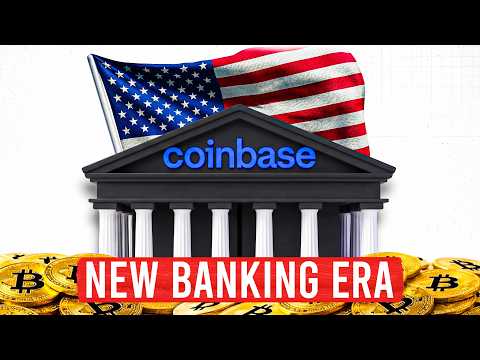
Coinbase Just Became a BANK (Here's What It Means For You)
2 min read

Coinbase Just Became a BANK (Here's What It Means For You)

Coinbase Gets a National Trust License – But Not a Traditional Bank

Coinbase now holds a National Trust Bank charter from the OCC, the federal bank regulator. However, it is not a full-service bank:

  • No accepting deposits, no lending
  • No FDIC insurance
  • Focus: custody of digital assets for institutions (e.g., BlackRock's IBIT ETF)
  • Staking, trading, and financing remain in separate Coinbase entities
Why Bank Lobby Is Suing

The Independent Community Bankers of America (ICBA) sued the OCC, calling the license a "backdoor for crypto into the banking system." The case is pending.

What the License Enables
  • Coinbase can now act as trustee for retirement accounts (IRA/401k) – a massive market
  • Institutional custody will shift from its New York charter to the federal charter within three years, boosting trust among pension funds
  • Similar licenses have been granted to Circle, Ripple, Anchorage, BitGo, and soon Paxos & Fidelity
Remaining Limitations
  • No Federal Reserve account, hence no direct access to Fed payment systems
  • Customer fiat still held at other banks
  • No deposit insurance for crypto assets held in custody
Bottom Line

Coinbase is not becoming a conventional bank, but it has secured a regulated foothold in the U.S. banking system – a remarkable turnaround after years of legal battles with the SEC and other agencies.

December 2026: Don't Miss These Deadlines!
4 min read

December 2026: Don't Miss These Deadlines!

⏰ December 2026: Don't Miss These Deadlines and Saving Opportunities!

December is a crucial month to save money and complete important to-dos. Here are the key points:

  • Retirement Planning: Riester vs. New Retirement Savings Account
    • December 2026 is the last month to open a new Riester contract. From January 2027, it will be replaced by the "Altersvorsorgedepot" (AVD).
    • The AVD is more attractive for most:
      • Higher state subsidies (e.g., up to €540 basic allowance per year instead of €175 for Riester).
      • No guarantee requirement – you can invest in ETFs for better returns.
      • Lower costs due to provider competition.
      • Exception: Families with low income and children (born after 2008) may benefit from a Riester contract, as small contributions (€60/month) activate the full subsidy (up to €775 with two children).
    • Existing Riester contracts remain valid. Three options:
      1. Continue with old terms.
      2. Keep the contract but switch to new subsidies.
      3. Transfer capital to the AVD.
    • Tip: Don't be rushed. Wait until after New Year's, compare providers, and then switch. Sign up for the AVD start list (link in video description) for a free video course.
  • 💶 Save on Taxes
    • Optimize your tax exemption order: Up to €1,000 in capital gains per year are tax-free. Check if your orders across different accounts are allocated correctly. Make changes before New Year's Eve, but not too late – many banks have a December deadline. If changed, your broker will automatically refund overpaid taxes.
    • Apply for a loss certificate: By December 15, you can request a loss certificate from your broker to offset losses in one account against gains in another. This is worthwhile if gains exceed the tax exemption.
    • 2022 tax return: You can still file your 2022 tax return voluntarily by end of December. On average, people received €1,240 back. Don't forget the home office allowance (up to €600) and the increased commuter allowance.
  • 🦷 Dentist: Bonus booklet and dental prosthetics
    • From January 2027, health insurance subsidies for dental prosthetics will decrease (from 60% to 50% without a bonus booklet).
    • Secure the old subsidies:
      • Go for a dental check-up this year to avoid a gap in your bonus booklet.
      • Have a cost plan for dental prosthetics approved by your insurance in 2026 – then the old rate applies even if treatment is in 2027.
  • 🏠 Utility bill
    • Your 2025 utility bill must be received by end of December. If it arrives later, your landlord cannot demand additional payments (unless not their fault). Refunds must still be paid.
    • Heating meters must be readable remotely by year-end. If not, you can reduce your heating cost share by 3%.
  • 🚆 Deutsche Bahn: New timetable
    • From December 13, new connections, e.g., ICE Sprinter Hamburg–Munich (5h 20min) and Berlin–Paris (under 8h).
    • Punctuality: Only 52.4% of long-distance trains were on time. Prices are supposed to remain stable, but super saver fares were more expensive (median +36%).
  • 🇦🇹 Austria: Digital vignette
    • From December, only digital vignettes are available (stick-on vignettes valid until end of January 2027).
    • Buy in December: The annual vignette costs €106.80 (from 2027: €108.90). Purchase possible without internet (provide license plate at gas stations).
Ethereum Made $6 Million in 30 Days. Does That Justify ETH's Price?
2 min read

Ethereum Made $6 Million in 30 Days. Does That Justify ETH's Price?

Analysis of Fundamental Value: Ethereum vs. Solana

This transcript questions whether current market capitalizations are justified by revenue and wallet usage.

Ethereum

  • 30-day revenue: Only $6 million (a bad month; extrapolated to $10M monthly).
  • Annualized revenue: $120M – with a 20x multiplier, value is only $2.4B.
  • Layer-2 hedging: Mentioned as a potential add-on, but still negligible.
  • Wallet analysis:
    • 200M wallets, average 0.1 ETH = 20M ETH held for gas fees.
    • At $2,000/ETH, utility value is $40B.
  • Market cap: $200B – only $40B is quantifiable, leaving $160B of speculation.

Solana

  • 30-day revenue: $1.7 million (rounded up to $5M monthly).
  • Annualized revenue: $60M – with multiplier, at most $5–10B value.
  • Wallet analysis:
    • 100M wallets, average 0.02 SOL = 2M SOL for active use.
    • At $100/SOL, utility value is just $200M.
  • Market cap: $50B – enormous gap.

Conclusion

Both Ethereum and Solana derive most of their value from social sentiment or hope, not from current revenue or active usage. The fundamental metrics fail to justify current prices.

Bitcoin: The Capitulation Spiral
2 min read

Bitcoin: The Capitulation Spiral

The Capitulation Spiral

The host delivers a thorough, cycle-based analysis arguing Bitcoin is deep into its final "Capitulation Spiral" of the midterm year. He directly compares the current downtrend to the market structures of 2015, 2020, and 2022, emphasizing the lack of a sustained breakout above the 200-Week Moving Average.

Key Data Points
  • Price: Dropped below $66k, breaking key support levels.
  • Year-to-Date Performance: Bitcoin underperformed drastically against the S&P 500 (-32%), Gold (-16.5%), and Energy (-48%).
  • Whale Activity: The Whale Activity Dashboard shows no significant accumulation around previous lows (Feb/Summer), suggesting the truly smart money is waiting for the Q4 bottom.
  • On-Chain Risk: Has dropped below 0.2; historical bottoms usually occur below 0.1.
The Cyclical Blueprint
  • Midterm Pattern: Strict adherence to the four-year cycle. Top in Q1, lows in Feb/Summer, and the final Q4 capitulation post-midterms.
  • Fake Outs: Rallies to previous highs lack the “extension” (20-40% surge) seen in true bull markets, making them dead cat bounces.
  • Rate Hike Alignment: The current movement perfectly mirrors the average path after the first rate hike of a hiking cycle (e.g., March 2022). The final low is statistically due around Day 94 (~35 days from recording).
Market Sentiment & Outlook
  • Social Interest: At an all-time low, indicating retail investor capitulation is in full swing.
  • Prediction: One or two more bounces/drops could occur before the bottom is found. The host is cautious about calling a bottom prematurely.
  • Call to Action: Avoid echo chambers. The upcoming conference in Miami aims for respectful, evidence-based discussion.