Nofinity Logo

Latest Analyses(7)

Bitcoin Falls Below the 200 Week Moving Average
2 min read

Bitcoin Falls Below the 200 Week Moving Average

Summary: Bitcoin Falls Below the 200-Week Moving Average

In this video, the speaker analyzes Bitcoin's recent drop below the 200-week EMA (200 EMA) and places it in the historical context of the four-year cycle.

Key Points:

  • First weekly close below the 200 EMA this cycle: The speaker emphasizes that this is not unusual, with similar events occurring in June 2022 and June 2018.
  • The four-year cycle remains valid: Despite current panic, history shows patterns repeat. The speaker warns against prematurely declaring the cycle invalid.
  • Typical market movement in midterm years:
    • Lows often form early in the summer.
    • This is followed by a counter-trend rally in mid to late summer.
    • The final cycle bottom is reached in late Q3 or early Q4.
  • Two types of capitulation:
    • Time-Based Capitulation: The more likely scenario. The market needs time to find a bottom (as described above).
    • Price-Based Capitulation: A massive, sudden sell-off with extreme volume (like the pandemic in 2020). This could bring an earlier bottom.
  • Importance of volume: A significant volume spike, as seen at the end of previous bear markets (2014, 2018, 2022), is currently absent.
  • Strategy:
    • Dollar-Cost Averaging (DCA) in the second half of midterm years has historically worked well.
    • The speaker advises against rigid predictions and recommends remaining flexible. If price-based capitulation occurs, one should adjust their strategy.
  • Comparison to the $60,000 level: The $60,000 level is compared to the $6,000 level in 2018 and 2019 – a strong break below it could signal the final cycle bottom.
  • Final prediction: Most likely scenario: a low in early summer, a rally in mid/late summer, and a final sell-off in Q3/early Q4. Price-based capitulation could bring an earlier bottom.

Conclusion: The speaker remains calm and recommends a long-term, flexible investment strategy. The drop below the 200 EMA is not a reason to panic, but a normal pattern within the Bitcoin cycle.

How Aztec Blockchain Can Flag North Korea's Stolen Funds Despite Being Private
2 min read

How Aztec Blockchain Can Flag North Korea's Stolen Funds Despite Being Private

Summary: How Aztec Blockchain Can Flag North Korea's Stolen Funds Despite Being Private

The video explains how Aztec (a privacy solution for Ethereum) works and how it can prevent illegal transactions without sacrificing privacy.

Core Principle: Trace Money, Not Addresses

  • Aztec does not track user identities (addresses), but the funds themselves – similar to serial numbers on banknotes.
  • The system uses UTXOs (unspent transaction outputs), similar to Bitcoin: funds are divided and combined into
The Most Important Insurance You Should Have...
2 min read

The Most Important Insurance You Should Have...

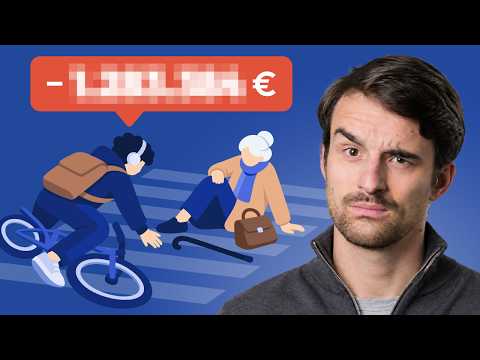
Thomas von Finanzfluss explains private liability insurance, widely considered the most important non-mandatory insurance.

Do you really need it?
  • Yes, it is crucial for protecting against existential risks. Liability claims can quickly amount to hundreds of thousands or even millions of Euros.
  • Passive legal protection: Your insurer defends you against unjustified claims (e.g., the Ingolstadt case).
  • Counterargument: Low probability (approx. 4%). However, for an annual premium of around €50, the risk is too high to bear alone.
What is covered?
  • Property damage, personal injury, and financial loss caused by negligence.
  • Gross negligence (e.g., fire from a forgotten candle) is usually covered.
  • Borrowed or rented items and neighborly favors are included in good policies.
  • Unintentional damages in connection with criminal acts can be covered.
What are the most important features to look for?
  • Loss of recourse coverage: Pays if the culpable party is uninsured or insolvent.
  • Rental property damage: Essential for tenants.
  • Gradual damage: Damage occurring over months.
  • Children incapable of tort: Coverage for damages caused by young children.
  • Sum insured: At least €10 million, preferably €50 million.
  • Key insurance: Covers lock replacement costs (up to €200,000).
  • Best performance guarantee: Policy updates automatically to market standards.
What does it cost and how to save?
  • Price: Great tariffs are cheap. The best single tariff is approx. €41 per year.
  • Single vs. Couple: A couple's tariff is cheaper, but inter-partner damage is often excluded.
  • Deductible: A small deductible protects against policy cancellation for minor claims.
  • Switching: Never cancel your old policy before the new one is confirmed.
  • SCHUFA: If you have negative entries, try AXA or VHV.

Conclusion: Private liability insurance is a fundamental building block of financial security. Low cost, essential protection.

The $250 Billion Copper Crisis is Only Getting Worse | Rick Rule
3 min read

The $250 Billion Copper Crisis is Only Getting Worse | Rick Rule

Buckle up for a masterclass in commodities with veteran investor Rick Rule. He breaks down the structural deficit in copper, the hidden value in streaming deals, and the changing dynamics of the gold and uranium markets.

🚨 The $250 Billion Copper Crisis
  • The industry is facing a massive supply deficit. The top 10 companies globally need $250 billion just to sustain current production levels.
  • Cost inflation is compounding at 8-10% annually, turning that $250B problem into a $375B problem by 2030.
  • Permitting is a nightmare: The Resolution project in Arizona has been in permitting for 28 years. Rick argues the US presents a political risk that can be worse than operating in the Congo.
  • Outcome: Copper will have to be rationed by price unless there is a synchronized global depression.
💰 The Streaming & Royalty Advantage
  • The Big Discrepancy: Cash flows from gold/silver by-products of copper mines are valued at 15-16x EBITDA. The exact same cash flows defined as pure copper revenue are valued at only 5-7x EBITDA.
  • This massive gap allows for enormous, win-win transactions. The capital hunger of the copper industry will supercharge the deal flow for buying these by-product streams.
  • Warning Shot: Most "me-too" royalty companies lack a durable competitive advantage. They are essentially just overpaying at auctions to win business.
🇮🇳 Gold, Silver & The Asian Engine
  • Rick's strategy: Moved from physical silver to silver mining stocks for better value, downside protection, and upside leverage.
  • Cultural Savings: Western investors sell gold, Asian investors hoard it. Rick shares a compelling anecdote about young, high-earning Indian tech workers in Silicon Valley who exclusively save in physical gold and silver, bypassing dollar-based assets entirely.
  • Taking a stand: The growing Asian middle class provides a massive, structural floor for precious metals, completely separate from central bank buying.
⚛️ Uranium: A Market Revolution
  • Japan's reboot: Public opinion has completely flipped. Japan is actively restarting its nuclear fleet, creating a huge new source of demand.
  • Game-Changing Contracts: The uranium market allows for 30-year fixed-price offtake agreements. This allows miners like NextGen to secure financing and build their own mines, fundamentally changing the bargaining power between developers and legacy producers.

A deeply informative episode highlighting why expertise, patience, and a focus on structural advantages (like streaming) are key in navigating the coming commodity super-cycle.

The Anthropic IPO
3 min read

The Anthropic IPO

📊 The Anthropic IPO: A Comprehensive Analysis

Key Facts:

  • The Anthropic IPO is the second-largest IPO in history by market cap (after SpaceX).
  • Offering price: $83 per share – fully diluted valuation: approximately $1.5 trillion.
  • Launch day: Thursday, similar to the SpaceX IPO.
🔄 Historical Patterns for Major IPOs

The speaker compares Anthropic to previous large IPOs (SpaceX, Tesla, Coinbase, Rivian, Apple). The typical pattern:

  1. Initial surge on launch (often +50% or more).
  2. Sharp pullback (typically around 50% from the high).
  3. Consolidation / basing – often followed by a better entry opportunity.

Examples:

  • SpaceX: +50%, then −53% – slow recovery afterwards.
  • Tesla: +73%, then −50% – then a multi-year sideways phase.
  • Coinbase & Rivian: strong initial spike, then 50% loss, later even lower.
  • Apple: +40%, then drop due to recession – but long-term success.
⚠️ The Speaker‘s Recommendation
  • “Don’t chase the initial hype” – better to wait for the expected pullback.
  • The pullback may occur within a few days to a few weeks after launch.
  • The IPO itself is short-term volatile, long-term promising.
🪙 Impact on Bitcoin and Other Markets
  • Bitcoin shows similar patterns as before the SpaceX IPO: currently weak inflows, sell-off ahead of the IPO.
  • The 21st of the month has recently been a local high for Bitcoin.
  • The next Fed rate decision on December 9 could mark a low point – consistent with the typical IPO pullback (~20 days after launch).
  • Bitcoin‘s RSI is around 24 (oversold), but the speaker warns: “Major crashes can occur from oversold conditions.”
🔭 Outlook
  • December 2026: Possible market low (FOMC, government shutdown), followed by recovery into 2027.
  • 2027: OpenAI IPO is expected – likely similar dynamics.
  • If the IPO does not surge as expected (e.g., drops immediately), that would deviate from the historical pattern.
💡 Conclusion

The speaker expects a surge on the first day, followed by a pullback of about 50% within a few weeks. This pullback would be the more attractive entry point – both for the stock and for Bitcoin, which may undergo a similar correction.

How a 19 Year Old Built Ethereum
4 min read

How a 19 Year Old Built Ethereum

A Teenager's Vision: How Ethereum Revolutionized Blockchain

This video tells the fascinating origin story of Ethereum, a blockchain that goes far beyond digital money.

The Limitations of Bitcoin

  • Bitcoin launched in 2009 as a revolutionary, decentralized monetary system.
  • Its blockchain was deliberately limited and optimized for payments.
  • The scripting language was restrictive (e.g., no loops), making complex applications impossible.
  • Early projects like Colored Coins or Mastercoin tried to extend Bitcoin but hit technical boundaries.
  • Developers needed a more flexible platform to build arbitrary decentralized applications (dApps) without creating a new blockchain each time.

Vitalik Buterin's Path to Ethereum

  • Vitalik Buterin (born 1994 in Russia, raised in Canada) discovered Bitcoin at 17.
  • Initially skeptical, he started writing for Bitcoin Weekly (5 BTC per article) and co-founded Bitcoin Magazine.
  • In 2013, he traveled to learn about projects like Colored Coins and Mastercoin.
  • His "Ultimate Scripting" proposal for Mastercoin was rejected – the trigger to create his own blockchain.
  • In November 2013, at age 19, he wrote the Ethereum Whitepaper in San Francisco.

The Core Idea: A Decentralized World Computer

  • Ethereum is designed as a universal blockchain where developers can program Smart Contracts.
  • A smart contract is an automatically executing program on the blockchain.
  • Example: A secure token swap where the smart contract holds tokens from both parties and only releases them when all conditions are met.
  • Important: Smart contracts are only as secure as their code and need external data sources (oracles) for real-world events.
  • Applications on Ethereum can interact with each other, making the platform a "decentralized world computer".

The Founding Phase and Team (2014)

  • January 2014: Presented at the North American Bitcoin Conference in Miami – received a standing ovation.
  • Eight co-founders, including:
    • Gavin Wood: Developed the first client, wrote the Yellow Paper, and designed Solidity (language for smart contracts).
    • Joseph Lubin: Later founded ConsenSys (developer of MetaMask).
    • Charles Hoskinson: Wanted a for-profit company, left after conflicts (later founded Cardano).
  • July 2014: Founding of the non-profit Ethereum Foundation in Switzerland – a decision for the open-source approach.

Technical Milestones: EVM, Gas, and Ether (ETH)

  • The Ethereum Virtual Machine (EVM) executes smart contracts and ensures determinism across the network.
  • Gas is the fee unit for computational work. Complex transactions consume more gas.
  • Ether (ETH) is the native cryptocurrency used to pay transaction fees.
  • Initially, Ethereum used Proof of Work (mining) but switched to Proof of Stake in September 2022.

The Crowdsale (July-September 2014)

  • Duration: 42 days; payments in Bitcoin only.
  • Price: 2,000 ETH per BTC in the first 14 days, dropping to 1,337 ETH.
  • Result: 31,600 BTC (approx. $18.4 million) raised.
  • Distribution: 60 million ETH to buyers, 12 million ETH for development and early contributors (total 72 million ETH).
  • Buyers funded unfinished software – a significant risk.

From Testnet to Live Launch (2015)

  • Olympic Testnet: Developers tested the software and received rewards (up to 25,000 ETH) for finding bugs.
  • Frontier: The first live version of Ethereum, intentionally designed for developers (no user-friendly interface).
  • Launch on July 30, 2015 with a temporary gas limit of 5,000 units (a simple ETH transfer requires 21,000) to give miners time to set up.
  • The Genesis Block marked the network's start.
Conclusion and Outlook
  • Ethereum's success was not guaranteed: The DAO hack of 2016 (3.6 million ETH stolen) nearly split the network.
  • The story continues in Part 2.

In summary: The vision of a 19-year-old became a groundbreaking technology that transformed blockchain from a mere payment system into a platform for decentralized applications.

Essentials: Nicotine's Effects on the Brain & Body & How to Quit Smoking or Vaping
2 min read

Essentials: Nicotine's Effects on the Brain & Body & How to Quit Smoking or Vaping

This transcript summarizes key insights about nicotine, its effects on the brain and body, and how to quit smoking or vaping. Here are the main points:

Neurochemical Effects of Nicotine
  • Dopamine release in the mesolimbic reward pathway → boosts motivation and well-being.
  • Increased acetylcholine → enhances focus and concentration.
  • Norepinephrine release from the locus coeruleus → increases alertness and energy.
  • Appetite suppression via activation of POMC neurons in the hypothalamus, plus a slight metabolic increase (2–5%).
Negative Health Effects
  • Smoking & vaping damage endothelial cells, contain thousands of toxins, and are highly carcinogenic (oral, lung cancer, etc.).
  • Cigarettes reduce life expectancy by about 14 years per daily pack.
  • Nicotine itself is not carcinogenic, but the delivery method (combustion, tar) causes severe harm.
Specifics of Vaping
  • Faster rise in blood nicotine compared to cigarettes → steeper dopamine curve increases addictive potential.
  • Vaping is associated with higher dependence and more difficult cessation than cigarette smoking.
  • Especially young people (under 25) are at risk; nicotine can impair brain development.
Quitting Methods
  • Hypnosis (by Dr. David Spiegel) – success rate about 23% after a single session.
  • Bupropion (Wellbutrin) – increases dopamine and norepinephrine, success rate also about 20%, but risk of seizures (prescription only).
  • Nicotine replacement therapy (patches, gum, spray) – best used in rotation (about one week per form) to avoid tolerance.
  • Self-help – only 5% success; first week is critical (relapse rate 75%).
  • Healthy dopamine sources like cold showers or exercise can ease withdrawal; alcohol should be avoided (increases relapse risk).

In summary: Nicotine is a powerful psychoactive molecule acting through dopamine, acetylcholine, and norepinephrine. The health risks are enormous, especially from smoking or vaping. A combination of behavioral therapy (e.g., hypnosis) and pharmacological aids can significantly improve quitting success.