Nofinity Logo

Latest Analyses(7)

Bitcoin: Die Haltefrist wird fallen! - 25% Crash am Aktienmarkt?
4 min read

Bitcoin: Die Haltefrist wird fallen! - 25% Crash am Aktienmarkt?

📊 Bitcoin & Crypto Market: Recovery with Obstacles
  • Bitcoin is trading below $63,000 and shows initial green signals. The 200 EMA (Exponential Moving Average) is a strong resistance – a breakout could lead to a recovery towards $74,000.
  • Short-term a recovery rally is possible, but a Hot Crypto Summer remains unlikely. The market may consolidate sideways, and deeper lows ($55,000–$50,000) are not ruled out.
  • Realized P/L Ratios have turned negative for the first time in a long while – a signal that historically indicated a bottom, but currently no sustainable trend reversal.
đŸ›ïž German Tax Policy: Holding Period to Be Abolished?
  • The German Ministry of Finance plans to tax crypto gains as capital assets (25% withholding tax). The holding period would be eliminated – affecting long-term investors.
  • Key details are missing: effective date, grandfathering, loss offsetting. No concrete bill exists yet. The announcement is legally questionable as Bitcoin was classified as non-equity-like by the Federal Fiscal Court in 2023.
  • No rush to action – developments are to be watched. A separate video with a tax expert is planned.
đŸ‡ș🇾 Clarity Act & MiCA: Regulatory Deadlines
  • Clarity Act (USA): The last chance for a Senate vote is August 7 before the summer break. Chances are slim, which could weigh on the crypto market.
  • MiCA (EU): The transition period has ended. Some platforms are restricting services, others operate normally. Regulated exchanges (e.g., Kraken) are a safe alternative for fiat on/off ramps and tax compliance.
📉 Stock Market: Correction Risk Despite Bull Market
  • The S&P 500 is near all-time highs, but market breadth is weakening. Tech stocks (especially semiconductors) show extreme volatility with double-digit percentage swings – reminiscent of the dot-com bubble.
  • Michael Barry warns of a bursting bubble. A 25% correction is discussed, but a rebound after the correction is possible as long as corporate earnings remain strong.
  • Korea: Overleveraged positions in chip stocks (Samsung, SK Hynix) could trigger a shockwave. The KOSPI index is extremely volatile.
đŸ’Œ Portfolio Update & Strategy
  • The speaker is 90% in cash (money market + cash) and monthly invests in an ACWI ETF (MSCI All World). Larger corrections would be used to buy the dip.
  • Individual stocks like Lumentum (−20%) are underperforming, while Marvell and Micron have gained from dips. The strategy is long-term (10–15 years).
🔍 Macro & Altcoins
  • US labor market data disappointed: only 60,000 new jobs (expected 110,000). The unemployment rate fell – contradictory signals. Rate cuts remain unlikely for now.
  • Altcoins: Lido (+70% in 30 days) due to tokenomics changes, Hyper Liquid above $70. A DeFi hack ($6M at Summer.fi) highlights ongoing security risks.
  • The Crypto Fear & Greed Index recovered slightly from deep fear but remains neutral. Demand is at lows – without a new impulse, no sustainable bull run.
⚠ Conclusion

The crypto market remains in a bear market, but recovery jumps are possible. Regulatory developments (Germany, USA, EU) are crucial. Caution is advised for stocks – a correction could also drag crypto down. Long-term strategy and cash reserves are currently the safest approach.

Google’s Plan to Bring Wall Street Onchain | Rich Widmann
2 min read

Google’s Plan to Bring Wall Street Onchain | Rich Widmann

Google’s Focus on B2B Infrastructure for Digital Assets
  • Google focuses on B2B enterprise infrastructure, not retail crypto. The Digital Assets team is part of Google Cloud.
  • Started as a "skunk works" project in 2019, the team evolved from Web3 to digital assets as a horizontal technology platform for financial services.
  • Key insight: Google doesn't compete on network effects like public L1s but builds products for existing institutional relationships.
Universal Ledger (GCUL) – The Institutional Blockchain
  • GCUL is Google’s own blockchain, designed for high throughput and global distribution, targeting regulated institutions.
  • Key partnerships: CME (24/7 derivative settlement) and Jack Henry (enabling community banks to use tokenized deposits via their core banking provider).
  • Business model: transaction fees and API calls – not tied to Google Cloud.
  • Goal: move tokenized deposits (not stablecoins) into mainstream finance, leveraging existing trust structures.
Google MPC – Multi-Party Computation for Custody
  • MPC allows key signing without a single point of failure; key shards are stored in Trusted Execution Environments (TEE).
  • Google offers this as an infrastructure layer to custodians like BitGo, Fireblocks, or Coinbase – it's not a regulated custodian itself.
  • Post-quantum cryptography is already embedded, as quantum computers may soon break current algorithms (ECDSA).
Future Outlook
  • Agentic commerce: Tokenized money on blockchains will become crucial for AI agents – instant settlement and combined data/value streams.
  • Quantum computing: Google has its own quantum team and is preparing post-quantum signatures – a major collective-action problem for protocols like Bitcoin.
  • Everything apps: Tokenization allows trading stocks, commodities, prediction markets, and cash on a single ledger – enabling new fungibility and automated arbitrage.
Claude Tested 10,000 Trading Strategies (Only These Won)
3 min read

Claude Tested 10,000 Trading Strategies (Only These Won)

Video Summary: 10,000 Trading Strategies Tested – Only These Won

In this video, YouTuber Mars Deutsche tests 10,000 real trading strategies against 10,000 random strategies on cryptocurrency markets using Claude Code (an AI coding tool). The goal: identify strategies that genuinely work – not just lucky ones.

Methodology
  • Data: 5 high-volume crypto assets (Bitcoin, Ethereum, Solana, XRP, BNB) from January 2019 to November 2026. Source: Binance.
  • Strategies: 50 popular real strategies across 6 categories – Trend (e.g., moving averages), Breakout (Donchian, Turtle), Momentum (RSI, Awesome Oscillator), Mean Reversion, Volatility, and Volume. Each tested with 10 different parameter settings on daily and 4-hour charts – totaling 10,000 backtests.
  • Random Twins: To separate skill from luck, each strategy gets a „random twin“ – same number of trades and holding periods, but random entry/exit. Average of 10 twins per strategy.
  • Fairness: Tests run only on out-of-sample data. Exchange fees are included.
Results
  • Real strategies outperform randomness: 73 out of 100 real strategies beat buy-and-hold, versus only 60 out of 100 random ones.
  • 6 filters separate the best from the rest:
    1. Outperform buy-and-hold
    2. Maximum drawdown below 50%
    3. No overfitting (at least 50% performance on test data vs. training data)
    4. Minimum 20 trades
    5. Parameter stability – strategy must remain profitable with neighboring settings
    6. Significantly better than its random twin
  • After filtering, 770 real strategies remain – but only 396 random strategies.
Best Strategy Type

Breakout strategies perform best: 13 out of 100 pass all filters – twice as many as random (6 out of 100). Trend and volume strategies also show strong results.

The Final Strategy

The creator builds a new strategy from the 8 breakout strategies (each with 10 settings = 80 variants). These 80 are applied to all 5 coins: each votes to buy, short, or stay out. A Bitcoin 200-day moving average controls market direction – only long when BTC is above its average, only short when below.

Final Strategy Performance:

  • Starting with $10,000 in 2019, the strategy grew to $145,000 (blue line). For comparison, a random strategy achieved at most $36,000.
  • Maximum drawdown: 41% (vs. 78% for buy-and-hold).
  • In 2022 (crypto bear market, down 64%), the strategy gained 31%.
  • Risk-adjusted returns (Sharpe ratio) are clearly superior to buy-and-hold.
Key Takeaways for Traders
  • Don't blindly chase the single best backtest result – it's often just lucky.
  • Breakout strategies offer the most statistically significant edge over randomness.
  • The final strategy provides a risk-adjusted approach to long-term crypto investing with moderate drawdowns.
  • All data, methods, and results are available for free in the creator's school community.

Bottom line: Always validate trading bots with thorough backtests and randomness comparisons – avoid relying on pure luck.

Gavin Baker on Why Jensen Matters So Much to Nvidia
2 min read

Gavin Baker on Why Jensen Matters So Much to Nvidia

Interview with Gavin Baker on NVIDIA and AI Semiconductors

In this conversation from the TomorrowX Summit, tech and semiconductor investor Gavin Baker discusses Jensen Huang's importance to NVIDIA, market trends, and the future of AI.

Jensen's Return as CEO
  • Baker estimates the probability of Jensen's return is much higher than 10% – the market underestimates it. He expects Jensen to be cleared by Congress, and shareholders overwhelmingly support him.
  • Despite strong quarterly results, NVIDIA's stock fell after Chairman Harvey Jones ruled out reinstating Jensen. Baker sees this as shareholders voting with their feet.
  • Not a single shareholder, employee, or partner Baker spoke to wants Jensen gone.
Semiconductor Market and AI Investments
  • Chip stocks have declined despite solid earnings (e.g., NVIDIA +4% pre-earnings). Reason: fears about ROI on massive AI capex (estimated $1.5 trillion). Many analysts only count ~$120–150B ARR from major AI firms.
  • Baker criticizes this calculation: it ignores fast-growing private companies, open-source models driving compute demand, and 6,500 on-premise GPU clusters mentioned by Michael Dell.
  • The AI buildout resembles 19th-century railroad expansion more than typical semiconductor cycles. The second derivative of investment growth has peaked, but long-term demand remains robust.
Competition and Jensen's Role
  • Jensen was NVIDIA's driving force behind technology and supply chain relationships (built over 30 years). His departure weakens NVIDIA significantly and is a windfall for competitors like Broadcom.
  • Without Jensen, Asian suppliers may gain pricing power.
Risk Scenarios and Opportunities
  • Key risk: Diminishing returns from superintelligence – if smaller models match large ones, compute demand could slow. However, GPU rental prices are rising and models are making scientific breakthroughs (e.g., Navier-Stokes), indicating ongoing value.
  • Opportunities: Many semiconductor stocks trade at low valuations despite gaining market share and having strong moats. Baker recommends focusing on companies with rapid growth and low multiples.
Conclusion

Despite short-term turbulence, Baker remains bullish: AI is becoming more economically useful, and token demand elasticity is positive. Investors should look beyond typical cycles and take a long-term view.

Pagani V12 Heaven: Utopia, Zonda & Huayra Driven!
3 min read

Pagani V12 Heaven: Utopia, Zonda & Huayra Driven!

Summary: Pagani V12 Heaven – Utopia, Zonda & Huayra Driven

This video offers an exclusive drive featuring three generations of Pagani roadsters: the Zonda F Roadster, the Huayra Roadster HP, and the brand-new Utopia Roadster. The film traces the evolution of the brand, from the Zonda's origins to the current Utopia, showcasing how Horacio Pagani has realized his vision of perfection.

The Cars in Detail:

  • Pagani Zonda F Roadster (2006):

    • Engine: 7.3-liter V12 (Mercedes-AMG), 650 hp, 6-speed manual.
    • Characteristics: Lightweight (1,230 kg dry), pure, analog driving experience. The start of the Pagani legend.
    • Conclusion: A masterpiece of lightweight construction with stunning sound and direct feel.
  • Pagani Huayra Roadster HP (Horacio Pagani’s personal car):

    • Engine: 6.0-liter twin-turbo V12 (Pagani-branded), approx. 800 hp (BC spec), 7-speed sequential with paddle shifters.
    • Characteristics: Extreme, aggressive, technically more refined than the Zonda, but less pure.
    • Conclusion: A wild, intense experience with overwhelming power and aggressive character.
  • Pagani Utopia Roadster (2024):

    • Engine: 6.0-liter twin-turbo V12, 864 hp, 7-speed manual (dog-leg first gear).
    • Characteristics: Combines the Zonda's lightness with Huayra's power. Beautiful, clean design and everyday usability.
    • Conclusion: The pinnacle of Pagani's philosophy – a return to the essence of driving, paired with modern technology.

Historical Context:

  • Zonda (1999-2011): The meteor that reinvented the supercar world. Lightweight, naturally aspirated V12, manual transmission – an unforgettable experience.
  • Huayra (2012-present): Technological progress with turbochargers, but initially a bit overdone. Later versions (like this HP) are fantastic, however.
  • Utopia (2022-present): A return to purity. Manual transmission, lightweight, clean design – the perfect synthesis of all Pagani virtues.

The Verdict: Which is the Greatest Pagani Roadster?

  • Zonda F Roadster: The winner from an emotional standpoint. The purest and most immersive experience.
  • Huayra Roadster HP: The surprising dark horse. Extremely intense and fast.
  • Utopia Roadster: The most balanced choice. Offers the best combination of driving fun, performance, and daily usability.

Conclusion: All three are unique. The choice depends on personal taste: Zonda = Purity, Huayra = Extremes, Utopia = Perfection.

Metric Conversions (from original imperial units):
  • 1,230 kg dry weight (approx. 2,710 lbs)
  • 7.3 liters displacement
  • 6.0 liters displacement
  • 650 hp (kW: 478)
  • 800 hp (kW: 589)
  • 864 hp (kW: 636)
Is the MARO the Best Home Espresso Machine?
3 min read

Is the MARO the Best Home Espresso Machine?

Lance Hedrick provides an in-depth review of the Maro Model One espresso machine, highlighting its €4,999 price and innovations. Built by two young entrepreneurs from about 430 locally sourced components.

Build & Design
  • Materials: Hi-Max (mineral-based acrylic composite) body, anodized aluminum top (~2 kg), stainless steel drip tray and water tank. Total weight: ~30 kg.
  • Criticisms:
    • Power switch: Feels spongy, requires precise pressure.
    • Water tank: Requires an Allen key to remove; otherwise, it gets stuck.
    • Drip tray: Sharp edges and water splashes during transport.
Brew Group & Heating System
  • Brew group: 58 mm, E61-compatible, with a thick-film heater (2,300 W) – no boiler, but an in-line heater.
  • Heat-up time: ~3–4 minutes to idle, then rock-solid temperature.
  • Energy consumption: 0.06 kWh per 2 shots – only the Zuriga is better (0.058 kWh). For comparison: Lelit Mini R uses 0.38 kWh, Ascaso Steel Duo 0.12 kWh.
Pump & Flow Control
  • Rotary pump (Fluid-o-Tech), extremely quiet – almost as quiet as lever machines.
  • Closed-loop system with flow meter and pressure sensor at the brew head, using PWM to precisely control flow and pressure.
User Interface & Profiles
  • Three modes: Explorer (simple), Expert (intermediate), Extreme (advanced).
  • Explorer: Shot Saver adjusts flow, Grind Analyzer gives feedback. Volumetric is precise (±1.5 g), with a Bluetooth scale even to 0.1 g.
  • Expert: Settings for pre-infusion time, temperature, brew pressure, dose, and yield.
  • Extreme: Multi-step profiles with flow/pressure targets and exit conditions (time, weight, pressure). Criticism: UI less intuitive than Decent, no curve smoothing, only linear steps. Recipes are sorted by roaster, only 3 pinned profiles visible.
Steam & Hot Water
  • Steam wand: PTFE plastic, cool to the touch. Optional stainless steel upgrade for €39. Steam is wet but functional.
  • Hot water: Some presets, but the spout drips and splashes – room for improvement.
Customer Service & Updates
  • WhatsApp support from the founders, response time usually <24 h.
  • Regular software updates (via YouTube, German only), current software is up-to-date.
  • Retrofit kit for direct water connection available (only for black model at no extra cost).
Taste Tests
  • Dark roast: Initially ground too coarse, Shot Saver corrects the flow. Result: sweet, low bitterness, good crema.
  • Light roast: With Goopy Lever profile at 88 °C: nectarine, tropical fruit juice – extremely thick texture. Ratings: Sweetness 4/5, Acidity 5/5, Bitterness 1/5, Body 4/5.
Conclusion & Comparison
  • Strengths: Energy-efficient, extremely quiet, precise temperature, versatile profiles.
  • Weaknesses: Tank removal cumbersome, sharp edges, UI could be more intuitive, hot water spout messy.
  • Competition: Decent (stronger community, dynamic temperature profiling, but louder). Unica Pro (quieter, better steam, but older tech). Lance would choose Decent if he could keep only one machine.

Verdict: A premium machine with innovative technology, ideal for energy- and noise-conscious users and those who love to experiment.

Is Bitcoin DEAD?
2 min read

Is Bitcoin DEAD?

📉 Bitcoin Crash and Capitulation
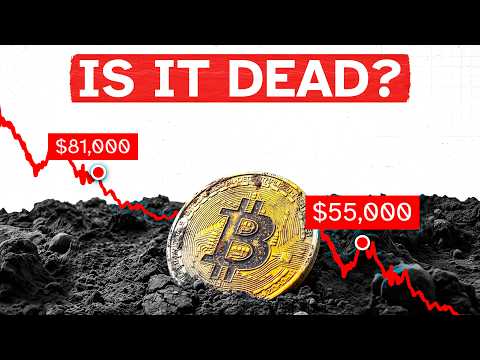
  • Bitcoin dropped to $55,000 over the weekend – its lowest since September 2024. Triggered by a liquidation cascade: over $2.7 billion in leveraged positions were forcibly closed within 24 hours (the 11th largest such event).
  • The crash began with a Nasdaq decline and hit concentrated long leverage near $60,000. When that level broke, sell-offs triggered further liquidations.
🔍 Who Sold and Why?
  • Short-term holders (cost basis ~$74,100) realized losses of over $11 billion in the crash week – about eight times more than profits. This is considered capitulation.
  • Macro pressure: Markets expect a Fed rate hike in December, with 10-year Treasury yields near 5%. This weighs on risk assets like Bitcoin.
  • Who bought? The Saturday recovery was driven mainly by short liquidations (longs were barely active). Wall Street ETFs saw $3.5 billion in outflows in November, stablecoin reserves shrank by $16 billion.
📊 Is the Bottom In?
  • The realized price (average cost of all coins) is $53,700. Bitcoin stopped just above it – a historically important support line.
  • Glassnode cites two signals for a true bottom:
    1. A renewed increase in stablecoin supply (fresh capital).
    2. A reclaim of $74,100 (the entry price of recent buyers).
  • Conclusion: Bitcoin is not dead, but a sustainable recovery requires new buyers. As long as capital flows out, the market remains vulnerable.

Author's view: The forced selling is over, but real buyers have yet to return.