
Peter Attia MD|10. Aug.
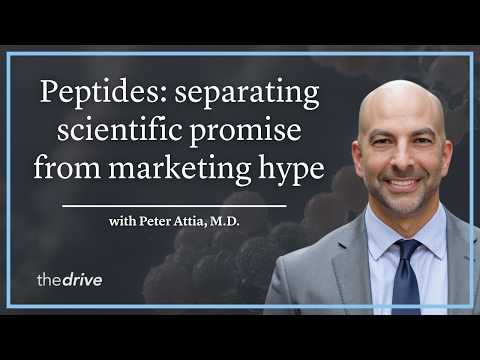
403 ‒ Peptides: separating scientific promise from marketing hype
Summary: Peptides – Separating Science from Hype
In this episode of The Drive, Peter Attia explores the controversial world of peptides. He provides a framework to critically evaluate them, distinguishing legitimate science from marketing hype.
What Are Peptides?
- Short chains of amino acids – the term alone says nothing about safety or efficacy.
- Often marketed as "natural," but most are synthetically modified (e.g., longer-acting, tighter binding).
Evaluation Framework (5 Questions):
- Plausible mechanism of action? – Defined molecular target and downstream effects?
- Evidence of meaningful benefit in humans? – Randomized controlled trials (RCTs) available?
- Known safety, dosing, pharmacokinetics? – How does it enter circulation, how long does it last, what are the risks?
- Does the likely benefit justify the risk for this individual? – Is the risk acceptable given the expected benefit?
- Are there better-characterized alternatives? – Why not use an approved, well-studied drug instead?
Three Categories of Peptides:
- Category 1: Scientifically unsupported – No validated mechanism, no human evidence.
- Example: BPC‑157 – No known receptor, no published RCTs, >80% of studies from one group with financial interests. Claims have expanded for 30 years without answering basic questions.
- Category 2: Biologically plausible, but no clinical evidence – Mechanism conceivable, but no demonstrated improvement in patient-relevant outcomes.
- Example: CJC‑1295 – Increases GH/IGF‑1, but functional benefits (strength, recovery) in healthy individuals are unproven. The drug was abandoned by its developer.
- Category 3: Scientifically legitimate molecules – Efficacy proven for specific indications.
- Example: GLP‑1 agonists (e.g., semaglutide) – Effective for obesity/diabetes, but evidence applies only to the specific tested product, not gray-market copies.
Anecdotes vs. Evidence
- Subjective success stories are often confounded by placebo effect, regression to the mean, or concurrent interventions (exercise, diet, other drugs).
- Randomized controlled trials isolate the molecule's effect from expectation.
FDA and the Gray Market
- FDA approval provides information on efficacy, safety, dosing, manufacturing quality, and post-market surveillance.
- Gray-market peptides bypass these standards: unknown pharmacokinetics, uncertain purity, lack of batch consistency.
- Even with identical sequence, a gray-market product is not equivalent – manufacturing processes alter drug properties.
- Many gray-market peptides were abandoned during pharmaceutical development (e.g., CJC‑1295, because tesamorelin had better data).
Conclusion
- Peptides are a legitimate and powerful drug class (insulin, GLP‑1).
- The hype around gray-market peptides is often unjustified: claims are not falsifiable, evidence does not precede use.
- For healthy individuals, the bar should be high: only use if there is a clear indication, proven benefit, and controlled quality.
- Evidence should come before use – not the other way around.