Nofinity Logo

Latest Analyses(7)

How To Become Dangerously Self-Educated (with AI)
2 min read

How To Become Dangerously Self-Educated (with AI)

🎓 The 'University in a Box' – Become Dangerously Self-Educated with AI

This video presents a revolutionary learning system that lets you teach yourself any topic completely for free. The core is the ALTER framework – five roles an AI can take on for you.

🧭 The Five AI Roles (ALTER)
  1. Advisor: Creates a personalized learning plan in 5 steps: destination, baseline, sequence, cut list, and milestones. Example prompt for a 6-week course creation including interview.

  2. Librarian: Protects against distraction and bad sources. Finds the 10 most important resources (e.g., with Notebook LM) and turns them into podcasts or summaries.

  3. Tutor: Closes knowledge gaps by asking targeted questions. Uses voice modes (ChatGPT/Gemini) to check understanding and eliminate confusion ('Teach me & test me').

  4. Editor: Improves your output by giving critical feedback on logic, structure, and precision – like a real-time coach.

  5. Roommate: Broadens your horizons by offering unexpected perspectives outside your field (e.g., connection between cooking and finance).

🔧 Automation with Zapier

The system becomes practical: Via Zapier MCP, you connect your AI plan with everyday apps like Google Calendar and Docs – AI creates study schedules and sends reminders.

Key message: The best education is the one you start rowing in. The AI tools are ready – use them!

Where Did Binance's Stolen $6 Billion Go?
2 min read

Where Did Binance's Stolen $6 Billion Go?

  • On October 29, approximately $6.3 billion in cryptocurrencies were stolen from Binance’s hot wallets. The theft itself took minutes, but the subsequent money laundering is a highly complex process that continues to this day.
How the Theft Happened
  • The attack exploited a vulnerability in Binance’s internal wallet signing service and the Ethereum function EIP-7702 to execute batch transactions.
  • Access was gained via an infected Homebrew installer at a developer’s machine – preparations began months before the theft.
The Stablecoin Challenge
  • A large portion of the haul consisted of USDT and USDC, which can be frozen by their issuers (Tether, Circle).
  • The thieves quickly converted the stablecoins into uncensorable assets like ETH using lending protocols (Aave, JustLend) and decentralized exchanges. This resulted in slippage losses of about $40 million.
  • Tether, Circle, and Ripple froze around $3 billion – but the rest was already out of their reach.
The Money Laundering Machine
  • 36 hours before the theft, operator wallets were funded via Tornado Cash to obscure the origin of funds.
  • After the theft, an automated system distributed the funds across 11 blockchains and 12,000 wallets in over 40,000 transactions within four days.
  • For cross-chain transfers, Thorchain was used – the FBI tried to get nodes to block addresses, but Thorchain only paused briefly due to a technical glitch.
Tracking and Setback
  • Investigators (FBI, Chainalysis, Elliptic) tracked the transactions in real time.
  • Chainalysis, the primary tool for authorities and banks, was hacked at the same time – customer information was leaked, and the “Reactor” tool was taken offline temporarily.
  • Currently, about $3.3 billion are still in motion, being shuffled hourly across multiple blockchains to further obscure the trail.
Conclusion
  • The perpetrators (likely a North Korean group) have built a highly automated system that continuously moves the funds to evade tracking.
  • Whether authorities can recover the money before it reaches the banking system remains uncertain – the race is still ongoing.
Bets Update - Buy and Forget: KSPI, maybe MELI, most is blah (even BRK)...Apart some crazy bets...
3 min read

Bets Update - Buy and Forget: KSPI, maybe MELI, most is blah (even BRK)...Apart some crazy bets...

Introduction: Portfolio Update in the Value Quadrant

In this video, Sven reviews the remaining positions in his Value Investing Quadrant, providing an update on his current bets.


1. Mercado Libre (MELI): Value Case or Deep Dive?
  • The operating cash flow is massive ($12B per year), making the stock look incredibly cheap at first glance.
  • Analysts are already predicting an EPS of 75, leading to a P/E ratio of 20.
  • Caveat: Sven warns of the "StoneCo syndrome" (down 90%). He requires a deep dive before making any recommendation.
  • Verdict: Interesting, but no buy recommendation yet.

2. Kaspi (KSPI): The Undisputed Favorite
  • Sven is highly bullish: "The best fintech in the world."
  • Growth of 17% with strong dividends ($2.2/share).
  • The strategy is Buy and Forget: Trust CEO Lomtadze and let it ride for 5–10 years.
  • Sven owns KSPI and relies on the portfolio theory (Pabrai style): A few massive winners will offset the losses from other bets.

3. Berkshire (BRK): Safety Comes at a Price
  • BRK is a business fortress (+18% in the last month, $45B in operating income).
  • BUT: The market cap of $1.24 trillion far exceeds the intrinsic value of ~$800 billion. Sven considers it expensive.
  • Critique: The aggressive EBITDA calculations at Bending Spoons (including expected cost savings) raise eyebrows ("Charlie Munger is spinning in his grave").
  • Verdict: Great business, but currently unattractive for value investors (5–6% yield vs. 10% historically).

4. The Bets: Turnarounds and Risk
  • Nike, Lululemon, Deckers: Fallen stocks with solid P/E ratios. More of a bet on a recovery than a clear value investment.
  • China (Kuaishou, Alibaba, PDD, Q Fin): Sven describes the sector as "ugly." Political risks and regulatory uncertainty make it a gamble.
  • Charter Communications: A classic turnaround bet. A free cash flow of $5B could mean a double-up. Failure to meet targets means debt takeover.
  • Pabrai & Oil: Being watched closely.

Conclusion & Portfolio Strategy
  • Sven is working on a diversified portfolio of roughly 15 positions.
  • The current market makes it hard to find true certainty; many stocks are still in the research phase.
  • The video reinforces the philosophy that risky bets can eventually evolve into solid value investments.
Should Ethereum Tax Its Apps Like a Nation? Arca's Jeff Dorman Says It Has To
2 min read

Should Ethereum Tax Its Apps Like a Nation? Arca's Jeff Dorman Says It Has To

This discussion centers on the fundamental valuation of Ethereum: Should ETH be treated like a corporate stock or the currency of a nation?

Vitalik's Stance: Decentralization over Fees
  • Vitalik Buterin warns against optimizing solely for fee burning.
  • He argues that prioritizing fees would require compromises on censorship resistance and decentralization.
  • A drop in ETH's price would also diminish the profits of applications built on top (e.g., the Otherdeed NFT sale), as users would have less capital.
  • If Ethereum were run purely to maximize revenue, it would function like a global conglomerate (rank 55, L'OrĂ©al), losing its core innovation.
Jeff Dorman's Counterpoint: The Blockchain as a Nation
  • Dorman reframes the debate: Is a blockchain a corporation or a nation?
  • The Nation Model:
    • A new island has purely speculative value.
    • Real value comes from investing in infrastructure, businesses, and citizens.
    • The key driver of value for a nation is tax revenue derived from this economic activity.
  • The Blockchain Dilemma:
    • Ethereum and Solana host massive economic activity but fail to tax the applications generating this value.
    • In a closed ecosystem, the value of the currency wouldn't matter much.
    • However, the reality is an open ecosystem where projects, liquidity, and users fluidly migrate between different chains (e.g., RWA tokenization happening across multiple platforms).
  • The Consequence:
    • If the native token cannot extract value from the network's economic growth (no taxation), its valuation behaves like a speculative stock.
    • Dorman concludes that a mechanism for value capture (analogous to taxes) is necessary for the token's value to be sustainably tied to the network's success.
Conclusion of the Debate

The conversation highlights a fundamental tension in blockchain economics. Vitalik prioritizes network freedom and openness (decentralization). Darman argues that without economic coupling between network success and token value, the native currency remains purely speculative.

€10,000 → €100,000 Challenge: THIS Stock Exploded Like a Rocket! HERE's What We're Buying NOW!
2 min read

€10,000 → €100,000 Challenge: THIS Stock Exploded Like a Rocket! HERE's What We're Buying NOW!

📊 Portfolio Challenge Update: 23.6% Invested – Battling a Tough Market Environment
  • Current Status: Starting capital of €10,000 at ±0% (slight gains after fees). Benchmark Bitcoin is −15%, so the portfolio is outperforming.
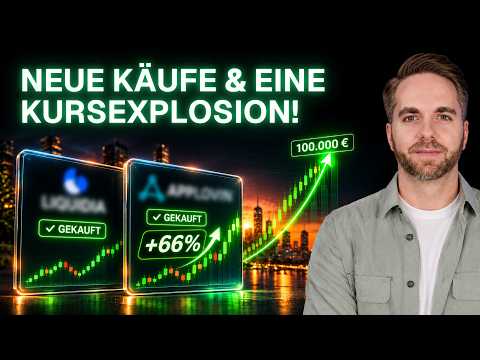
  • New Purchases: AppLovin (bought more after strong earnings, +60% pre-purchase gain), Liquidia (missed earlier entry, now bought in, focusing on biotech turnaround).
  • Existing Positions: ServiceNow (weak quarterly results, turnaround uncertain, Q4 will decide), Circle (in the red due to crypto downturn), Hai Group (small position, Chinese risk, slightly positive).
  • Watchlist & Limits: Chronos (limit order active), Critical Metals (rare earths, high risk, max €250), Uranium Energy (downtrend, waiting), Monday.com (new, under analysis).
  • Strategy: Cash is king – only 23.6% invested. Discussing stop-loss rules (35% vs. 50% for moonshots). AI stocks under watch after the crash, but no purchase yet.
  • Community: New Discord channel for fast updates and exchange. Key upcoming events: Nvidia earnings, Entropic IPO.
  • Conclusion: Despite a challenging environment, the portfolio holds its ground. Next buys will be carefully considered – stay tuned!
Buy Nvidia After the Crash? My Decision + Our Additional Purchases // BRIEFING
2 min read

Buy Nvidia After the Crash? My Decision + Our Additional Purchases // BRIEFING

Market Sentiment: Like the Corona Crash of 2020
  • Nvidia collapses, Jensen Huang resigns. The atmosphere mirrors March 2020 – yet the speaker remains optimistic and bought Nvidia during the dip.
Winners & Losers of the Week
  • Winners: Singulus (+100%, SpaceX order), Broadcom, AMD, Cerebras, Modine (Samsung acquisition rumors), Sanmina (+20%).
  • Losers: Nvidia (CEO resignation, -30% from peak), Hims and Hers, Corteva (Brazil -31%), Rheinmetall (peace hopes), Super Micro (Justice investigation).
Bears vs. Bulls: Inflation & AI
  • Bears: Hot inflation data, December rate hike 100% priced in (even 50bps on the table). The AI party is finally over.
  • Bulls: Oil price falling, strong economy (retail +10.1% YoY), retail investor sentiment so negative it historically signals a buy signal. AI has been called dead “100 times” over three years but fundamentals remain strong.
Dossier: Anthropic & Nvidia Decision
  • Anthropic IPO (ANTX): Six times oversubscribed, valuation up to $1.4 trillion. First trading day on November 19th.
  • Nvidia Decision: Pros: Fundamentals are explosive (13× expected earnings), chips in high demand, geopolitical relevance. Cons: Without Huang, the strategist is missing, political risks (chip smuggling). My verdict: Despite high risks, I bought Nvidia on Friday – the market has already released a lot of pressure (Tech P/E nearly halved, similar to March 2020 buying opportunity).
Personal Purchases & Outlook
  • My Buys: TSMC, Broadcom (+20%), Celestica (+17%), SpaceX (new entry).
  • Team Portfolio: TSMC, Fujikura, Creador, Samsung, Air Test Systems (all in the green).
  • Promotions: Advent Calendar (prizes >€6,000), 13F Holding Strategy (free report coming shortly), Daily Briefing free trial until Nov 30th.
  • Next Week: Anthropic deep dive, exciting interview, and 13F update.
Should Ethereum Tax Its Apps to Prove Its Security Is Worth It?
2 min read

Should Ethereum Tax Its Apps to Prove Its Security Is Worth It?

This transcript puts a provocative idea on the table: Should Ethereum tax the apps built on it to prove its security is actually worth the cost? The speaker challenges the foundational value propositions of the ETH token.

Challenging the "Store of Value" Thesis
  • The speaker dismisses Vitalik Buterin's vision of ETH as a Store of Value as a fallacy. Bitcoin is framed as a one-in-a-billion fluke ("immaculate conception"), not a replicable standard. Without assuming the dominance of Ethereum over all other blockchains, the store of value argument for ETH collapses.
The Call for Quantification
  • A major critique targets the inability of Ethereum proponents to quantify the value of the token. The fundamental question is asked: How many apps, transactions, or stablecoins need to exist on Ethereum before the token itself gains intrinsic value? Answers allegedly remain vague, focusing on protocol quality rather than token value accrual.
The Hyperliquid Model and the Tax Solution

Hyperliquid is highlighted as a successful L1 model because it captures value directly through its native DEX and stablecoin distribution.

  • Hindsight Option: Ethereum should have built its own native stablecoin and DEX.
  • Current Proposal: Tax the apps. If Ethereum's security is as invaluable as claimed, applications should be willing to pay a tax to use it.
  • The Litmus Test: The tax rate determines reality. If apps stay and pay, security is proven. If they migrate to cheaper chains, the security premium is exposed as a commodity.
Conclusion

The proposal serves as a financial litmus test for the value creation of the Ethereum network. It moves the debate from philosophical visions to raw market consent.