
Coin Bureau|11. Juli
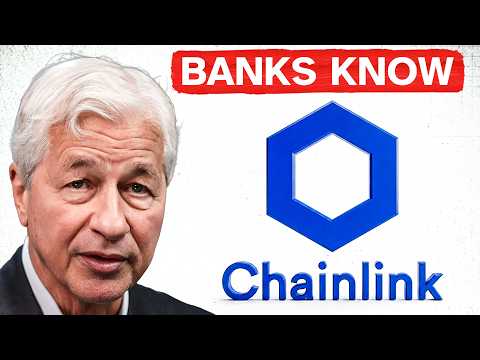
Why BIG BANKS Are Betting On Chainlink
Wall Street's Big Bet on Chainlink
Despite the LINK token trading far below its all-time high, the world's largest banks and institutions are heavily betting on Chainlink's infrastructure. Why? Because Chainlink has evolved beyond a simple oracle into the crucial bridge between traditional finance and blockchain.
The Three Pillars of Chainlink for Banks:
- CCIP (Cross-Chain Interoperability Protocol): Enables secure transfer of assets and messages between different blockchains (public or private).
- Data Streams: Provides high-frequency market data, such as prices, FX rates, and fund valuations, directly into smart contracts.
- Proof of Reserve: Automatically verifies that tokenized assets are actually backed by their claimed reserves.
Key Projects and Partnerships:
- Project Guardian (Pangaea): A consortium of over 50 banks with more than $10 trillion in assets under management. Aims for instant (T+0) foreign exchange settlement using stablecoins. The pilot starts with the Euro/Korean Won corridor.
- DTCC (Depository Trust and Clearing Corporation): The backbone of US financial markets is building a "Collateral App Chain" on Chainlink to automate 24/7 collateral management. Production target is Q4 2026.
- Fidelity International: Their tokenized money market fund 'FILQ' uses Chainlink to publish its Net Asset Value (NAV) on-chain. JP Morgan supplies the daily pricing data. The fund received a triple-A rating from Moody's.
- Robinhood: The Robinhood Chain (Ethereum L2) went live and uses Chainlink from block zero as the official oracle and cross-chain provider for tokenized stocks like Nvidia, Google, and Apple. Reason: "Institutional-grade security and reliability."
Chainlink's Reach Extends Beyond Tokenized Funds:
- Payments, Reserves & Prediction Markets: For the 2026 FIFA World Cup, ADI PredictStreet will use Chainlink as its exclusive oracle infrastructure for prediction markets. Official FIFA data will enable automatic and instant payouts.
- Macroeconomic Data: The US Department of Commerce has been publishing macroeconomic data on-chain via Chainlink since 2025.
But Does the Adoption Actually Reach the LINK Token?
This is the critical question. Value accrual for token holders is indirect but present:
- Chainlink Reserve: A portion of enterprise client revenue (in stablecoins, etc.) is programmatically converted to LINK and held in a strategic reserve. Companies also pay fees in LINK through the 'BUILD Program'.
- Staking (Economics 2.0): A staking pool of ~8% of supply (~45M LINK) offers yield. The goal is to shift rewards from token emissions to real usage fees (CCIP, Data Streams).
Bullish Facts vs. Valid Criticism:
| Fact | Criticism |
|---|---|
| CCIP fees rose 213% quarter-over-quarter in Q1 2026. | Significant dilution from token unlocks (~19M LINK in April 2026). |
| CCIP transfer volume up 78% QoQ and 319% YoY. | No fully public vesting schedule for the remaining ~250M LINK. |
| Total Value Secured crossed $110 billion in May 2026. | Absolute network fees are still modest (single-digit millions per month). |
| Cumulative transaction value since inception: over $31 trillion. | Flagship projects like Pangaea and DTCC are still at the pilot stage, not live volume. |
Summary: An Asymmetric Bet?
The market has not yet priced the institutional adoption into the token price. The Chainlink thesis rests on the hope that pilots turn into production volume and that value accrual mechanisms (reserve, staking fees) kick in before dilution becomes overwhelming.
5 Signals to Watch:
- DTCC Production Launch (Q4 2026): If it goes live and generates fees, it's a game-changer. Delays strengthen the skeptics.
- CCIP Fee Trajectory: Does the 213% growth persist or flatten out?
- Reserve vs. Unlocks: Is reserve accumulation accelerating to offset token releases?
- Emissions-to-Fees Transition: Are staking rewards actually shifting from emissions to usage fees? That's when usage becomes cash flow.
- Chainlink Labs Wallets: Monitor on-chain movements of the uncirculated supply as an early warning system for supply shocks.