
Nofinity Logo

Latest Analyses(7)

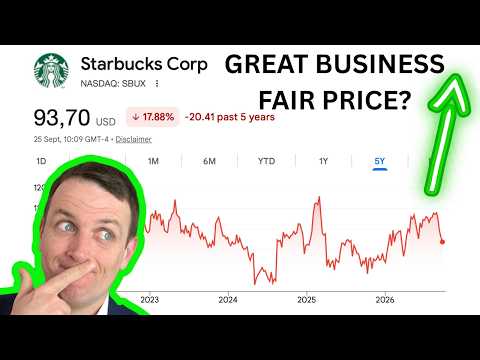
Starbucks SBUX Stock Analysis + Intrinsic Value
2 min read

Starbucks SBUX Stock Analysis + Intrinsic Value

Current Situation

  • Starbucks (SBUX) stock down -20% over 5 years, market cap $108B, P/E ratio 54, dividend yield 2.61%.

New CEO

  • Returned 2 years ago (ex-Chipotle CEO 2018–2024). Goal: return to former strength. Early successes: comparable store sales improving, operating margin rising.
  • Challenges: dirty stores (especially in Europe), union disputes, higher prices → customer decline.
  • Sale of 60% of China business strengthens balance sheet.

Financials

  • Long-term strong revenue and profit growth (revenue 6x, profit 8x over 15–20 years).
  • Current: net income last 12 months only $2B (normal ~$4B). Last quarter: operating margin back to historical levels → possible turnaround.
  • $25B in buybacks at high prices, financed with debt – criticized as 'financial engineering'.
  • High leverage since 2018, limited benefit for shareholders.

Analyst View

  • Mostly 'Hold', only 12% strong buy. Analysts expect 20% earnings growth by 2028 and P/E of 25.
  • Speaker's estimate: long-term return of ~6% at current price (based on 5% dividend growth, 10% discount rate).
  • Worst case: if required dividend yield rises to 5%, stock must fall 50%.

Intrinsic Value

  • With a required 10% return, intrinsic value is far below current price.
  • Market appears satisfied with 6% return → implies 4% dividend yield in future.
  • Bottom line: Low expected return (5–6%) with high risk – comparable to Nike; better alternatives like Netflix, Meta, Fiserv with lower P/Es.

Conclusion

Starbucks has a strong brand and potential, but current price is high, return low. Investors should wait for sustainable profitable growth or a cheaper entry point.

This VIRAL Espresso Machine Is Very Confusing
3 min read

This VIRAL Espresso Machine Is Very Confusing

Introduction & Personal Note (Book Success Mentioned)
  • The speaker (Morgan) celebrates his New York Times bestseller Coffee for Here.
  • Today's focus, however, is on an unusual espresso machine – the Bloom Box by Kiara.
The Machine in Detail
  • Price: approx. $50 | Design: compact, colorful, with a magnetic door ("door" feature).
  • What's Included: Machine, a surprisingly high-quality tamper (49 mm, ergonomic, solid), and a camping cup.
  • Technical Specs:
    • Brew Group: 49 mm portafilter with pressurized basket (works with pre-ground coffee).
    • Capacity: 12–13 g coffee, about 6 oz (180 ml) water tank.
    • Temperature Control: 3 levels (approx. 185°F, 195°F, 200°F).
    • Battery: Can run unplugged, but water must be preheated (no heating in battery mode – for hot espresso, you need hot water).
Preparation & First Test
  • Preheat time: about 5 minutes.
  • Important: Portafilter must be inserted before preheating, or the electronics may glitch.
  • First attempt (volumetric guess): Result: "very adequate" – slightly over-extracted.
  • Second attempt (using clear cup): Much better – limited extraction to about 30–32 g.
Assessment: Strengths & Weaknesses
  • Positives:
    • Tamper is unusually good for the price.
    • Temperature selection and portable battery are thoughtful features.
    • Compact design with included cup – ideal for travel or camping.
    • Always produces a crema-like foam (via pressurized basket).
  • Critiques:
    • No space for a scale (only tiny models like Acaia would fit).
    • Cup size limited (max about 4 oz / 120 ml).
    • Build quality is mostly plastic (expected at $50).
    • No real heating in battery mode – you must add preheated water.
Conclusion
  • Surprisingly good for its price and target audience (travel, camping, beginners).
  • Not a pro machine – flavor lags behind traditional setups, but for on-the-go use, it's definitely usable.
  • The speaker is split ("tickled but skeptical") – but overall pleasantly surprised.
Recommendation
  • For travel: solid alternative, but not the very best (handheld models are often more flexible).
  • Value for money: surprisingly high, especially due to the quality tamper and temperature control.
Miscellaneous
  • Sponsor note: Cometeer (flash-frozen coffee).
  • Book link and social media channels are mentioned.
New V10 Supercar With World’s Most Insane Driving Position! | 4K
3 min read

New V10 Supercar With World’s Most Insane Driving Position! | 4K

The World's Most Insane Driving Position? A Look at the Sanravati 1

The Sanravati 1 is a hyperactive track-day special with a radical innovation: a prone driving position on your stomach. We got a first look at the model, tried a simulation, and even took a prototype for a spin.

The Core Idea: The Apex Position for Ultimate Control
  • Inspired by motorcycles: The driver should feel a direct connection to the car, similar to riding a bike.
  • The solution: The driver lies on their stomach, with their head near the windscreen opening. The hands are placed directly over the front axle for an unparalleled, direct steering feel.
  • A mix of both worlds: Controls remain car-like with a steering wheel and foot pedals. However, the pedals are located behind the driver – requiring a completely new foot operation.
Technology and Specifications
  • Engine: A 5.5-liter Judd V10 – an emotional, raw racing engine with 800 hp.
  • Transmission: A sequential 6-speed racing gearbox by Hewland with paddle shifters.
  • Drivetrain: Rear-wheel drive for classic racing character.
  • Safety: No road legality allows for custom safety standards. It uses a six-point FIA harness that is worn like a backpack.
  • Entry: No conventional doors. The roof opens like a jet cockpit, allowing the driver to step in. The rear is open to showcase the engine and intake.
First Driving Experience (Simulation & Prototype)
  • Simulation: The apex position in the simulator feels extremely direct and unusual. The driver feels as if they are sitting between the front wheels. The sensation requires an extremely smooth driving style to control the car's swaying.
  • Prototype (Porsche Boxster conversion): Driving with your head through the windscreen is bizarre and stressful yet thrilling. The sense of speed is extreme, similar to a motorcycle. Views of the corner apex are outstanding, but the spatial awareness is still disorienting.
  • Initial impressions: The position feels awkward and exposed. After a few laps, shoulder and hamstring cramps set in. The position isn't perfect yet, but the idea holds potential.
Challenges and Future
  • Start-up risk: The founders are young engineers realizing a highly ambitious project. The Sanravati 1 is a passion project with uncertain production.
  • Target audience: The car needs to be sold to an established, possibly older clientele – a huge challenge.
  • Conclusion: The concept is an extremely daring gamble. Even if the car never reaches production, it showcases the spirit of innovation and inspires the automotive world. It is a brave and creative approach to redefining the connection between human and machine.
Is Staying Local the Fix for Hardware Wallet Supply Chain Attacks?
2 min read

Is Staying Local the Fix for Hardware Wallet Supply Chain Attacks?

🔒 Staying Local as a Fix for Hardware Wallet Supply Chain Attacks

The Problem: Vulnerable Supply Chains
  • The industry must take supply chain attacks seriously and protect against them.
  • Key risk: manufacturing in uncontrolled or distant facilities.
Foundation’s Solution: ITAR-Certified US Production
  • Manufacturing in an ITAR-certified facility with strict security standards (military/government level).
  • Hands-on control: the speaker or team members are often on-site to oversee the deployment process.
  • This establishes a chain of trust and custody – even for firmware updates, the speaker travels there personally.
Criticism of Offshoring (e.g., Ledger / Foxconn)
  • Ledger used to manufacture in France, but now produces new devices at Foxconn in Vietnam → the speaker calls this “nerve-racking”.
  • Counterargument: “Your iPhone is also made by Foxconn” – the speaker replies: “I don’t store my wealth on my iPhone.”
  • He accepts trade-offs but refuses to buy a hardware wallet from a supply chain he doesn’t trust.
Outlook: Locality over Nationality
  • Not necessarily US – Foundation might eventually set up a European manufacturing site with an EU headquarters.
  • What matters most: local, high-security, audited, and the ability to be physically present at the facility.
Crypto Just Failed a Critical Bull Market Test! What's Next?
4 min read

Crypto Just Failed a Critical Bull Market Test! What's Next?

Bankless Episode Summary

📉 Bitcoin: Bull Market Test Failed?
  • Bitcoin lost its 50-week moving average ($75.5k) and now trades around $72k – between the 50-week and 200-week moving average ($68k).
  • The Fear & Greed Index shows 'Extreme Fear' – worse than at any point during the early 2023 bull market.
  • A test of the 200-week MA ($68k) seems increasingly likely. If Bitcoin drops below $58k, the four-year cycle model would be considered broken by analysts.
  • Historically, the 50-week MA was briefly lost twice during the early bull market of 2019–2020, but the 200-week MA held.
  • Key takeaway: Sentiment is broken, but cycles aren't invalidated yet. DCA (dollar-cost averaging) has outperformed active timing.
🤖 Nvidia & Jensen Huang: Scandal or Strategy?
  • Jensen Huang resigned as Nvidia CEO, officially due to two extramarital affairs (one with an alleged Chinese intelligence asset).
  • Nvidia lost $1 trillion in market cap in a month (down 17% on the week, 27% in November).
  • David suspects hidden reasons:
    • Huang was a strong advocate for open-source AI models, which may threaten elites (CIA, Democrats, closed AI labs).
    • Potential violations of the Chips Act (selling chips to China via intermediaries) – a real legal issue, not just a private scandal.
    • Media (Economist, NYT, BBC) swiftly called for his removal without questioning proportionality – suspicious.
  • Occam's razor: The simplest explanation is illegal chip sales to China, not the affairs. A national security matter.
💰 Ethereum: Vitalik Speaks – ETH Is Money
  • Vitalik Buterin stated at Devcon: ETH is a store of value / money – for the first time so explicitly.
  • Previously ambivalent (fee token vs. store of value), he now says: “The pragmatic reason to hold ETH is that ETH is money.”
  • Context: David Hoffman asked Vitalik this in 2019 – the answer then was vague (“ETH can be money if the community wants”).
  • Assessment: Many see the statement as too late – in 2021 it would have been global news. Still, it's better late than never and aligns with the Crops roadmap.
  • Criticism: Vitalik should have led this earlier. Now the statement comes during a weak market (ETH ~$2k, below both key MAs).
🛡️ Ethereum Security: Phylax & Titan Builder – Cloudflare for Ethereum?
  • Phylax Systems and Titan Builder (produces ~50% of all Ethereum blocks) introduce app-level circuit breakers at the block builder level.
  • Apps can define rules (e.g., “vault cannot pay more than 50% of AUM in one transaction”). If a transaction violates the rule, it gets reverted – even if included in the block.
  • Protection against hacks: North Korean hackers could be stopped without sacrificing protocol immutability.
  • Tension: Censorship resistance vs. security. The upcoming EIP-Fossil (forces transaction inclusion) and Phylax would complement each other: Fossil forces inclusion, Phylax causes revert.
  • Verdict: A small compromise on cypherpunk values, but a big win for DeFi security and market growth.
🏛️ Regulation & Taxes
  • CFTC: US-compliant perpetual futures on single stocks are now allowed (Coinbase, Kraken, Kalshi). Traditional exchanges (CME, Citadel) are suing to block them.
  • IRS: Sending more Letter 6174 to crypto traders – a friendly reminder to check tax obligations. No mandatory response, but a sign of increased scrutiny (aided by AI).
🔍 Other Topics
  • Ethereum Foundation: A laid-off employee is suing the EF over the Seppuku clause (exaggerated “suicide pact”) and termination shortly after a cancer diagnosis. The restructuring was necessary but poorly handled and demoralizing.
  • Conspiracy theories: David and Ryan explore whether Huang’s resignation has deeper causes – from open-source AI to political maneuvering. The full truth remains unclear.
Did You Buy NVDA Yesterday? Will You Today? 2028 P/E of just 7!
2 min read

Did You Buy NVDA Yesterday? Will You Today? 2028 P/E of just 7!

Nvidia Stock: A Deep Dive into the Recent Decline

The speaker analyzes the recent price movement of Nvidia, marked by a massive retail buying spree in the first 30 minutes of trading, pushing the stock from $150 to $166. Record inflows into Nvidia ETFs and leveraged funds were observed. Despite the optimism, the speaker warns of a potential bubble.

Key Metrics

  • Price-to-Earnings (P/E) Ratio: The forward P/E is 18, extremely low for a company expected to triple earnings in the next two fiscal years. Wall Street consensus estimates earnings per share (EPS) of $21 for fiscal 2029, implying a P/E of 7.8.
  • Analyst Sentiment: 57 strong buy and buy ratings, with only 4 hold and one strong sell. The sole bear, Jay Goldberg, was about to upgrade the stock before the recent scandal.

Risk Factors

  • Price Hikes: Nvidia has increased chip prices from $200 to $1,000, boosting revenues. In a downturn, prices could collapse, as seen with memory chips.
  • Overcapacity: Nvidia is forcing suppliers to double production, which could lead to a glut when demand slows. TSMC must double capacity over the next decade.
  • Competition: Google is developing its own AI chips, and China has its own alternatives. The market has ignored these news, but smart money is already selling.
  • Insider Selling: Jensen Huang, Nvidia's CEO, has sold $1.9 billion worth of shares since 2021 – a clear signal he sees the peak.

Future Scenarios

  • Optimistic: EPS of $20 in 2028, P/E of 10 → Stock price $100, market cap $2 trillion.
  • Pessimistic: Sharp demand drop, falling prices and margins → Net income of $75 million, market cap $750 billion (80% below current).

Lessons from the Past

The speaker quotes Warren Buffett: “If something can't go on forever, it will end.” He warns against buying now, calling it speculation like in 1999 or crypto. Instead, wait for true market distress with bankruptcies and low prices.

Conclusion: A P/E of 7 might be the most expensive stock you ever buy if the cycle reverses.