Nofinity Logo
How it works

YouTube Insights in 5 Minutes Instead of 3 Hours

Compact AI summaries & key takeaways from leading experts in longevity, crypto, finance, and more – ad-free, research-backed, and concise.

Latest Analyses(6)

How Germans invest (vs. Finanzfluss community!)
Finanzfluss
3 min read

How Germans invest (vs. Finanzfluss community!)

📊 Study Comparison: Saving vs. Investing in Germany
  • Two contradictory studies: German Stock Institute (DAI) says only 20% invest in stocks; ING claims nearly 50% are in the stock market. The difference lies in methodology: DAI counts only stocks/funds/ETFs, ING includes bonds and all fund types and surveys adults online only.
🏩 German Financial Assets (€9.5 trillion)
  • 37% sit in savings/checking accounts (low interest, banks profit).
  • 28% in life insurance & occupational pensions (often guaranteed products, 2.4% return).
  • 14% in investment funds (mostly actively managed, expensive).
  • 7% directly in stocks, 12% in non-listed company shares.
📈 Stock Investors: Record Numbers & Trend Shift
  • 2025: 14.1 million shareholders (20% of population aged 14+) – a record, but methodology now includes employee savings plan fund savers.
  • Younger people drive growth: Under-40s are the largest age group with 4.9 million.
  • Female investors increased by 24% (twice the male rate) but still underrepresented.
  • Income dependency: Over €4,000 net monthly income → 50% invest; under €2,000 → only 12%.
💾 Active Funds vs. ETFs: Spot the Cost Trap
  • 8.5 million investors use actively managed funds; only 4.7 million use ETFs (but ETFs are rising fast).
  • Cost comparison (ESMA): Active funds: 1.28% p.a., ETFs: 0.21% p.a. – six times more expensive.
  • 2024 returns: Active funds 17%, ETFs 21.4%. Over 10 years: 7.6% vs. 9.3%.
  • Reason: Bank distribution with high commissions (45% of costs go to intermediaries). German funds are above EU average in costs.
đŸ„‡ Other Asset Classes
  • Gold: 9,173 tons in private households (~€1 trillion) – more than the Bundesbank reserve.
  • Cryptocurrencies: 9 million adults (12.8%), 28.4% among 25-34 year olds.
  • Real estate: 42% of households own their home; real estate constitutes 58% of total wealth.
🚀 Finanzfluss Community Comparison
  • 97% of shareholders own ETFs (vs. 35% in DAI). Only 16% have active funds (mostly as a supplement).
  • 39% own crypto, but most as a small allocation (≀3% of wealth).
  • Asset allocation (financial assets excluding real estate/gold/crypto):
    • Community: 54% in funds/ETFs, 22% in cash, 17% in individual stocks, 6% insurance.
    • Germany overall: 14% in funds/ETFs, 37% in cash, 7% stocks, 28% insurance.
  • Half of the community has ≄40% of wealth in ETFs; ≀17% in cash.
🎯 Conclusion: A Hidden Nation of Investors? Not yet.
  • Despite the record, only one in five invests in stocks. Two-thirds of financial assets sit in low-yield accounts and insurance.
  • Banks and insurance companies profit, not savers. But the trend toward ETFs and direct investments is growing – especially among the young.
  • The Finanzfluss community shows what a low-cost, return-oriented investment strategy can look like: more ETFs, fewer expensive funds and insurance, less cash.
Milk Froth Without Espresso Machine: Do You Need It?
Kaffeemacher
2 min read

Milk Froth Without Espresso Machine: Do You Need It?

Device Overview

The WPM MS130Ct is a standalone steam wand for milk frothing without an espresso machine. It measures 35×35×14 cm, weighs about 7 kg and has a 0.8 l water tank. Build quality is solid, but the design is rather bulky.

Performance & Technology
  • Thermoblock heats up in about one minute.
  • 4 bar steam pressure – comparable to good home machines (around 1.2–1.4 bar in a boiler).
  • Water addition is extremely low: only 1.6 g condensation during purging, 17 g extra when frothing 250 g milk (under 10 %).
  • Temperature adjustable from 40 °C to 90 °C (e.g. for hot chocolate).
Milk Froth Quality
  • Manual steaming produces very fine latte art foam with plenty of power – almost too much for a single serving.
  • Milk (at 55 °C) is frothed in 30–35 seconds (from fridge temperature).
  • Result: sweet, creamy milk foam without watery taste, ideal for latte art.
Auto Mode
  • With the built‑in temperature sensor, the steam wand can automatically froth milk to the desired temperature (e.g. 55 °C).
  • Works reproducibly, but requires too much milk for small pitchers (e.g. cafĂ© macchiato) – better for double portions.
Oat Milk
  • Oat milk also froths well, best set at 50 °C to avoid overpowering the coffee flavour.
Conclusion
  • Strengths: Excellent milk foam quality, very low water dilution, precise temperature control, sturdy build.
  • Weaknesses: Large footprint, stiff steam wand adjustment, outdated display, price around €450–550.
  • Recommendation: Ideal for owners of single‑boiler machines without steam wand, for catering or as a backup in gastronomy. Anyone who needs lots of milk foam for latte art will love it.
What Is a Smart Contract?
Coin Bureau
2 min read

What Is a Smart Contract?

Introduction
  • Smart contracts are programs on a blockchain that automatically execute agreements when conditions are met.
  • They replace trusted intermediaries (banks, lawyers) and rely on an “if-this-then-that” logic.
How Smart Contracts Work (5 Steps)
  1. Developer writes code – typically in Solidity, compiled into bytecode.
  2. Deployment on the blockchain – the contract receives its own address.
  3. Immutability – once deployed, the code cannot be changed (except via upgradeable proxies).
  4. Triggering – a transaction from a wallet or another smart contract initiates execution.
  5. Consensus – thousands of computers (nodes) execute the identical code and agree on the result.
Example: Alice and Bob Swap
  • Alice deposits ETH into the contract; Bob deposits Token X.
  • The contract checks if both have paid.
    • Yes: tokens go to Alice, ETH to Bob.
    • No (deadline expired): both get their deposits back.
  • No trust needed between the parties – only trust in the code.
Importance and Use Cases
  • DeFi (Decentralized Finance): lending, trading – over $95 billion locked in smart contracts (TVL).
  • Stablecoins (e.g., USDT, USDC) – over $300 billion, based on the ERC-20 standard.
  • NFTs (ERC-721) – ownership recorded via smart contract.
  • DAOs – collective management of funds through voting.
  • Tokenized Real-World Assets (RWAs) – e.g., BlackRock’s BUIDL fund with over $2 billion.
Risks and Limitations
  • Code bugs – e.g., Reentrancy bug (The DAO 2016) caused loss of 3.6 million ETH. In 2025, exploits led to $3.4 billion in losses.
  • Oracle dependency – smart contracts cannot access external data; they rely on oracles (e.g., Chainlink). Manipulation of these data (e.g., Mango Markets 2022) can cause losses.
Conclusion
  • Smart contracts are not perfect but offer a transparent, automated alternative to traditional intermediaries.
  • They operate 24/7 without office hours and enable trust between strangers.
  • Nick Szabo coined the concept in 1994; Ethereum made it reality in 2015. Today, smart contracts manage hundreds of billions of dollars.
Black October! What Is Happening to the Internet?
Bankless
4 min read

Black October! What Is Happening to the Internet?

Introduction: Black October and the Key Players

In this emergency broadcast of Bankless, host David discusses the ongoing cybersecurity crisis known as Black October with security experts Hari (CEO of Canina Security) and Odysius (CEO of Filix).

The Reality: An Exponential Trend, Not Just Hype
  • Hari tempers the panic: This isn't a sudden event but the culmination of an 18-month exponential trend in cybersecurity incidents.
  • The cost of hacking has collapsed due to AI. Internal data shows a 15x efficiency gain in just the last six months.
  • It has become an economics problem. Where hacking was once a bespoke craft requiring weeks of human time, it now costs as little as $10 per target to automate a full attack.
The New Paradigm: AI as an Industrial Cyber Criminal
  • Hacking has gone from a custom handmade operation (expensive, needing high ROI from crypto heists) to industrial manufacturing.
  • Hacking Factories exist: AI agents that scan websites and churn out exploits with no human needing to think about costs.
  • Security through obscurity is breaking down in real-time. Every company, from your dentist to major banks, is now a viable target.
  • The Zero-Day Clock is negative: companies are living on borrowed time, unable to patch fast enough.
Concrete Dangers for Companies and Individuals
  • Scalable Social Engineering: AI can now combine leaked data (health, finances, relationships) to craft the perfect phishing email and blast it to millions simultaneously (the new version of the "Grandparent Scam").
  • Blast Radius: It's not just about funds. It's about reputation and data privacy. AI agents already know shocking details about employees from internal data leaks.
  • Second and Third Order Effects: Leaked data is combined to identify high-value targets for physical or sophisticated financial attacks.
Defense: Offensive Security is Vital
  • Offense dominates for the next 12-18 months. The only valid defense is an AI-powered counter-offense.
  • "Attack Yourself First": Companies must use AI security agents (like Canina's product Apex) to simulate attacks on their own external surfaces and source code.
  • The goal is to raise the cost of attack from $1 to $10,000 to deter mass exploitation.
  • Bureaucracy is the bottleneck: Incumbent large firms (the "Tanker") are struggling to turn the ship, while crypto-native startups are faster to adapt to the new threat (the "fast drone").
Advice for Crypto Investors
  • Question your Custodians: Actively ask services like Coinbase what they are doing about this new wave. If they haven't changed their security posture, move your assets.
  • Build Redundancies: Odysius recommends the "Burst Radius" principle. Ensure multiple independent systems must fail for you to lose funds (e.g., use a Ledger + an iPhone + a different ecosystem).
  • Self-Custody vs. Third-Party: The experts lean towards relying on regulated custodians with cyber insurance for now, as the threat landscape is too complex for most individual users. However, be warned that insurance carriers might start failing in the coming months.
  • Be extremely wary of clicking links.
The Future Outlook: The Internet as a "Dark Forest"
  • After a bloody 18-month transition period, software will become inherently safer, but the constant adversarial pressure will remain.
  • Crypto has a structural advantage: The space was born in an adversarial environment ("raised in the darkness"). Companies in crypto have a higher baseline of security culture and technology than the traditional financial world.
  • The age of innocence for the internet is over. The "Dark Forest" is our new permanent reality.
$1,000,000 Portfolio Asset Allocation Final Take
Value Investing with Sven Carlin, Ph.D.
2 min read

$1,000,000 Portfolio Asset Allocation Final Take

Introduction
  • The speaker summarizes his four‑part series on allocating a million‑dollar portfolio and presents his personal conclusion.
  • Money is a personal matter – individual circumstances, risk tolerance, and goals are crucial.
Evaluation of Asset Classes
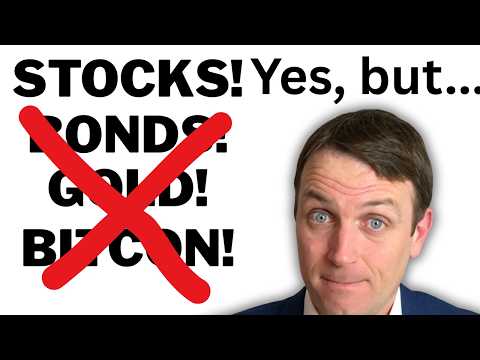
  • Bitcoin & Gold: Both are considered unproductive assets. Bitcoin is pure gambling with zero value; gold offers no cost‑effective risk mitigation and incurs high opportunity costs. Unsuitable for long‑term wealth building with safety.
  • Bonds: Currently more attractive (around 5 %), but long‑term bonds are too risky – inflation could destroy real returns. Short‑term Treasury bills (3 months) are acceptable for money needed soon.
  • Stocks: The only solution for long‑term growth if returns of 10 % or more can be achieved with a margin of safety. All other asset classes dilute capital growth.
The Value Investing Approach
  • Introduction of a quadrant model to classify companies by risk and return (e.g., Palantir, Zoetis, Lululemon, Berkshire Hathaway).
  • Timing and patience are essential: The market is in the second most expensive phase in history (AI bubble), so caution is advised.
  • It is not about a fixed portfolio but a process: Buy companies when the purchase is risk‑appropriate and value‑oriented.
Conclusion
  • Every investor must consider their personal situation, knowledge, and risk appetite.
  • Recommendation: The new handbook „The Value Investing Handbook“ (500+ pages) as a starting point for long‑term, secure wealth building.
10,000€ → 100,000€ - New Buys, Surprising Watchlist & Limit Orders | Portfolio Challenge
Bitcoin2Go
2 min read

10,000€ → 100,000€ - New Buys, Surprising Watchlist & Limit Orders | Portfolio Challenge

📊 Portfolio Update
  • Starting capital: €10,000, current portfolio value approx. +€80
  • Two positions in profit: ServiceNow (+12%) and Circle
🛒 New Purchases & Limit Orders
  • Liquidia (Biotech): Limit at €30 – legal dispute could create a bottom?
  • AppLovin (AdTech): Limit at €220, potential re-entry below €200
  • Cronos Group (Cannabis): Limit at €2.55 (recommended by analyst Alec)
  • Hesai Group (Robotics/Lidar): Limit at €10.65 – strong cash position, but China risk
  • Hyperliquid (Crypto/DeFi): Limit at €60 – live product with measurable revenue
👀 Watchlist Highlights
  • Monolithic Power Systems (power supply), ASML (European chip giant)
  • Near Protocol, Chainlink, Ondo Finance (crypto)
  • Novo Nordisk (healthcare), Uranium, mining plays
🧠 Important Notes
  • No copy‑trading – do your own research
  • Risk management first; moonshots only with small allocations
  • A free Discord channel will launch in November for faster updates
  • Community input is very welcome – suggest more tickers in the comments