
Nofinity Logo
How it works

YouTube Insights in 5 Minutes Instead of 3 Hours

Compact AI summaries & key takeaways from leading experts in longevity, crypto, finance, and more – ad-free, research-backed, and concise.

Latest Analyses(7)

I Replaced My Financial Advisor With Claude Opus 5 (full system)
Miles Deutscher Finance
3 min read

I Replaced My Financial Advisor With Claude Opus 5 (full system)

đŸ€– Your AI-Powered Financial Analyst – How to Get Live Market Data into Claude

This video shows how to turn Claude into a full-time market analyst using the FMP connector (free tier included). The system replaces expensive Bloomberg terminals for retail investors and enables daily AI-driven portfolio analysis.

🔧 System Setup

  1. Activate FMP connector: Go to Connectors > Add > search for FMP (Financial Modeling Prep) – free for 250 requests/day, paid for higher usage.
  2. Create context folder: Build a folder with these markdown files:
    • Investor profile: Goals, strategy, risk tolerance, time horizon
    • Strategy.md: Investment thesis, max drawdown, rebalancing rules
    • Portfolio(.csv or Google Sheets): All positions (preferred: Google Sheets for live updates)
    • Watchlist.md: Watched assets with theses and sell targets
    • Prompts.md: Five ready-made prompts (see below)
  3. Use Co-Work: Open a Co-Work session (not chat) – Claude can access the local folder, remember context, and edit files automatically.

📋 Five Essential Prompts

  1. Stock snapshot: Current price, month performance, valuation vs. 5-year average, analyst targets, red flags from filings.
  2. Quarterly report summary: Let Claude extract revenue drivers, margins, and hidden risks (e.g., buried debt).
  3. Compare two assets: Growth, fees, risks side-by-side (e.g., AMD vs. NVIDIA) – crucial for opportunity cost assessment.
  4. Market screening: Find hidden gems with parameters: market cap <$2B, revenue growth >25%, positive free cash flow, expanding margins. Claude runs parallel agents and presents the top 3-5 candidates with bull/bear cases.
  5. Automated morning report:
    • Schedule: Weekdays at 9:00 AM.
    • Content: Overnight index moves, portfolio news, alerts on holdings, upcoming earnings.
    • Output: HTML artifact – automatically generated by Claude.

⚠ Important Notes

  • Data quality: Ensure FMP is active (see logo) – otherwise Claude uses unreliable web data (Yahoo Finance).
  • Not a sole advisor: Always double-check prices before trading.
  • Costs: FMP basic is free; for screening and automated reports, the Starter plan ($19/month) is recommended.

🔼 Outlook

In the future, AI agents can even execute trades via brokers (Robinhood, Interactive Brokers) – the creator is working on automated portfolio rebalancing systems.

Why The Divine Intervention on CoreWeave Stock CRWV!
Value Investing with Sven Carlin, Ph.D.
3 min read

Why The Divine Intervention on CoreWeave Stock CRWV!

Core Argument: Wall Street vs. the AI Narrative

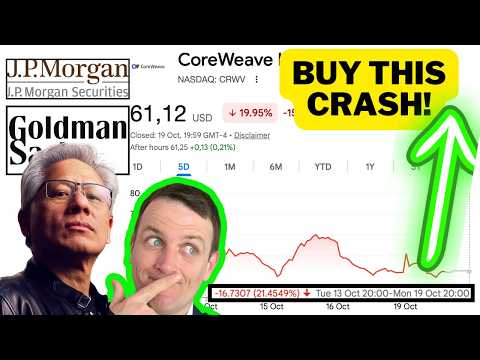
The channel analyzes the crash of CoreWeave (CRWV) and the subsequent 'divine intervention' by investment banks (Goldman, JPM) and Nvidia CEO Jensen Huang. The central thesis argues that banks and Nvidia protect each other to sustain the profitable AI narrative.

The Trigger: Debt Fears Shake the House of Cards
  • CoreWeave stock dropped 21% last week.
  • The yield on CoreWeave's 2030 bond spiked to 14-15% – a level that fundamentally alters the investment thesis.
The 'Rescue' by Wall Street
  • Goldman Sachs upgraded the stock to "Buy" despite fears, claiming mixed debt costs only rose 100-200 basis points.
  • Deutsche Bank and JP Morgan echoed the positive sentiment ("The business is solid").
  • The Conflict of Interest: These banks were the lead underwriters for CoreWeave's IPO. The host points out the irony of research departments recommending to buy what the investment banking arms just issued (comparing it to SPACs and the Dot-com era).
The 'Divine Intervention': Nvidia's Skin in the Game
  • Jensen Huang (Nvidia CEO) publicly reassures the market: "No reason for concern."
  • The Catch: Nvidia holds 10-11% of CoreWeave (one of the largest shareholders) and invested $2 billion, which CoreWeave exclusively uses to purchase Nvidia chips – a closed loop they must defend.
The Real Problem: The Narrative is Everything
  • The entire AI boom rests on a narrative. Without rising stock prices and optimism (fueled by bond sales and favorable analyst reports), the house of cards crumbles.
  • "Look at the incentive, and you understand the narrative." (Charlie Munger): Wall Street collects its hefty fees at issuance. Pension funds and retail investors are left holding the risk.
  • Warning to Investors: Projections assume 7-10 years of linear growth, but AI will drastically lower prices. What looks like a value investment today could become worthless once the narrative flips.
Conclusion

The host strongly advises against such narrative-driven investments and instead recommends tangible assets. The "divine intervention" is, in his view, nothing more than a desperate support operation for an overheated house of cards.

Elon Says $100T Is LOW: How SPCX Compute Could Break Every Model 🚀
InvestAnswers
2 min read

Elon Says $100T Is LOW: How SPCX Compute Could Break Every Model 🚀

🚀 SpaceX Compute: Elon Musk Says $100T Is Low – How It Could Break Every Model

This video analyzes SpaceX's explosive growth potential, especially in compute. Elon Musk has never been more bullish, tweeting that SpaceX could be worth over $100 trillion in less than 10 years – a 50x from today's valuation.

đŸ”„ Why SpaceX Has an Unfair Advantage

  • Fastest data center build: 20 weeks to completion, 100,000 GPUs operational in 90 days. Competitors take 2–4 years.
  • Coherent compute: SpaceX is the only company able to cluster more than 30,000 GPUs – Elon runs 220,000 GPUs repeatedly (e.g., Colossus: 150k H100s, 50k H200s, 30k GB200s).
  • Power on site: 400 MW wind turbines in Brownsville, Texas. Up to 456 Starship launches/year under FAA review.

📈 Starlink & Starship as Accelerators

  • Starlink revenue could grow 925% in 5 years (10x). Ron Baron values Starlink alone at $14–15 trillion.
  • Starship lifts 100–150 ton payloads; competitors (China, Europe, Russia) are far behind.

đŸ€ SpaceX–Tesla Merger?

  • Rumors of an all-stock acquisition of Tesla by SpaceX are heating up. Prediction markets show 60% chance by spring 2027.
  • Tesla already holds billions in xAI shares converted to SpaceX stock.

💰 Price Targets – Compute Only (no Launch, Starlink, etc.)

  • Base case (66.5 GW online by 2031): SpaceX share price $825 (5.65x). A 655-share „retiree bag“ = $540,000.
  • Bull case (double the GW): Share price ~$4,000 (21.7x) → 655 shares = $2.4 million.
  • Musk says even 66 GW is too low – actual numbers could be much higher.

⚡ Scarcity Drives Prices Higher

  • Compute demand is parabolic, but supply is constrained. Power shortages (13–15 GW gap in North America) mean only SpaceX can deliver fast – and charge a premium.

đŸ—łïž Community Poll

  • 74 % believe 100 SpaceX shares will outperform 0.18 Bitcoin (each about $15,000) over 4 years.

Takeaway: SpaceX’s compute business alone could make investors wealthy – before factoring in Starlink, Starship, or a Tesla merger.

What will the Federal Reserve Do Next?
Benjamin Cowen
2 min read

What will the Federal Reserve Do Next?

Analysis: What the Federal Reserve Will Do Next

This video analyzes the likely course of US monetary policy in the coming months, with a special focus on parallels to 2018.

Current Situation
  • The federal funds rate is currently at 4% – another hike before year-end is expected.
  • For the upcoming FOMC meeting (in about 9 days, October), the market implies an 80% probability of a pause – not a hike.
  • Recent inflation data (CPI, PPI) were elevated, but the market still does not expect a move in October.
The 2018 Comparison
  • In 2018, the Fed raised rates in September – right in the middle of a midterm election year.
  • It paused in November (the meeting took place right after the midterms) and then hiked again in December.
  • The projections at the time (SEP) called for further hikes in 2019 – but they never happened. Instead, the Fed started cutting rates in 2019.
The Role of the 2-Year Yield
  • The Fed closely follows the 2-year Treasury yield – currently at 4.76%, above the federal funds rate.
  • In late 2018, the 2-year yield was around 2.9%, matching market expectations at the time. When it later fell, further hikes became unnecessary.
  • Potential scenario: The 2-year yield rises into the midterms, falls afterward, and the Fed hikes in December. Then the funds rate and the 2-year yield would be nearly identical – making further hikes unnecessary.
Historical Midterm Pattern
  • Long-term yields in midterm election years often peak in October, rise again shortly before the elections, and then fall after the midterms.
  • This dynamic could repeat in 2026.
The Video's Forecast
  • No rate hike in October (only about 16% probability).
  • Yields rise into the midterms and fall afterward.
  • Likely one more rate hike in December.
  • After that, the Fed could keep rates stable through 2027 – similar to 2018, when planned hikes never materialized.
Porsche Has Finally Built A Supercar! | 4K
Top Gear
2 min read

Porsche Has Finally Built A Supercar! | 4K

A Supercar Above the 911
  • The Porsche Mission S is a design study previewing a future model positioned above the 911.
  • The production version is planned as a mid-engine two-seater with an internal combustion engine – not a hypercar, but a proper, buyable supercar.
Design: Porsche's Greatest Hits
  • The exterior blends references from Porsche history: GT1 front, 911 headlights and window line, 959 rear, Carrera GT spoiler, 928 wheels.
  • Supercar details include bargeboards, large intakes, an active rear spoiler, four exhausts, and exposed rear tires.
  • A standout feature is the horizontally mounted fan at the rear, emphasizing mechanical openness and recalling the 917.
Interior: Reduction Over Screens
  • No huge infotainment display: Porsche deliberately reduces complexity to save weight and distraction.
  • The five classic instruments can be reduced to three essential displays via a button.
  • A clever hidden MagSafe mount for your smartphone replaces the built-in sat nav.
  • The manual gearbox can be upgraded with a sequential shifter in rally style.
Designer Interview: Strategy and Proportions
  • Designer Tobias Sulleman explains how he selected specific elements from Porsche's history.
  • Key were the proportions of a mid-engine supercar: volume shifted to the rear, cabin deeply set into the body.
  • Technical details like the fan should be visible and tangible – like a mechanical watch.
Powertrain and Production Prospects
  • Porsche plans to build the car in series production – using metal instead of expensive carbon fiber to enable higher volumes.
  • Porsche remains tight-lipped about the engine. The designer hints at exploring the 917 fan, fueling speculation about a flat-eight.
  • Possible options are pure combustion with manual gearbox (purist) or hybrid with PDK – the big question is whether the ICE version arrives before the 2030 EU ban.
Outlook
  • Porsche also plans a luxury SUV above the Cayenne and a 918 successor.
  • Electric models like Boxster and Cayman will continue – ICE, hybrid and fully electric may coexist.
Bitcoin CRASH Coming? AI Bubble Bursts & Inflation SHOCK
Coin Bureau Podcast
3 min read

Bitcoin CRASH Coming? AI Bubble Bursts & Inflation SHOCK

đŸ”„ Macro Meltdown: Inflation & Oil Shock

The macroeconomic picture is heating up fast.

  • Inflation: CPI and PPI came in much hotter than expected. Core inflation is rising, signaling energy costs are spilling over into the broader economy.
  • Oil: Brent crude surged above $108/barrel and WTI above $100, driven by escalating Middle East tensions.
  • Bonds & Dollar: The Dollar Index (DXY) hit an 18-month high. US 30-year mortgage rates climbed to 7.5%, levels not seen in decades. The bond market shows zero relief.
  • KOSPI Crash: South Korean stocks collapsed (down 40% from highs) so badly the president tweeted a suicide helpline. Key memory makers (SK Hynix, Samsung) were hit hardest.
đŸ€– Is the AI Trade Cooked?

Chip stocks just suffered their longest losing streak since the 2008 Financial Crisis. The AI euphoria is facing a reality check.

  • Catalysts for the Sell-off:
    • Failed IPO of Fermis (Australian Neocloud).
    • Broadcom CEO admitted investors are in a "casino" betting on companies that "might not end up profitable."
    • Chinese breakthrough by CXMT in memory chips, threatening US dominance.
    • Anthropic's valuation slashed from $2 Trillion to $1.5 Trillion.
    • CoreWeave bond yields skyrocketed to 15%, indicating frozen credit markets for AI.
  • Systemic Risk: Larry Fink warned a moratorium on data centers would trigger a US recession. Over 50% of the S&P 500 is exposed to the Mag 7 / hyperscalers.
📉 Bitcoin Technical Analysis (with Matt)

Bitcoin is stuck in a choppy range, failing to break crucial resistance levels.

  • Key Levels: $87,000 is the ultimate resistance. Breaking this is needed for a run at new highs.
  • Support: Failing to hold $82,000 opens the door to a retest of liquidity zones at $80,000 and eventually the major level at $76,000.
  • Correlation: BTC is heavily correlated with oil prices. Relief rallies happen when oil drops slightly.
  • Outlook: Expect a retest of the $81,500 mark. A bullish case requires breaking $87,000.
🐩 Tweets of the Week: Chaos & Cringe
  • Memecoin Culture: The pump.fun party at Token2049 is called out as a display of everything normies hate about crypto (rug pulls, broccoli haircuts).
  • Richard Heart Arrested: The Hex/PulseChain founder was detained in Istanbul on an Interpol warrant. Cops found gold, cash, and loaded weapons.
  • Cybersecurity Fail: Denmark's national ID database was hacked because the password was "123456". 8.8 million people exposed.
  • Flying Car Skepticism: Elon's Roadster reveal is met with skepticism regarding regulatory hurdles and practicality.
đŸ—“ïž Dates for Your Diary
  • Wednesday: Tesla, Meta & IBM earnings reports.
  • Thursday: Fed balance sheet data (liquidity, repo).
  • Friday: Manufacturing PMI & Consumer Sentiment data.