
Nofinity Logo
Onboarding

Welcome to Nofinity

Your premium hub to transform hours of YouTube video into concise, 5-minute text summaries. Build your custom expert feed!

1. Skip the Video

Save hours of watching. Read compact, AI-powered key takeaways in a premium magazine layout – completely ad-free.

2. Custom Feed

Subscribe to top experts in the Explore area to curate your personal, dynamically updating video feed.

3. Suggest Channels

Propose new YouTube channels. Once approved, our system automatically ingests and summarizes new uploads.

Latest Analyses(7)

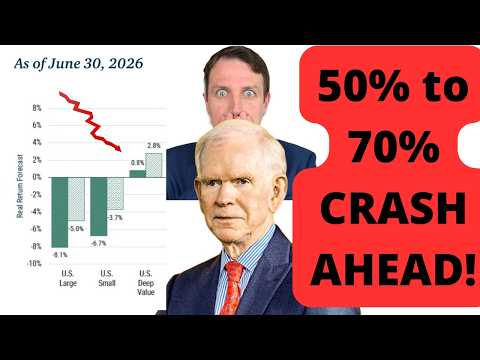
Here is The Notorious 70% US Stocks Crash Jeremy Grantham Prediction, Again!
Value Investing with Sven Carlin, Ph.D.|01. Aug.

Here is The Notorious 70% US Stocks Crash Jeremy Grantham Prediction, Again!

Introduction: Grantham's Crash Prediction in Focus
  • Jeremy Grantham (GMO) forecasts a real decline of 47% for US stocks over the next 7 years (8.1% loss per year).
  • The YouTuber discusses viewer comments and puts the prediction in context with his own value-oriented investment strategy.
Criticism of Grantham and Counterarguments
  • Critique: Those who followed Grantham missed the bull market since 2022.
  • Response: Grantham only warns about risks; his value strategy (e.g., emerging markets) performed similarly to the market.
  • A viewer (Dave, 70 years) argues: No real recession since 2009 because the Fed supported markets with money printing and deficits. The next crash will be worse – Grantham is right.
  • Objection: In a bubble, nobody sees it. Only when the government can no longer borrow will it burst.
Dangerous Investing Mindset
  • The statement 'Grantham is a billionaire, he just wants to protect wealth – we need more risk' is deemed dangerous.
  • Historical evidence: Nasdaq crash 2000 (−82%), housing crash 2007 – high risk hurt investors badly.
  • The key question is not 'When will the crash come?' but 'What happens to me if it comes?' (Buffett’s rule #1: Don't lose money).
Fundamental Valuation and Historical Patterns
  • Current valuations (P/E, margins) are two standard deviations above the mean (2 sigma). In 26 cases over 100 years, this led to reversion to the mean – a decline of roughly 60%.
  • Grantham predicts a 70% loss if valuations fall to the long-term average (P/E 16).
The YouTuber’s Strategy: Certainty Over Timing
  • Instead of market timing, he focuses on global value investing: buying cheap stocks (P/E ~10, growth 10–15%), selling when overvalued.
  • Recommendation: Build a globally diversified portfolio via a low-cost broker (mentions Interactive Brokers).
  • Goal: Achieve financial objectives with high certainty, regardless of crash predictions.
Personal Perspective of the Speaker
  • He started with a low income (€400/month at age 21), quintupled his money twice through value investing, learned English, and built a research platform.
  • His credo: Understand your own situation and whether you could survive a potential crash – that matters more than any prediction.
Pourovers Made Stupid Easy
Lance Hedrick|20. Sept.

Pourovers Made Stupid Easy

Challenges of Traditional Pourovers
  • Many variables affect extraction: pouring speed, height, laminar vs. turbulent flow, contact points, etc.
  • Even seemingly consistent pouring often leads to inconsistent results.
Introducing the Gabby Drip Master A
  • A device that maintains constant water flow – regardless of pouring technique.
  • Consists of a water reservoir and a chamber below with a dispersion screen.
  • Water accumulates and drips at a steady, predictable rate (max. ~1.5 g/s) onto the coffee bed.
  • Similar to a Melodrip, but with fixed flow – no speeding up or slowing down.
Advantages Over Bare Kettle Pouring
  • Prevents clogging: Gentle saturation reduces fines migration, improving filtration.
  • Cleaner cups: The coffee bed acts as an additional filter, enhancing clarity and reducing bitterness.
  • Reproducibility: One variable (pour rate) is eliminated; focus shifts to grind size and water temperature.
Tested Recipes
  1. Bare kettle bloom (15 g coffee, 60 g water), then Gabby for the rest (165 g)
    • Water temperature: 88 °C → drops to ~78 °C during brew.
    • Brew time: about 3 minutes.
    • Result: 1.3 TDS, 16% extraction – preferred for light roasts, emphasizing floral and acidic notes.
  2. Finer grind, same recipe
    • Extraction rises to 20.5% with 1.65 TDS.
    • More body and sweetness, but less nuance.
  3. Single pour (12 g coffee, 200 g water) – to emulate cupping
    • Water temperature 83 °C, very coarse grind, well-rested coffee required.
    • Extraction approx. 17% at 1.15 TDS – very clear flavor separation.
Conclusion
  • The Gabby Drip Master A is a tool for consistency – ideal for quality control or when you want to ditch the gooseneck kettle.
  • Personal favorite: bloom with bare kettle, then use Gabby – yields the most balanced cups.
  • Low extraction (around 16%) is preferred to highlight complexity and vibrancy, but higher extractions are easily achieved with a finer grind.
DEATH AT DAWN ... A SINGLE GREAT MYSTERY ... The Case of Liz Barraza
WhatPadiLoves|20. Sept.

DEATH AT DAWN ... A SINGLE GREAT MYSTERY ... The Case of Liz Barraza

Introduction

The case of Liz Barraza: On January 25, 2019, the 29-year-old was shot dead in front of her house in Tomball, Texas. Despite video footage and extensive investigations, the murder remains unsolved.

Timeline of the Crime
  • Early morning: Liz is preparing a garage sale; her husband Sergio leaves for work at 6:48 AM.
  • 6:47 AM: A dark Nissan Frontier (2013–2019) parks nearby; a disguised person gets out.
  • Shots: After a brief conversation (Liz says a friendly
How To ACTUALLY Retire Your Bloodline With Crypto
Coin Bureau|20. Sept.

How To ACTUALLY Retire Your Bloodline With Crypto

💰 Generational Wealth with Crypto: How to Build & Preserve It

This video explains how to actually build and preserve multi-generational wealth using crypto. It highlights the key differences between wealth creation and wealth preservation, offering a clear strategy.

🔍 The Four Critical Questions for Project Selection

  • Real users? Does the project have active users?
  • Reason to exist? Would it be missed if it disappeared?
  • Demand independent of token price? Does utility remain during sideways markets?
  • Value flow to the token? Is there a mechanical reason the token benefits?

Examples:

  • Hyperliquid: Strong fee revenue ($419M in H1 2026), automatic buybacks. A real "cash flow" asset.
  • Zcash: Minimal revenue, focused on private payments with fixed supply. Seen as "insurance against Bitcoin" (Naval Ravikant). Both pass the test of demand independent of price.

📉 Psychology and Risk Management

  • Concentration over fragmentation: Holding 30 assets is like lottery tickets. Own a few strong projects.
  • Drawdowns are normal: Bitcoin and Ethereum have historically dropped over 80%. Those without conviction sell at the bottom.
  • Don't marry old favorites: New cycles reward new projects. Example: Cardano (ADA) never reclaimed its 2021 high, while Robinhood Chain attracted billions in volume within two months.

⚖️ Attack vs. Defense: The Right Balance

  • Early stage: Higher risk for big gains (aggression).
  • Later stage: More Bitcoin as a base (compressing drawdowns: from 93% to 53%). Bitcoin allocation should increase as portfolio grows.
  • Take profits: No one knows the exact top. Scale out gradually.
  • Never go to zero: Position size so you can't be wiped out.

🏛️ Estate & Family Planning

  • Single key = single point of failure: Up to 3.8M Bitcoin are already lost. Legal structures (trusts, wills) and tax planning are essential.
  • Williams Group study: 70% of wealth is gone by the second generation, 90% by the third. Main reasons: lack of communication (60%) and unprepared heirs (25%).
  • History lesson: Rockefeller used trusts and preserved billions. Vanderbilt trusted judgment alone – the wealth vanished within a few generations.

Conclusion: With patience, a repeatable process, and smart structures, crypto can truly create generational wealth. Avoiding psychological pitfalls and reducing risk in time offers the best chances.