Nofinity Logo

Latest Analyses(6)

Bitcoin: The Bears Strike Back
2 min read

Bitcoin: The Bears Strike Back

📉 Bitcoin: The Bears Strike Back

Analyst Benjamin (Into the Cryptoverse) presents a bearish case for Bitcoin. He argues that the current breakout above the 50-week moving average (WMA) is fundamentally different from the bull runs in 2019 and 2023: The retest happened quickly, while the WMA itself is still trending down.

🔍 Why the Bull Case Doesn't Hold
  • 2019 & 2023: After the breakout, Bitcoin surged 35–50 % in 3–4 weeks without retesting the WMA.
  • Currently: Only ~10 % gain, then an immediate retest of the 50 WMA.
  • Similarities to 2019: No rotation into altcoins, top ~2 months before QT ends, three rate cuts.
đŸ» Key Bear Arguments
  1. Q4 Lows in Midterm Years: Historically, Bitcoin drops in Q4 of every midterm year – 2026 is no exception. Lows occurred in Q1, summer, and now Q4.
  2. Missing Volume Spike: Previous bear markets ended with a massive volume spike. Currently absent – the February spike was comparatively weak.
  3. Stablecoin Market Cap: It has fallen below the February and July lows – a clear warning sign.
  4. BTC/USDT Dominance: The indicator for sustainable uptrends has not yet bottomed.
⚡ Macro Background: Parallels to 2018
  • Same president, trade wars (US vs. everyone), hawkish Fed (80 % chance of rate hike in December), MAG-7 stocks struggling.
  • NASDAQ already falling, similar pattern to 2018 (Q4 crash). Another ~20 % decline is possible.
  • Rate Shock: After the first rate hike of a cycle, Bitcoin consolidates for ~1.5 months, then the final crash follows.
📊 Short-Term Outlook
  • Currently at ~$76,000, key support at $74,900. If broken, a rapid drop to summer lows (around $57,000) or the 200-week moving average is likely.
  • Conclusion: The midterm year low will likely occur in Q4 – exactly as planned. The bears have the last word, before a recovery in 2027.
How the $6B Binance Hack Ran Through Aave: Uneasy Money
2 min read

How the $6B Binance Hack Ran Through Aave: Uneasy Money

A Hack That Made Headlines
  • The $6B Binance hack caused a stir everywhere. Aave was mentioned in connection with the incident, but crucially, the protocol was not exploited. It worked exactly as a permissionless lending market should.
What Actually Happened? Step by Step
  • The Hacker's Predicament: After the exploit, massive amounts of stablecoins (USDT, USDC) landed on Ethereum. Tether and Circle swiftly began blacklisting these funds.
  • The Flight to ETH: The hacker used Aave to convert their easily frozen stablecoins into non-freezable ETH. They deposited roughly $60M USDT as collateral and borrowed ~$45M in ETH against it.
  • No Panic at Aave: The hacker utilized the protocol's intended over-collateralized loan function. Aave's governance reacted with a targeted “Market Freeze” (see below).
  • The Resolution: The hacker's position was extremely tight (max Loan-to-Value). Due to market movements, the position was eventually liquidated.
What is a “Market Freeze”?

Aave's response was not a total shutdown, but a one-way valve:

  • Frozen: No new supplies to the market, no new borrows.
  • Open: Existing users can still repay their debts and withdraw their capital. Liquidations proceed normally.
The Big Question: Should DeFi Have Limits?
  • The Dilemma: Should a protocol allow a single entity to borrow a billion dollars at once?
  • This thread highlights the trade-off between absolute censorship resistance and necessary risk management. Overly strict limits (e.g., “max $1M per account per minute”) could cripple the market for regular users if a large actor (like North Korea) clogs the system.
  • The Compromise: Aave is working on Risk Oracles that dynamically cap borrowing capacity over time, balancing usability and safety.
Conclusion: Nuanced Lessons

This incident is not a sign of a broken Aave, but proof of the resilience of the on-chain financial system. At the same time, it reveals the complex trade-offs between decentralization, user sovereignty, and the need to manage systemic risks.

The 1 Mineral Needed for Every Energy Reaction in Your Body | Dr Andrea Rosanoff
2 min read

The 1 Mineral Needed for Every Energy Reaction in Your Body | Dr Andrea Rosanoff

The Central Role of Magnesium
  • Magnesium is involved in over 600 enzymatic reactions, but its most vital role is in energy production. The energy molecule ATP exists in the body almost exclusively as Magnesium-ATP. Every movement, thought, and biochemical reaction depends on it.
The Measurement Problem: Chronic Latent Magnesium Deficit (CLMD)
  • Standard blood tests (serum magnesium) measure less than 1% of your body's total magnesium. The body depletes its stores in bones and muscles to keep the serum level stable, masking a deficiency known as Chronic Latent Magnesium Deficit (CLMD).
  • A more accurate method is the ER Scale (Erlangen-Rosanoff Scale), which measures the ratio of calcium to magnesium in the blood. A high ratio indicates magnesium depletion.
  • The Magnesium Depletion Score assesses risk factors like hypertension, alcohol consumption, and use of proton pump inhibitors.
Interactions with Other Nutrients
  • Vitamin D: Vitamin D requires magnesium for its activation in the body. Low magnesium status can lead to a low serum vitamin D reading. Supplementing Vitamin D without sufficient magnesium can worsen the calcium-to-magnesium ratio, potentially leading to calcification issues.
  • Calcium: The modern Western diet has a severely imbalanced Ca:Mg ratio (often >3:1, ideal is <2:1). Excess calcium without enough magnesium can lead to soft tissue calcification (arteries, kidneys).
  • Cholesterol (The Mevalonate Pathway): The rate-limiting enzyme for cholesterol synthesis (HMG-CoA Reductase) is magnesium-dependent. Magnesium deficiency can cause this pathway to overproduce LDL cholesterol. Unlike statins which just block the pathway, adequate magnesium allows for natural regulation.
Diet and Supplementation
  • Modern agriculture (high-yield crops) and food processing (refining grains, sugars, and oils) strip away over 80% of the natural magnesium.
  • For supplements, research suggests the elemental dose of magnesium is more critical than the specific form (oxide, citrate, glycinate). The body can adjust its absorption rate based on need.
  • A practical test for sufficiency: increase magnesium intake until you reach gastrointestinal tolerance (loose stools), then slightly reduce the dose. This signals your body's stores being replenished.
Midterm Tsunami, Equity Perps + Uncensored Ai - The Chopping Block
2 min read

Midterm Tsunami, Equity Perps + Uncensored Ai - The Chopping Block

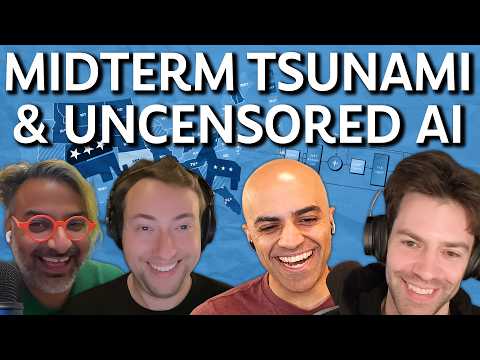
🌊 Midterm Tsunami & Its Impact on Crypto
  • The Democrats achieved a surprising landslide victory in the midterms—a “mega tsunami.” Prediction markets like Polymarket were highly accurate, while traditional polls underestimated Democratic strength.
  • Crypto industry: Many pro-crypto candidates were elected (226 in the House, 19 in the Senate). That’s a silver lining, but the next two years will focus on Trump corruption investigations; concrete crypto legislation is unlikely.
  • The panel agrees: Trump has become toxic for the GOP; the party must reposition for 2028.
📊 Equity Perps – CFTC Opens Door, Lawsuit Follows
  • The CFTC now permits trading of single-stock perpetual futures in the U.S. Citadel and SIBO immediately sued, arguing these instruments are swaps.
  • Market makers welcome the new product; the lawsuit is seen as an attempt to slow down competition.
đŸ€– Anthropic & AI Risk: Recursive Self-Improvement
  • Anthropic reported $17B revenue in Q3 (+50% QoQ) and a slight operating loss. New in its risk factors: RSI (Recursive Self-Improvement) – the possibility that AI models self-improve, causing exponentially accelerating progress.
  • The midterm results may slow U.S. data center builds, which could concentrate market power among existing hyperscalers and push compute abroad.
🧠 Uncensored AI – “Obliteration” Models: Freedom vs. Danger
  • Obliterated AI models (open-source without refusal training) are vital for cybersecurity, red-teaming, and defensive use. The Foundation for American Innovation warns they enable bad actors.
  • The panel argues that banning them would violate free speech and be technically impossible. Instead, providers must take responsibility for misuse – similar to crypto regulation (U.S. vs. non-U.S. services).
Did Elon Musk Just BURST the AI Bubble?
3 min read

Did Elon Musk Just BURST the AI Bubble?

Elon Musk published multiple posts over two weeks targeting the weaknesses of the neo-cloud market. He warned about massive debt, rapid chip depreciation, and an impending credit crunch. Shares of many neo-clouds subsequently dropped sharply.

What are Neo-Clouds?
  • Companies that buy AI computing power (mostly Nvidia GPUs) with borrowed money and lease it to big tech firms.
  • The model: loan → chips → lease contracts → collateral for lenders.
  • Key issue: Chips lose value quickly (new Nvidia generations), while loans run for years.
Musk's Warnings in Detail
  • October 12: Endorsed a post calling AI investors 'casino players'.
  • October 13: Reacted to falling Coreweave bonds (yield ~15%) with 'Ouch'.
  • October 25: Full threat: Credit markets are closing for neo-clouds without other revenue. Consequence: 'stranded compute' (expensive chips in never-completed data centers).
  • Comparison with SpaceX: SpaceX secured $40B for GPUs but has revenue from Starlink and rocket launches – unlike neo-clouds.
The Weak Spot: Debt vs. Chip Depreciation
  • Neo-clouds like Coreweave have $35B in direct debt. Bonds traded below 80 cents, yield ~15% → warning signal.
  • Coreweave's backlog: $104B in future revenue, but dependent on one client (Microsoft ~2/3).
  • Other neo-clouds (e.g., Nebius) have more cash reserves, but over 200 smaller operators lack both backlog and reserves.
Interconnections with the Entire AI Industry
  • Lenders: Private credit funds (Blackstone, Apollo etc.) lend against GPUs as collateral.
  • Nvidia: Sells chips, holds an equity stake in Coreweave and has committed to lease unused capacity – a circular system.
  • Clients: Microsoft, OpenAI, Meta, Google lease capacity → part of their AI infrastructure relies on debt.
Timing Problems
  • Data centers require power, cooling, and networking. Delays mean chips (and interest) accrue before revenue starts.
Musk's Possible Motive
  • SpaceX has committed $40B GPU financing and is in direct competition with neo-clouds for chips, power, and loans.
  • Musk's warnings potentially weaken OpenAI (a major neo-cloud tenant) and strengthen SpaceX’s bargaining position.
  • Conclusion: Market movements (Coreweave bonds fell before Musk's comments) show real pressure, but Musk has his own agenda.
Outlook
  • Analysts like Goldman Sachs remain bullish due to backlogs. Nvidia CEO Huang sees immense demand.
  • Nevertheless: Credit markets are tightening, and many neo-clouds may cease independent operations by 2030 (Gartner predicts over 80%).
Long Gold And Short Semis Into Year-End? | Weekly Roundup
3 min read

Long Gold And Short Semis Into Year-End? | Weekly Roundup

Big Picture: The Post-Midterms Clearing Event
  • The market is experiencing a violent shakeout after the midterm elections. Intense, head-spinning volatility (three sigma reversals) makes it very difficult to trade the broad indices.
  • The analogy is Q4 2018, where the S&P slid into year-end after the midterms.
  • Key message: Don't get confused by the index noise. The real story is a massive rotation between sectors.
The Core Trades Into Year-End
  • Long Gold, Short Semis is the central thesis.
    • Gold: Holding strong above $4,000. The dip below the summer lows followed by an immediate recovery (no follow-through selling) signals a strong floor. Gold is doing exactly what it should be doing: staying resilient while tech implodes.
    • Semiconductors (Semis): The AI bubble is officially broken. The SMH chart is falling from the 600s towards 350. The Anthropic IPO is viewed as a potential peak selling event rather than a catalyst for another leg up.
    • Bonds: The bond market bottomed in October. This is considered a historic low and is respected by the market. Recovery will be extended, making this a solid long position.
Sector-Specific Plays
  • Tech (Avoid / Short): The weak link. Banks like Goldman and JP Morgan are artificially supporting the sector to push AI capex sales, but the underlying liquidation is strong. Avoid the hype.
  • Home Construction (Opportunity): Felix points out this sector is unchanged on the year despite facing high mortgage rates and diesel costs. It has a beautiful flat bottom and reacts well to the bond market turning.
  • Basic Materials & Natural Resources: Likely to survive the tech deleveraging. Industrials and miners form the foundation of a defensive portfolio.
  • Oil (The Wild Card): A nightmare to trade due to political chaos (Iran talks, refinery attacks). However, relying on the instability could pay off if peace talks fail.
  • Crypto: Took a credibility hit with a massive hack, but the chart structure (blue sky breakout) remains intact.
Risk Management Strategies
  • The Three-Prong Approach: To enter a position against resistance:
    1. Set a bid below current market.
    2. Have a stop-buy above to get stopped in.
    3. Use an 'egg timer' (time-based commitment) to force a partial position if the others don't fill.
  • Sector Focus: Ignore the S&P confusion. Focus on the crosscurrents (Gold vs. Tech).
  • Quote: "Good prices, good things. Bad prices, bad things." Don't get suckered into risky prices just because a ticker looks cheap.
Event Note
  • Don't miss the TG Conference in Nashville in February. Guest list includes Grant Williams, Jared Dillian, Johnston, and Michael Howell. The in-person vibe is described as a "new luxury good."