Nofinity Logo

Latest Analyses(7)

This AI Trading Strategy Made Me $8,262 This Week. AMA.
2 min read

This AI Trading Strategy Made Me $8,262 This Week. AMA.

The creator presents an AI trading strategy that earned $8,262 in one week. He explains the architecture and offers insights into building and using AI bots.

The Strategy
  • Starting capital $20,000, 9 trades with 8 wins and 1 loss (88% win rate).
  • Used a combination of Bollinger Bands and RSI, executed via Claude Code with an MCP server.
  • The bot can take both long and short positions.
Setup and Recommendations
  • Step 1: Connect Telegram or Claude Code to your exchange (e.g., Bybit).
  • Step 2: Test with small amounts (e.g., $50) and automate simple trades.
  • Step 3: Add your own market views and indicators.
  • Important: AI is not yet fully reliable – keep control over larger positions.
Market Outlook
  • Bitcoin: Cautious short-term due to ETF outflows and weak relative strength vs. Nasdaq. Long-term still bullish.
  • Altcoins: Focus on AI coins and projects with real inflows (e.g., Zcash, VVV).
Future Plans
  • Planned comparisons between different LLMs (Claude, GPT, Gemini).
  • An alpha scanner for X is being developed to identify top setups.
Why Did 67 Companies Opt Out of Tokenized Stock Trading on OKX ICE?
2 min read

Why Did 67 Companies Opt Out of Tokenized Stock Trading on OKX ICE?

Background and Controversy
  • 67 companies opted out of tokenized stock trading on OKX ICE's Tokenized Stock Venue (TSV), leaving mostly crypto-related firms as participants.
  • Reasons: lack of understanding, short 30-day opt-out deadlines, and legal warnings from law firms pushing hasty rejections.
  • Negative past experiences with unregulated offshore tokenization (e.g., AMC/Robinhood) fueled distrust.
SEC's Innovation Exemption
  • Effective September 17, 2025: a 5-year conditional exemption allowing TSVs to trade tokenized listed stocks via permissioned Automated Market Makers (AMMs) without registering as exchanges.
  • Key design choices:
    • Issuer consent (30-day opt-out) – issuers can opt back in later.
    • Volume caps: 25 bps for liquid stocks, 2.5% for less liquid ones.
    • No synthetic derivatives – all original rights (dividends, voting) must be preserved.
  • Goal: controlled innovation, followed by permanent rulemaking by 2027.
Differences in Tokenization Models
  • Securitize (Brett Redford): Custodial model using broker-dealers and best execution – similar to traditional trading, no opt-out. Benefits: 24/7 trading, DeFi utility, direct investor visibility.
  • TSV model (e.g., OKX ICE): Enables peer-to-peer trading without intermediaries, but different pricing mechanisms (AMMs). Requires issuer consent.
  • Offshore synthetics: Offer no voting or dividends, not SEC-regulated – carry counterparty risk (total loss if issuer fails).
Current Market Developments
  • First TSV: Canton (Nov 4) with only one stock – likely a PR move.
  • OKX ICE: Launching Nov 23 with over 70 assets, including Strategy, Coinbase, Robinhood, and 59 ETFs.
  • Other players: DTCC (tokenization service), NASDAQ (Avalanche), Formation Securities (Solana) – a competitive landscape.
  • SEC is monitoring pricing, arbitrage, and compliance (e.g., OFAC rules).
Future Outlook
  • ETFs are prime candidates for tokenization; SEC is open.
  • Rulemaking expected by 2027 – possibly allowing synthetic forms.
  • SEC's Jamie Celway emphasizes: competition drives innovation – aim is a sustainable, regulated ecosystem.
Stock Market: The Breakdown Continues
2 min read

Stock Market: The Breakdown Continues

Current Market Situation: The Breakdown Continues

The S&P 500 has fallen another 1% and remains in a correction. Top-building processes (phases where a market high forms) often take weeks, while lows are reached more quickly. The current pattern shows repeated recoveries and renewed declines.

Targets and Potential Downside Moves
  • Short-term target: Testing the low below 7,200 points.
  • A 10% decline would bring the S&P to around 7,000 points, while a 20% decline would target about 6,200 points.
  • A 20% drop would be comparable to the 2025 tariff crash.
Nasdaq: Stronger Losses and Historical Patterns
  • The Nasdaq is over 15% below its highs and hit a new local low on November 17, 2026.
  • Historically, midterm years (e.g., 2018, 2022, 2014) often see a correction at the beginning and another at the year-end. This pattern is repeating in 2026.
  • A comparison with 2018 shows similarities: sell-offs in January, a recovery, and renewed sell-offs in Q4.
Influencing Factors: Interest Rates, Dollar, and Metals
  • Rising 10-year yields and a strong US dollar weigh on markets, especially long-duration assets.
  • The Fed raises rates in a strong economy, which often triggers corrections (similar to 1997).
  • Metals (gold, silver) continue to weaken, hitting new lows. Historically, stock markets only find a bottom after metals.
Outlook and Risks
  • The correction may last until the December FOMC meeting.
  • 2026 is described as a
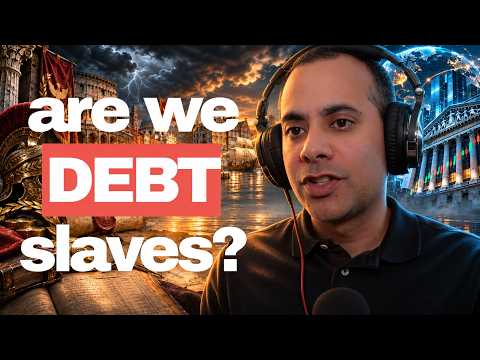
Today’s Debt Crisis Started In 1694 with E.M. Burlingame
5 min read

Today’s Debt Crisis Started In 1694 with E.M. Burlingame

Introduction to E.M. Burlingame
  • E.M. Burlingame has an unusual background: from tech investing and financial analysis (focusing on fraud detection in China) to serving in the Green Berets and completing doctoral studies in computational engineering.
  • He deeply explores how the world works and who the real power players are.
The Three Fundamental Archetypes of Power
  • Burlingame distinguishes three fundamental archetypes found across all mammalian and even single-celled life:
    • Resentfuls (those motivated by envy)
    • Responsibles (those motivated by gratitude)
    • Adoptables (the 50% in between, motivated by a mix of both)
  • The eternal conflict is the struggle between Responsibles and Resentfuls over the Adoptables.
  • Modern forms of Resentfuls are Marxists and National Socialists. The Responsibles are everyone else.
Financialists: The System of Debt
  • Financialists are those who see the world only in numerical values and seek to convert everything into financial assets ("Financialization of everything").
  • Their goal is the extraction of value through a complex system of debt and derivatives.
  • Burlingame views Financialism as a religion that replaced Christianity in the 17th century (Peace of Westphalia 1648, "Inglorious Revolution" 1688).
Historical Roots: Rome and the Praetorians
  • Julius Caesar and Augustus created the Praetorian Guard as a security apparatus.
  • After Augustus, the Guard became the real power in the empire, manipulating and killing emperors (e.g., four emperors in one year).
  • They developed sophisticated derivatives and financial instruments to conceal their wealth and plunder the Roman Empire.
  • The fight against the Praetorians led to the division of the Roman Empire (East/West) and the Battle of the Milvian Bridge (312 AD).
Byzantium and the Fight Against the Praetorians
  • The Eastern elites tried to free themselves from Praetorian influence by retreating to Byzantium (Constantinople).
  • The Praetorians took revenge through the Fourth Crusade and the sacking of Constantinople.
  • Burlingame sees the direct successor of Byzantium in modern Russia (Rurik dynasty, Orthodox Church). The war in Ukraine is a remnant of this ancient conflict.
Venice: The Birthplace of Modern Financialism
  • After the fall of the Western Roman Empire, the Praetorians fled to the lagoons of Venice.
  • There, they developed a new financial system based on debt and contracts to replace the Roman slave economy.
  • Venice used maritime trade, maritime insurance, and admiralty law (Roman contract law) as tools of power.
  • The Peace of Westphalia (1648) formalized the power of Financialism in Europe.
The Rise of England and the Struggle for Sovereignty
  • Alfred the Great created Common Law, based on individual sovereignty, private property, and separation of powers – as a bulwark against Rome.
  • The Financialists tried to infiltrate England, first through joint-stock companies (VOC, British East India Company), then through the Glorious Revolution (1688).
  • In 1694, the Bank of England was founded, establishing state debt as sovereign. This effectively enslaved the English-speaking peoples.
The Present: The Fight Against Financialism
  • The struggle remains the same: Slavers vs. Anti-Slavery.
  • According to Burlingame, Russia and China have freed themselves from Financialism.
  • America is in the midst of a liberation process, but the outcome is uncertain.
  • Hope lies in the unique history and legal structures of the English-speaking peoples (Common Law).
Actionable Advice
  • Think locally: Focus on your community, your neighborhood, and your state.
  • Understand the laws: Learn your state's constitution and your rights.
  • Build relationships with your neighbors.
  • Ignore the global stage: The big world is mostly irrelevant to your life.
  • Reading: Read Burlingame's own works ("The Eternal War", "The Sovereignist Essays") and Japanese koans to liberate your mind.
  • Have faith: Your ancestors have won this fight for over 1,200 years, time and again.
Conclusion

The current debt crisis is the result of a 2,000-year-old power struggle between those who wish to enslave people (Financialists) and those who defend freedom and sovereignty. Understanding the historical roots provides the strength to fight for a better world in your own environment.

Extreme Fear đŸ˜± Worst Crypto November Since 2018. Where's the Bottom?
2 min read

Extreme Fear đŸ˜± Worst Crypto November Since 2018. Where's the Bottom?

Market Sentiment: Extreme Fear 🚹

The Fear & Greed Index hit 12 (Extreme Fear). Crypto is experiencing its worst November since 2018, down 17.6%.

Crypto Carnage: Bitcoin & Ethereum
  • Bitcoin (BTC): Dropped to ~$64k. Long-term holders are dumping (74k BTC). Supply in Profit is at bear market lows – a classic bottom signal.
  • Ethereum (ETH): Absolute bloodbath. Massive ETF outflows, MVRV stuck below 1.0 (average coin held at a loss). Tom Lee's wallet (BitMine) lost 46%, amounting to a staggering $9.3 billion loss.
Liquidity and Contagion
  • Stablecoins: Total supply dropped $4 billion. Ethereum alone saw outflows of $3.12 billion in a week. Liquidity is fleeing the system.
  • Silver: Adjusted for inflation (M2 growth), silver has lost 92% of its purchasing power since 1980.
  • Tech & Semis: The Semiconductor index dropped 4.8% (double the S&P 500's volatility). Fear of rising rates and slowing AI capex is weighing heavily on the sector.
Bright Spots: Solana, Nvidia & SpaceX
  • Solana (Breakpoint): Huge adoption. Firedance V1 went live on Mainnet. Solana handles 70% of all crypto transactions. Partnerships with DTCC (stock settlement) and Western Union.
  • Nvidia: Beat earnings estimates ($2.68 EPS vs. $2.47 est.). The underlying demand for compute remains insatiable.
  • SpaceX: CFO Brett Johnson confirmed zero slowdown in compute demand. Orbital data centers (targeting 2027) are projected to be 50% cheaper per watt than terrestrial alternatives ($30 vs. $60).
Bottom Line

Despite the grim numbers, multiple bottom signals are emerging. The AI infrastructure cycle (Nvidia, Solana, SpaceX) shows no signs of stopping. The fuse for a recovery might be closer than the fear suggests.

New Corvette Grand Sport: Don’t Buy A Porsche 911 GT3! | 4K
3 min read

New Corvette Grand Sport: Don’t Buy A Porsche 911 GT3! | 4K

New Corvette Grand Sport: The Best Sports Car Bargain?

Dive into the world of the new Corvette Grand Sport (C8), a car not officially sold in Europe, yet potentially one of the best value propositions in the automotive world, according to Top Gear.

Background & Positioning

  • The Grand Sport is the middle variant of the C8 generation: more power than the base Stingray, but less extreme than the Z06 or ZR1.
  • Starting price: approx. $86,000. The fully loaded test car costs $131,000 – still less than a base Porsche 911 in the US.

Engine & Performance

  • New 6.7-liter naturally aspirated V8 (LS6) producing 535 hp – no turbochargers, pure character.
  • Performance on par with a Porsche 911 GT3, but for significantly less money.
  • Standard electronic limited-slip rear differential and revised suspension.
  • Optional Z52 packages with semi-slick tires (Cup 2R) and carbon-ceramic brakes.

Driving Feel & Handling

  • Surprisingly agile and responsive for a car weighing approx. 1.7 tons.
  • Tremendous grip (especially with the optional slick tires).
  • The gearbox works well with the engine.
  • Despite its sportiness, it remains comfortable and livable on the highway.
  • Only criticism: The drive mode selector is somewhat complicated and less intuitive than in a Porsche or Ferrari.

Design & Interior

  • Exterior: The striking blue color (Admiral Blue) with white stripes is a homage to the 1995 original. The quad-exit central exhaust (option, $2,000) looks spectacular.
  • Removable roof (Targa top) can be easily stowed in the large trunk (behind the engine). No compromise on rigidity.
  • Interior: Significantly improved – the annoying 'wall of buttons' has been replaced with standard switches. The sport seats (option, $1,995) are comfortable and supportive.
  • Character is key: The car feels honest and passionate.

Conclusion & Key Takeaways

  • The Corvette Grand Sport is the complete package: exciting, fast, livable, and affordable.
  • Best-sounding production supercar – the V8 sounds incredible.
  • For the price of a base 911, you get a near-GT3 competitor.
  • Available without a VIP list – a high-quality, 'no-nonsense' sports car.

Core Message: The Grand Sport is the best surprise of the year – an American muscle car that makes European supercars look overpriced.

Anthropic-IPO: I'm Subscribing! // The Big Analysis of the Claude Stock
2 min read

Anthropic-IPO: I'm Subscribing! // The Big Analysis of the Claude Stock

The Biggest AI IPO of All Time

Anthropic, the creator of Claude, is going public on November 19th, with a valuation of $1.4 Trillion. Mario Lochen and Sinan Krieger break down the massive opportunities and risks.

The Brutal Growth Story
  • Revenue: $17 Billion in Q3 (12x YoY growth).
  • Customer Stickiness: $1M clients now spend an average of $9M – a net revenue retention of 900%.
  • Profit Warning: A net loss of $104 Billion, mostly a book loss from convertible bonds.
Significant Risks
  • Infrastructure: Commitments totaling $900 Billion for data centers.
  • Politics: Conflicts with the Pentagon and increasing regulatory scrutiny.
  • Stock Price: The IPO price can rise from $70-$78 to as high as $120.
Why This Investment? (Sinan Krieger's Perspective)

Sinan (Beating Beta), a strict ETF investor, is making an exception. The reason: Claude as a truly disruptive technology. In his company, Claude cut the layout process for reports from one week down to 12 minutes.

Historical Insight: Disruptive tech (Auto, Internet) always wins eventually, but 90% crashes (like Amazon/Nvidia) are a real possibility.

The Three Stock Price Scenarios (2030)

Analysis based on an issue price of ~$74:

  • 🟱 Base Case: $108
  • 🟱 Bull Case: $247
  • 🔮 Bear Case: $19 (a 74% loss)
Conclusion

There is immense potential from productivity leaps, but a strong warning against hype and FOMO. A strategic, long-term entry is recommended, but investors must be prepared for the very real risk of losing their entire investment.