Nofinity Logo
Onboarding

Welcome to Nofinity

Your premium hub to transform hours of YouTube video into concise, 5-minute text summaries. Build your custom expert feed!

1. Skip the Video

Save hours of watching. Read compact, AI-powered key takeaways in a premium magazine layout – completely ad-free.

2. Custom Feed

Subscribe to top experts in the Explore area to curate your personal, dynamically updating video feed.

3. Suggest Channels

Propose new YouTube channels. Once approved, our system automatically ingests and summarizes new uploads.

Latest Analyses(7)

The AI Bubble is About To Hit EVERYTHING
Coin Bureau|17. Aug.

The AI Bubble is About To Hit EVERYTHING

A Record Deal with Negative Consequences

Nvidia secured over $500 billion from six major financial firms for AI infrastructure – yet its stock fell 2.6%. The market saw this not as growth, but as a sign of a credit bubble.

Where's the Money? Tech Giants' Cash Cows Are Drying Up
  • Amazon spent $54.2B on capex and posted negative free cash flow of $8.8B.
  • Alphabet reported its first-ever negative free cash flow (−$5.9B).
  • Meta spent $30B+ but scraped out only $1.7B positive.
  • Oracle had −$1.9B on $16.5B in spending.
  • Only Microsoft remains solid: $35.8B spending, $19.6B positive free cash flow.

PIMCO estimates that capex now consumes 94% of hyperscaler operating cash flow – up from under 50% two years ago.

The Bond Market Steps In

The gap is filled by debt, not profits:

  • Tech companies issued roughly $225B in bonds during the first half of 2025.
  • By mid-2026, issuance jumps from $16.7B (2024) to $193B – nearly a tenfold increase.
  • Morgan Stanley and JPMorgan see $1.5 trillion in new data center debt needed by 2028.

Examples:

  • Alphabet added $21.1B in net debt.
  • Meta added $25.9B.
  • Amazon's long-term debt rose 81% to over $119B.
  • Oracle carries $156B in total debt with negative free cash flow; S&P downgraded it to BBB− (one notch above junk).
Dangerous Structures: Vendor Financing and Circular Funding
  • Vendor Financing: Nvidia indirectly finances its own customers by guaranteeing loans (up to 25%, or $125B exposure).
  • The Bank for International Settlements (BIS) warns in its annual report that circular AI financing is one of the top three risks to global financial stability.
  • GPUs lose value quickly, while debt runs for decades – a dangerous maturity mismatch.
Far-Reaching Impact Beyond AI
  1. Concentration: The 'Magnificent 7' now make up 34% of the S&P 500 – a new record. A bursting AI bubble would hit broad indices and thus pension funds directly.
  2. Rate Pressure: Hyperscaler issuance pushes 30-year US Treasury yields to 20-year highs (5.25%). Every borrower (corporates, mortgages) competes for scarce capital.
  3. Private Credit: Lending to AI/cloud companies rose from $3B (2010) to over $40B (2025). About 20% of private credit funds have already made AI loans.
Historical Parallel: The Dot-Com Bubble

Similar to Lucent and Nortel in the 1990s (who financed customers to book revenue), AI infrastructure might be built years too early. Back then, over 90% of telecom high-yield debt defaulted.

What This Means for You
  • Index funds, workplace pensions, target-date funds: You already hold roughly one-third of your equity allocation in this bet.
  • Bond funds: The AI share is growing here too.
  • Alternative assets like gold (currently over $4,450/oz) and Bitcoin (around $65k) could benefit as capital rotates.
Conclusion

The AI bubble is no longer just a technology bet – it has become a credit risk that spreads through pensions, insurers, and bond markets to the entire economy. If expected revenues (e.g., from AI apps) don't arrive quickly, massive write-downs loom. The question: Are markets rational, or is this a ticking time bomb?

Called $90K Bitcoin for October… We Just Hit $87K in 2 Weeks 📈
InvestAnswers|21. Sept.

Called $90K Bitcoin for October… We Just Hit $87K in 2 Weeks 📈

The Bitcoin price has surged from $68,000 to $87,000 in just two weeks, approaching the predicted October target of $90,000. Exchange-traded funds (ETFs) are seeing strong inflows, and long-term holders have significantly reduced their selling, which is considered a bullish signal. The price has broken through the 50-week moving average, suggesting further gains, while institutional investors are increasingly using MicroStrategy to gain exposure to Bitcoin. The purchasing power of the US dollar continues to decline due to inflation.

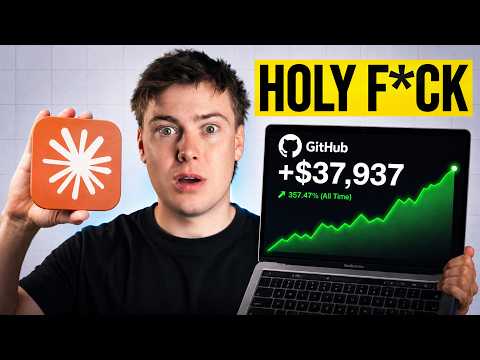
3 free Github repos to print $$$ AI trading
Miles Deutscher Finance|21. Sept.

3 free Github repos to print $$$ AI trading

Introduction

If building your own trading bot feels overwhelming, there are professional developers who have done it for free on GitHub. This video covers my top three repositories for executing trades, along with setup and usage tips.

Repo 1: Freak Trade
  • Function: Free, open-source crypto trading bot in Python, supporting all major exchanges and controlled via web UI or Telegram.
  • Features: Backtesting, plotting, money management, and machine learning for strategy optimization.
  • Key Point: Beginner-friendly with pre-built parameters and risk settings. Also supports stocks, commodities, and FX via exchanges like Binance or Hyperliquid.
  • Live Trading: Control via Telegram commands (e.g., /performance, /start, /stop). Includes built-in backtesting with historical data and a dry run feature.
  • Conclusion: Perfect for those wanting a ready-to-use solution without deep programming.
Repo 2: Vibe Trading
  • Function: Personal trading agent with self-improving features to generate and test strategies.
  • Features: Answer market questions, backtest, review trades, read institutional filings, run analyst teams, and access a library of over 450 pre-built alpha factors.
  • Application: Ideal as a research and strategy development tool before live trading. Can connect to Alpaca for paper trading.
  • Example: Tested momentum strategies for NVDA, META, AAPL, MSFT, and AMZN, backtested with realistic fees, and set up paper trading with $100k.
Repo 3: No FX
  • Function: AI trading terminal for stocks, commodities, forex, and crypto.
  • Features: Autopilot mode, no need for personal hardware – everything runs on their servers. Provides a dashboard with liquidation maps, order books, signal matrix, and orchestration.
  • Application: Create and execute strategies directly via the web interface on Hyperliquid or other exchanges.
  • Advantage: Very user-friendly as the infrastructure is pre-built.
Conclusion & Recommendations
  • Recommendation: Try all three repos as they serve different purposes. You can combine tools, e.g., use Vibe Trading for strategy development and Freak Trade for execution.
  • Tip: Experiment with paper trading to test strategies risk-free. This is the best way to learn and improve AI trading.
  • Additional Info: For setup guides and community access, check the description.