Nofinity Logo

Latest Analyses(7)

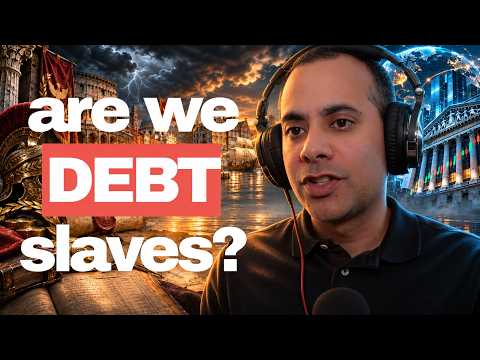
Today’s Debt Crisis Started In 1694 with E.M. Burlingame
5 min read

Today’s Debt Crisis Started In 1694 with E.M. Burlingame

Introduction to E.M. Burlingame
  • E.M. Burlingame has an unusual background: from tech investing and financial analysis (focusing on fraud detection in China) to serving in the Green Berets and completing doctoral studies in computational engineering.
  • He deeply explores how the world works and who the real power players are.
The Three Fundamental Archetypes of Power
  • Burlingame distinguishes three fundamental archetypes found across all mammalian and even single-celled life:
    • Resentfuls (those motivated by envy)
    • Responsibles (those motivated by gratitude)
    • Adoptables (the 50% in between, motivated by a mix of both)
  • The eternal conflict is the struggle between Responsibles and Resentfuls over the Adoptables.
  • Modern forms of Resentfuls are Marxists and National Socialists. The Responsibles are everyone else.
Financialists: The System of Debt
  • Financialists are those who see the world only in numerical values and seek to convert everything into financial assets ("Financialization of everything").
  • Their goal is the extraction of value through a complex system of debt and derivatives.
  • Burlingame views Financialism as a religion that replaced Christianity in the 17th century (Peace of Westphalia 1648, "Inglorious Revolution" 1688).
Historical Roots: Rome and the Praetorians
  • Julius Caesar and Augustus created the Praetorian Guard as a security apparatus.
  • After Augustus, the Guard became the real power in the empire, manipulating and killing emperors (e.g., four emperors in one year).
  • They developed sophisticated derivatives and financial instruments to conceal their wealth and plunder the Roman Empire.
  • The fight against the Praetorians led to the division of the Roman Empire (East/West) and the Battle of the Milvian Bridge (312 AD).
Byzantium and the Fight Against the Praetorians
  • The Eastern elites tried to free themselves from Praetorian influence by retreating to Byzantium (Constantinople).
  • The Praetorians took revenge through the Fourth Crusade and the sacking of Constantinople.
  • Burlingame sees the direct successor of Byzantium in modern Russia (Rurik dynasty, Orthodox Church). The war in Ukraine is a remnant of this ancient conflict.
Venice: The Birthplace of Modern Financialism
  • After the fall of the Western Roman Empire, the Praetorians fled to the lagoons of Venice.
  • There, they developed a new financial system based on debt and contracts to replace the Roman slave economy.
  • Venice used maritime trade, maritime insurance, and admiralty law (Roman contract law) as tools of power.
  • The Peace of Westphalia (1648) formalized the power of Financialism in Europe.
The Rise of England and the Struggle for Sovereignty
  • Alfred the Great created Common Law, based on individual sovereignty, private property, and separation of powers – as a bulwark against Rome.
  • The Financialists tried to infiltrate England, first through joint-stock companies (VOC, British East India Company), then through the Glorious Revolution (1688).
  • In 1694, the Bank of England was founded, establishing state debt as sovereign. This effectively enslaved the English-speaking peoples.
The Present: The Fight Against Financialism
  • The struggle remains the same: Slavers vs. Anti-Slavery.
  • According to Burlingame, Russia and China have freed themselves from Financialism.
  • America is in the midst of a liberation process, but the outcome is uncertain.
  • Hope lies in the unique history and legal structures of the English-speaking peoples (Common Law).
Actionable Advice
  • Think locally: Focus on your community, your neighborhood, and your state.
  • Understand the laws: Learn your state's constitution and your rights.
  • Build relationships with your neighbors.
  • Ignore the global stage: The big world is mostly irrelevant to your life.
  • Reading: Read Burlingame's own works ("The Eternal War", "The Sovereignist Essays") and Japanese koans to liberate your mind.
  • Have faith: Your ancestors have won this fight for over 1,200 years, time and again.
Conclusion

The current debt crisis is the result of a 2,000-year-old power struggle between those who wish to enslave people (Financialists) and those who defend freedom and sovereignty. Understanding the historical roots provides the strength to fight for a better world in your own environment.

Why Teams of AI Agents on Open Models May Someday Outpace Frontier Models
2 min read

Why Teams of AI Agents on Open Models May Someday Outpace Frontier Models

AI Agents as Economic Actors
  • Base is evolving from a blockchain for global finance to a blockchain for agent finance – much of the money flow will soon be managed by AI agents.
  • Two areas are growing rapidly: agentic payments (paying for inference and data) and agentic finance (e.g., trading strategies, high-frequency trading).
Open Marketplace for Agents
  • Today, frontier models dominate in a single-player mode – powerful, but lacking collaboration.
  • The thesis: teams of agents on open models may outperform frontier models, just as a team of people can outperform the smartest individual.
  • Such an open marketplace will naturally emerge on-chain, because agents are programmable and gravitate toward programmable money.
Future Outlook
  • After payments and finance, the next wave is the agent marketplace – a global venue for efficient trade. This theme will be prominent from 2027 onward.

Note: The transcript contains no imperial measurements.

Ferrari Ditches Hybrid! New 296 Challenge Stradale! | 4K
4 min read

Ferrari Ditches Hybrid! New 296 Challenge Stradale! | 4K

Overview: The New 296 Challenge Stradale

This video introduces the Ferrari 296 Challenge Stradale – a radical, road-legal track tool that ditches the hybrid system for pure internal combustion power. It's a faithful tribute to the Challenge Evo race car, offering an extremely purist driving experience.

Design & Aerodynamics: Racing for the Road
  • The car is an impressive imitation of the Challenge Evo race car.
  • The bodywork is packed with numerous aerodynamic fins, intakes, a large rear wing, and a massive diffuser.
  • Downforce has been increased by 72% compared to the standard 296 GTB. At 155 mph (249 km/h), the car generates 671 kg of downforce, with 250 kg coming from the rear wing alone.
  • The front vents efficiently channel hot air from the radiator over the hood and through the front fenders to optimize airflow. The front trunk remains partially usable (approx. 70 liters) despite the aerodynamic modifications.
Powertrain: No Hybrid, Pure Sound
  • The central feature: The hybrid system has been completely removed. This saves weight and creates a more purist character.
  • The car is powered by the familiar 3.0-liter twin-turbo V6 (F163). It produces 670 hp (matching the old 488, but with a smaller displacement).
  • Compared to the 296 Speciale (with hybrid), the Challenge Stradale has 200 hp less, but focuses on a revised torque curve and improved throttle response.
  • The exhaust is sourced from the Challenge race car, and a sound tube channels more engine noise into the cabin. A starter motor was added.
Chassis & Lightweight: Optimized for the Track
  • The Challenge Stradale is 140 kg lighter than the 296 GTB (about 70–80 kg lighter than the Speciale), primarily due to the removal of the hybrid system.
  • Optional carbon fiber wheels save 2 kg per corner. Carbon-ceramic brakes and significantly stiffer suspension (main springs nearly twice as hard) are standard.
  • For the first time, there is a two-stage Magnaride damping system offering different levels of stiffness on rough roads.
Interior: Driver Focus
  • The interior is stripped back and focused on the essentials. New carbon fiber panels save weight.
  • It features new, narrow sports seats (optional from the SF90 XX/F80) and a 6-point harness. The driving position is excellent.
  • Despite the racing focus, ADAS systems (lane keep assist, adaptive cruise control) are retained – a very unexpected feature.
  • The hybrid charging flap remains but now contains only a magnetic 12-volt connector for a trickle charger.
Positioning & Conclusion: The New Purist
  • The Challenge Stradale is not a limited edition – Ferrari will build as many as it can sell.
  • The price matches that of the 296 GTB (approx. £260,000 / €303,000), making it more affordable than the special series cars.
  • The author compares the strategy to Porsche (e.g., Turbo vs. GT): The Speciale is the maximized GTB, while the Challenge Stradale is the ultimate track tool.
  • Critique: The extreme aero styling covers up the elegant lines of the 296 GTB. The author expresses hope for a future, more subtle 'Touring' version.
Why Base's First Tokenized Stocks Launched Outside the US, and What's Next
2 min read

Why Base's First Tokenized Stocks Launched Outside the US, and What's Next

Why Base's First Tokenized Stocks Launched Outside the US
  • Strategic Decision: The first version of the tokenized equities product was launched outside the US, before the SEC's innovation exemption. The aim was to offer a globally accessible, fully backed non-debt security.

  • US Expansion: With the new SEC innovation exemption, Coinbase plans to bring the product to the US, seeing it as a huge innovation opportunity. It aims to show US companies the benefits, such as voting rights, dividends, and new features like equity rewards.

Insights into the B20 Version and Issuer Conversations
  • B20 Version: This is fully permissionless and integrated into DeFi, now listing 250 assets with deep liquidity and better execution than competitors.

  • Dialogue with Issuers: Conversations with CEOs are ongoing, but there is initial hesitancy due to technological changes. Coinbase prioritizes education and open dialogue to build trust, avoiding rushed moves.

Philosophy and Trust Building
  • Measured Approach: Coinbase favors a slow and steady approach, even if others move faster. The tokenized equities are 1:1 fully backed, without debt instruments, featuring voting rights and dividends.

  • Technology Speaks for Itself: The company emphasizes that the power of the technology – global internet money, near-zero cost, 24/7 availability – will ultimately convince. Customers receive honest pros and cons without exaggerated promises.

Mercadolibre MELI - Subprime 62% Interest Credit Expansion Makes 40% Growth UNSUSTAINABLE
2 min read

Mercadolibre MELI - Subprime 62% Interest Credit Expansion Makes 40% Growth UNSUSTAINABLE

Business Model and Growth Engine
  • 146 million buyers across 18 Latin American countries
  • Integrated ecosystem of marketplace, logistics, advertising, and fintech (Mercado Pago)
  • Revenue growth of 48% per year over the past six years, driven by credit expansion
The Credit Business – Core Risk and Opportunity
  • 62% interest rates on credit cards, targeting subprime and underbanked customers
  • High default rates: 7% NPLs (15-90 days), 18% after 90 days
  • Loan loss provisions of around 20% of each credit; gross margin (NIMAL) declining to 20%
  • Regulatory risk: Brazilian interest cap at 100% of loan principal
Growth Sustainability
  • Current price-to-earnings ratio of 40 with 40% growth – cheap but unsustainable
  • Analyst reduces long-term assumption to 20% or even 12%
  • A credit slowdown would also dampen e-commerce and advertising
  • 82% of Brazilian households in debt, 29% of income for debt service
  • Risk of a credit cycle crash with potential government intervention
Valuation and Conclusion
  • After adjustment, intrinsic value is below 1,000
  • Currently too risky from a value perspective; reevaluation at a price of 1,000
  • Main risk factor: credit quality and expansion
Context
  • Michael Burry holds the largest position but is seen as a gambler rather than a value investor
  • Compared to Amazon, MercadoLibre barely dilutes shareholders
How a Base Token Could Help Decentralize Coinbase's Blockchain
2 min read

How a Base Token Could Help Decentralize Coinbase's Blockchain

Focus on Decentralization and Token Strategy
  • Background: Over a year ago, Coinbase announced the exploration of a Base token to further decentralize its blockchain.
  • Philosophy: Initially, they deliberately avoided introducing a token to prevent distraction from noise and incentives. The goal was to achieve product-market fit purely from a product perspective, without mixing in economic incentives.
  • Progress: As Base matured (growing in rank, enabling trading and payments), a token was seen as a powerful lever for decentralization, aligning participants, and driving technological innovation.
  • Current Stance: Coinbase continues to explore the token launch but remains unhurried. The priority is to accelerate growth without derailing product goals via premature decisions.
  • Outlook: A token remains a future possibility, but no further details or timelines are available.
Stocks are crashing! When will it stop? THIS is what matters now // BRIEFING
2 min read

Stocks are crashing! When will it stop? THIS is what matters now // BRIEFING

Market Driven by Sentiment: Panic vs. Fundamentals
  • The market is currently ruled by panic and psychology, not fundamentals. Recency Bias and Negativity Bias distort reality.
  • Bears vs. Bulls: While bears celebrate the end of the AI bubble, bulls point to rock-solid fundamentals (Nvidia growth +103%) and missed gains from panic selling.
AI Sector Under Fire
  • Anthropic IPO: Successful launch, then heavy selling. A sentiment killer, but not the end of the story.
  • Nvidia: Despite record revenue and beating all estimates, the stock falls. Fear of rate hikes and new regulations outweigh the stellar earnings.
  • Everything is dropping simultaneously (Stocks, Gold, Crypto) – a clear sign of a liquidity-driven, sentiment-based selloff.
The Key Variable: The Fed & Interest Rates
  • Markets are pricing in an interest rate shock of up to 100 basis points.
  • Hope: Inflation is cooling. Goldman Sachs forecasts point towards a soft landing.
  • Risk Scenario: Rate hikes combined with an AI cooldown = recession. The analyst doesn't see this as the base case yet.
Actionable Advice: Hold Cash & Watch for Opportunities
  • Keep your powder dry. Mario himself holds roughly 20% cash, parked at XTB earning 4.5% interest.
  • Single Stocks: Despite the crash, stocks like SK Hynix are still massively up on a yearly basis. SpaceX is touted as a long-term high-risk, high-reward independence play.