
Nofinity Logo
Onboarding

Welcome to Nofinity

Your premium hub to transform hours of YouTube video into concise, 5-minute text summaries. Build your custom expert feed!

1. Skip the Video

Save hours of watching. Read compact, AI-powered key takeaways in a premium magazine layout – completely ad-free.

2. Custom Feed

Subscribe to top experts in the Explore area to curate your personal, dynamically updating video feed.

3. Suggest Channels

Propose new YouTube channels. Once approved, our system automatically ingests and summarizes new uploads.

Latest Analyses(7)

The Fellow ES1 Espresso Machine Review
James Hoffmann|13. Aug.

The Fellow ES1 Espresso Machine Review

Overview

The reviewer tested the Fellow ES1 ($1,500) over several months and gives a nuanced verdict: It can make excellent coffee, but has some weaknesses that matter differently depending on the user.

Strengths
  • Design & Build: Compact, elegant, high-quality finish – one of the best-looking machines in its price range.
  • Steam Wand: Classic wand with adjustable temperature cutoff; produces good microfoam.
  • Temperature Management: Large water tank, three cup-warming spots, offset function for the first shots.
  • Pressure Profiling: Many presets (e.g., 9 bar, lever profile) and custom profiles via app.
  • Heating & Speed: Quick heat-up and good shot-to-shot recovery for most use cases.
Weaknesses
  • Portafilter: Cheap plastic handle, poor balance – surprising at this price point.
  • Pressure Accuracy: Set to 9 bar at the group, but actually delivers 10–11 bar (measured at puck). Causes channeling.
  • Ramp Down Function: Not a smooth decline; pressure just drops according to puck resistance – cannot create a controlled, long ramp.
  • App & Guardrails: Allows users to create unrealistic profiles that the machine cannot execute (overshoots, oscillations). No warnings.
  • Temperature Variance: Some fluctuation between shots; offset settings are hard to calibrate without external tools.
  • Gen 1 Risks: Difficult to repair at home, firmware updates promised but not guaranteed.
  • No Smart Scale Integration (only future firmware possibility).
Two Audiences – Two Verdicts
  1. Design & Convenience Seekers (want good looks plus helpful presets): Buy it – great everyday espresso and milk drinks with minimal fuss.
  2. Optimization Enthusiasts (want precise control): Not recommended yet – pressure control is too imprecise; better to wait for Gen 2 or choose competitors like Decent or Meticulous.
Final Take

The Fellow ES1 is a solid first-gen machine with stunning aesthetics and a promising feature set. It makes tasty coffee and steams well. However, the pressure profiling is not as refined as advertised, and the software lacks safeguards. If you value design and are happy with curated recipes, it's a good deal. If you want to tweak every variable, look elsewhere.

Passive Investing Is BREAKING The Market (Here’s What Happens Next)
Coin Bureau|27. Sept.

Passive Investing Is BREAKING The Market (Here’s What Happens Next)

The Unintended Consequences of Passive Investing

The original English title "Passive Investing Is BREAKING The Market (Here’s What Happens Next)" is summarized here. The transcript examines how the dominance of passive index funds is reshaping stock markets and now spilling into crypto.

Key Insights:

  • Passive funds as the marginal buyer: U.S. index funds and ETFs hold nearly $22 trillion, representing over half of all long-term fund assets. Money flows automatically into the market without any valuation judgment.
  • Rising market concentration: The top 10 stocks now make up about 40% of the S&P 500 – higher than during the dot-com bubble (2000: 26%). The “Magnificent 7” alone account for a third of the index (2022: 21%, 2015: 12%). Nvidia alone is worth $5.3 trillion.
  • Shrinking price discovery: Global sell-side research headcount has fallen by roughly one-third since 2008. Around 3,000 listed companies now have no analyst coverage at all. Fewer voices mean prices become less informative.
  • The flow multiplier: Every dollar flowing into the stock market can add about $5 to total market value – not because companies are more valuable, but because there are fewer sellers to push back.
  • Bitcoin as a flow asset: Spot Bitcoin ETFs now hold roughly $100 billion (≈6% of Bitcoin’s market cap). Major banks like Morgan Stanley and UBS are adding 1–4% crypto sleeves to model portfolios. Bitcoin’s 90-day correlation with the NASDAQ has dropped to 33%, while its correlation with gold climbed to 50%.
  • Bottom line: The market is increasingly driven by a buyer who never forms an opinion on what it owns. This can lead to distorted prices and greater fragility – a dynamic now extending to cryptocurrencies.

The analysis highlights that passive investing brings efficiency but also risks from diminished price discovery and extreme concentration. The same forces are now shaping Bitcoin and other crypto assets.

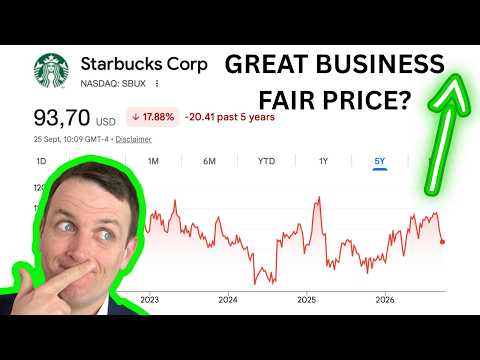
Starbucks SBUX Stock Analysis + Intrinsic Value
Value Investing with Sven Carlin, Ph.D.|27. Sept.

Starbucks SBUX Stock Analysis + Intrinsic Value

Current Situation

  • Starbucks (SBUX) stock down -20% over 5 years, market cap $108B, P/E ratio 54, dividend yield 2.61%.

New CEO

  • Returned 2 years ago (ex-Chipotle CEO 2018–2024). Goal: return to former strength. Early successes: comparable store sales improving, operating margin rising.
  • Challenges: dirty stores (especially in Europe), union disputes, higher prices → customer decline.
  • Sale of 60% of China business strengthens balance sheet.

Financials

  • Long-term strong revenue and profit growth (revenue 6x, profit 8x over 15–20 years).
  • Current: net income last 12 months only $2B (normal ~$4B). Last quarter: operating margin back to historical levels → possible turnaround.
  • $25B in buybacks at high prices, financed with debt – criticized as 'financial engineering'.
  • High leverage since 2018, limited benefit for shareholders.

Analyst View

  • Mostly 'Hold', only 12% strong buy. Analysts expect 20% earnings growth by 2028 and P/E of 25.
  • Speaker's estimate: long-term return of ~6% at current price (based on 5% dividend growth, 10% discount rate).
  • Worst case: if required dividend yield rises to 5%, stock must fall 50%.

Intrinsic Value

  • With a required 10% return, intrinsic value is far below current price.
  • Market appears satisfied with 6% return → implies 4% dividend yield in future.
  • Bottom line: Low expected return (5–6%) with high risk – comparable to Nike; better alternatives like Netflix, Meta, Fiserv with lower P/Es.

Conclusion

Starbucks has a strong brand and potential, but current price is high, return low. Investors should wait for sustainable profitable growth or a cheaper entry point.

New Vanguard ETF: Is It Better Than the FTSE All-World?
Finanzfluss|27. Sept.

New Vanguard ETF: Is It Better Than the FTSE All-World?

The New Vanguard FTSE Global All Cap ETF
  • Launch: Trading started in August 2026; it quickly gathered over $2 billion in assets.
  • Coverage: Tracks the FTSE Global All Cap Index, covering 98% of the global stock market (Large, Mid, and Small Caps from 48 countries; 10,113 stocks).
  • Cost: Extremely low Total Expense Ratio (TER) of just 0.07%.
  • Sampling: Uses optimized sampling (~6,429 stocks) to keep trading costs low while closely tracking the index.
  • Downside: Very young fund with no long-term tracking difference record available yet.
Comparison: The Perfect Combination?
  • Old Trade-off: Broad ETFs (incl. Small Caps) were expensive (~0.17%+). Cheap ETFs (0.07%) excluded Small Caps.
  • New ETF: Combines maximum diversification with rock-bottom costs.
Should You Switch Your Portfolio?
  • Diversification: The FTSE All-World or MSCI World already provide excellent diversification. The additional market cap coverage from Small Caps adds almost no measurable performance benefit due to their low weight in the index.
  • Costs vs. Taxes (Crucial Point):
    • Selling your old ETF in a taxable account triggers capital gains tax immediately.
    • Example: €25k portfolio (€7.5k profit). The new ETF saves you €25/year in fees, but selling incurs €1,121 in taxes. Break-even period: 45 years.
    • For most investors, a direct switch is not financially beneficial.
Conclusion & Recommendation
  • New Savings: This ETF is a new top contender and perfect for new investors or starting a new savings plan.
  • Existing Investors: Do not sell your current holdings. Instead, change your savings plan to the new Vanguard ETF to benefit from the 0.07% TER on future contributions.
  • Exception: The German "Altersvorsorgedepot" (Retirement Account), launching in 2027, allows tax-free switching, making a change much easier there.
Nivona Cube Review: Can a Fully Automatic Machine Taste Like a Portafilter Machine?
Kaffeemacher|26. Sept.

Nivona Cube Review: Can a Fully Automatic Machine Taste Like a Portafilter Machine?

Introduction

The Nivona Cube is a fully automatic coffee machine that borrows key techniques from manual espresso machines (portafilters) to overcome common flaws: uneven extraction and channeling.

Key Advantage: Manual Coffee Distribution
  • Biggest plus: You see the ground coffee before brewing and can distribute it evenly (tamping).
  • Traditional super-automatics create uneven coffee cakes → channeling → bitter and sour drinks.
  • Manual leveling ensures uniform extraction → much better flavor.
User Experience & Workflow
  • Removable brew basket (hand-wash only).
  • Conical burr grinder (grinds 12 g in ~8 seconds).
  • Grind settings: Fine (espresso) to coarse (lungo), but overall too coarse for true portafilter espresso.
  • Auto-tamping adjusts to coffee amount → clean puck.
  • Dead space (~12.5 g): Old grounds affect first brew; tip: preheat the basket for better results.
Espresso Test (1:2.5 Ratio)
  • 12 g coffee → 28–32 g brew → TDS ~6% ✅ qualifies as espresso.
  • Taste: Solid, but limited by crema valve and grinder.
    • Crema valve (fancy term for dual-wall basket) creates artificial pressure → fake crema (not flavor-relevant).
    • Grinder limit: Particle size in coffee-crema range (400 μm peak) vs. espresso (200-300 μm).
  • Temperature: Highest setting recommended (measured ~85°C without resistance).
Lungo Test (Coffee-Crema Zone)
  • 12 g coffee → 70 g brew (1:5.8) → best coffee-crema from a super-automatic in a long time.
  • Clean, full-bodied, sweet, cocoa-like – no stale machine taste.
  • Brew profiles:
    • Dynamic (1 bar): reduced flow → bitter-metallic; better for lighter roasts.
    • Constant (3 bars): recommended → slow pressure build → balanced, similar to vibe-pump espresso machines.
    • Intense (5 bars): extends extraction time → pointless for lungo; only for experimenting with light roasts.
  • Pre-infusion: Wets only ⅓ of the coffee bed → minimal effect.
Target Audience & Verdict
  • Best for:
    • Households wanting high-quality longer drinks (80–100 ml) rather than pure espresso.
    • Beginners who want more control than a standard super-automatic.
    • Those valuing easy cleaning (no internal mess).
  • Not ideal for:
    • Espresso purists → grinder too coarse, crema valve → dedicated espresso machine + grinder (e.g., Dedica + DF54 for ~€ 450) is superior.
  • Price: ~€ 430 (DE) / CHF 500 (CH).
Key Tips
  1. Preheat brew basket → massive flavor improvement.
  2. Use regularly (avoid long pauses) to prevent stale dead-space coffee.
  3. Quality coffee: Freshly roasted (check roast date), e.g., Compadre (darker roast) – balanced, chocolaty.
  4. Grind settings:
    • Espresso: finest grind + minimum water (~12 g / 30 ml).
    • Lungo: medium grind (level 3) + 70 ml.

Conclusion: The Nivona Cube is not a portafilter replacement, but the best compromise in the super-automatic market for long, clean coffee drinks. Manual distribution is the game-changer – simple, effective, and fun.