Finanzfluss
5 min read
Retirement Savings Depot 2027: Answers to Your Questions!
Basics & Inheritance
- Inheritability: Contributions and returns can be inherited, but allowances and tax savings must be repaid (like a termination). Exception: the spouse can continue the contract including the subsidy.
- In the payout phase, the remaining capital is inherited; with a life annuity, only if a guarantee period has been agreed.
- Converting Riester to AVD: Open a new AVD, then the provider can handle the transfer (authorization required). You can keep an old Riester contract alongside, but then the new subsidy rules apply to all.
- Transfer costs: Contract older than 5 years → free; younger → max. €150 from the old provider + max. €150 from the new provider.
- Wohn-Riester: Transferable during the savings phase; not if the loan is already being repaid.
- If your retirement income is significantly lower than your current income → tax deferral effect.
- Children increase the allowance (up to €300 per child per year).
- Crucial: Low costs are essential, otherwise the advantage is nullified.
- Disadvantages: Unknown future tax burden, less flexibility, high costs.
- Cost impact: 1% costs reduce a lump sum by about 25% over 30 years (assuming 7% return). With a savings plan, about 18% less.
- Two pots: The subsidized part (up to €1,800/year) is taxed at 100%. The non-subsidized part (€1,800–€6,840) is only taxed on gains; if paid out after 12 years and age 62, half the gain is taxable (half-income method).
- Allowances: Paid retroactively the following year (max. €540/year plus child allowances). Tax refund via tax return.
- Health insurance: Exempt from contributions if compulsory insured in the statutory health insurance for retirees (KVdR); otherwise, contributions are due.
- Home purchase/loan repayment: Withdrawal is tax-free, but deferred taxation via a housing subsidy account (spread over 5 years). Requirement: owner-occupancy. Not all providers offer this.
- Energy-efficient renovation: Minimum withdrawal €3,000, only for owner-occupied properties, no double subsidies, must be carried out by a specialist company.
- Self-employed: Can open an AVD and receive subsidies if they have income from business or self-employment and are under 67.
- Students/mini-jobbers: Eligible if subject to pension insurance (e.g., working students). Low contributions (€10–€30/month) yield a high subsidy rate (approx. 50%). Under 25: one-time career starter bonus of €200.
- Children: AVD possible for minors (early starter pension €10/month from 2026 for a specific birth cohort). Child allowance goes to one parent (transferable).
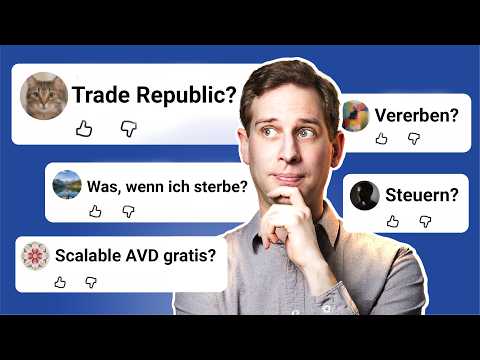
- Trade Republic: Likely a free AVD, but no details yet.
- Scalable Capital: Announces a free AVD (standard & self-managed), ETFs max. 0.15%.
- Cost changes: Providers can increase fees with 4 months' notice; then a free switch is possible.
- Opening a depot: A new depot is required; easier if you already have an account with the provider.
- Maximum contribution: €6,840/year per AVD, max. two AVDs (total €13,680). Subsidies only up to €1,800/year.
- Contribution flexibility: Freely increase/reduce, also irregular (depends on provider). Minimum contribution for subsidy: €120/year.
- Payout plan: At least 80% of the assets are distributed over the chosen term (min. until age 85). The provider may retain a 20% buffer. No pausing possible.
- Termination before retirement: Repay allowances and tax benefits; gains taxed at income tax rate. Only worthwhile with very low income at the time of termination.
- Savings phase: Keep the AVD and continue contributions. Subsidies only if still eligible (e.g., cross-border commuter, tax return in Germany).
- Payout phase: Within EU/EEA no problem. Outside EU/EEA: repay allowances and tax savings (provider offsets against payouts). Taxation depends on double taxation agreements.
- ETFs: Allowed up to risk class 5 (all common global ETFs). No individual stocks, crypto, gold ETCs. Standard depot has a low-risk and a higher-risk ETF.
- Risk class changes: Very unlikely for broad global ETFs; if it happens, the ETF is replaced in a standard depot; in a self-managed depot, it can no longer be purchased.
- Distributing ETFs: Allowed, but distributions must stay in the AVD.
- Guarantee: No capital guarantee for equity ETFs. Guarantee products possible via insurance (80–100% contribution guarantee).
- Deposit insurance: Cash account insured up to €100,000; the depot assets are segregated assets.
- Lifetime annuity: Possible by taking out a pension insurance or switching to a provider offering a life annuity before the payout phase.