Nofinity Logo

Latest Analyses(7)

3-Drug Combo Extends Lifespan by 41% | Dr. Irina Conboy
2 min read

3-Drug Combo Extends Lifespan by 41% | Dr. Irina Conboy

Dr. Irina Conboy (formerly UC Berkeley, now CSO at Generation Lab) discusses her latest study on selective targeting of cancer and senescent cells and the future of systemic rejuvenation.

Study Results: +41% Lifespan?
  • The triple combination (DMA) of dichloroacetate (DCA), metformin, and ABT263 (navitoclax) was tested in 18–20-month-old mice – equivalent to a 65–70-year-old human.
  • From treatment start, mice lived ~41% longer; relative to total lifespan, the extension was ~10–12%.
  • Importantly, the main goal was not lifespan extension but eliminating cancer and senescent cells together without harming healthy cells.
  • Mice showed improved treadmill performance and no increase in frailty – despite a chemo-like intervention.
Mechanism: A Shared Vulnerability
  • Cancer and senescent cells have damaged mitochondria and heavily depend on glycolysis.
  • DCA forces cells to push pyruvate into mitochondria and use oxidative phosphorylation.
  • Metformin inhibits mitochondrial electron transport (complex I), worsening the energy crisis.
  • ABT263 blocks BCL survival proteins, allowing cytochrome C release and triggering apoptosis.
  • Crucially, healthy cells have enough functional mitochondria and survive; diseased cells die selectively.
Safety and Key Features
  • ABT263 was used at only one-tenth of the usual dose to avoid thrombocytopenia (low platelets).
  • In vitro tests on various human cells showed: cancer and senescent cells were eliminated, while healthy liver and neuronal cells remained largely unaffected.
  • The authors view DMA not as a classic senolytic or chemotherapeutic, but as a dual-capacity therapy against both pathogenic cell types.
Outlook: Generation Lab and FDA
  • Generation Lab is developing an injectable substitute for therapeutic plasma exchange (TPE) that antagonizes age- and disease-elevated blood proteins and promotes tissue repair.
  • The drug "One Generation" consists of two FDA-approved components and is being prepared for clinical trials.
  • A potential indication is prevention and treatment of cardiovascular disease.
  • Dr. Conboy advises against biohacking with the combination until safety and dosing are validated in clinical trials.
The SEC Rule That Could Transform Small-Cap Capital Raising | Cromwell Coulson
2 min read

The SEC Rule That Could Transform Small-Cap Capital Raising | Cromwell Coulson

In this interview, Cromwell Coulson, CEO of OTC Markets Group, discusses his company's role, the challenges of capital raising for smaller companies, and pending SEC rule changes.

Key Points
  • OTC Markets Group: Operates alternative trading systems (ATS) for over-the-counter securities, focusing on transparency and efficiency.
  • Market Tiers:
    • OTCQX: Highest quality tier for ADRs and community banks.
    • OTCQB: Venture market for emerging companies with disclosure requirements.
    • OTC Pink: Basic market with varying disclosure levels (e.g., 'Pink Limited' with warning flags).
  • SEC Rule Proposals:
    • Modernization of registered offerings: Preemption of state 'blue sky' rules and expansion of ATMs (At-the-Market programs) to all exchange-listed and OTCQX/QB issuers.
    • Aim: Lower capital costs and more efficient fundraising for small caps.
  • Risk Flags:
    • Skull and crossbones flag as a warning for suspicious companies.
    • New flags for reverse splits (e.g., two reverse splits in two years leads to exclusion from OTCQX).
  • Tokenization: Seen as a useful technology but not a panacea; expected slow integration into existing systems.
  • Data Licensing: Fast-growing business; data as 'fuel' for AI and investment decisions.
  • Decline in Listings: Regulatory burdens and tax advantages of private alternatives (e.g., private equity) disadvantage public companies.
Conclusion

Coulson emphasizes the importance of transparency and the need for more companies to embrace public listing benefits – especially through upcoming SEC reforms that could revolutionize capital raising.

Beautiful, but with a catch: Nurri R-Type espresso machine tested
2 min read

Beautiful, but with a catch: Nurri R-Type espresso machine tested

Design and Build
  • Compact dimensions (32 cm height, 26 cm width, 56 cm depth) – fits easily under kitchen cabinets.
  • Elegant look with customizable wood trims and paint options (white, black, custom colors).
  • High-quality construction (17 kg) – only a sharp edge on top is a minor flaw.
Technical Features
  • Dual boiler (0.8 L each) with heated brew group and rotary pump.
  • No hot water spout and no volumetric dosing – shots must be stopped manually.
  • Water tank: 1.5 L, drip tray: 900 ml (fills faster due to large purge volume).
  • Warm‑up time: about 15 minutes for the first espresso.
Espresso Performance
  • First shot after 15 minutes perfectly tempered (93–94 °C) with excellent crema.
  • Temperature drop on the second shot of about 2.5 °C after only 1 minute wait; –1 °C after 2 minutes, stable again after 3 minutes.
  • Very stable temperatures during extended operation (e.g., 14 back‑to‑back shots) – suitable for small catering.
  • Manual pump adjustment via knob (not a true pressure profiling, but fixed pressure changes possible).
Steam and Milk Frothing
  • Steam boiler max. 140 °C – high power but relatively slow (35 s to 60 °C).
  • Condensation in the steam wand (approx. 15 ml) – purging into the drip tray is recommended.
  • Good for single cappuccinos; slight pressure drop when steaming large quantities.
Accessories and Price
  • Price from around €3,000; custom paint adds €200–300.
  • Includes: double spout portafilter, bottomless portafilter, various baskets – no tamper.
Conclusion

A beautiful, high‑quality espresso machine with great customization potential. The downsides: lack of volumetric dosing, no hot water, and temperature behavior after short warm‑up. For home use or small‑scale catering with patience, it’s still a strong package.

Where Did Binance's Stolen $6 Billion Go?
2 min read

Where Did Binance's Stolen $6 Billion Go?

  • On October 29, approximately $6.3 billion in cryptocurrencies were stolen from Binance’s hot wallets. The theft itself took minutes, but the subsequent money laundering is a highly complex process that continues to this day.
How the Theft Happened
  • The attack exploited a vulnerability in Binance’s internal wallet signing service and the Ethereum function EIP-7702 to execute batch transactions.
  • Access was gained via an infected Homebrew installer at a developer’s machine – preparations began months before the theft.
The Stablecoin Challenge
  • A large portion of the haul consisted of USDT and USDC, which can be frozen by their issuers (Tether, Circle).
  • The thieves quickly converted the stablecoins into uncensorable assets like ETH using lending protocols (Aave, JustLend) and decentralized exchanges. This resulted in slippage losses of about $40 million.
  • Tether, Circle, and Ripple froze around $3 billion – but the rest was already out of their reach.
The Money Laundering Machine
  • 36 hours before the theft, operator wallets were funded via Tornado Cash to obscure the origin of funds.
  • After the theft, an automated system distributed the funds across 11 blockchains and 12,000 wallets in over 40,000 transactions within four days.
  • For cross-chain transfers, Thorchain was used – the FBI tried to get nodes to block addresses, but Thorchain only paused briefly due to a technical glitch.
Tracking and Setback
  • Investigators (FBI, Chainalysis, Elliptic) tracked the transactions in real time.
  • Chainalysis, the primary tool for authorities and banks, was hacked at the same time – customer information was leaked, and the “Reactor” tool was taken offline temporarily.
  • Currently, about $3.3 billion are still in motion, being shuffled hourly across multiple blockchains to further obscure the trail.
Conclusion
  • The perpetrators (likely a North Korean group) have built a highly automated system that continuously moves the funds to evade tracking.
  • Whether authorities can recover the money before it reaches the banking system remains uncertain – the race is still ongoing.
Bets Update - Buy and Forget: KSPI, maybe MELI, most is blah (even BRK)...Apart some crazy bets...
3 min read

Bets Update - Buy and Forget: KSPI, maybe MELI, most is blah (even BRK)...Apart some crazy bets...

Introduction: Portfolio Update in the Value Quadrant

In this video, Sven reviews the remaining positions in his Value Investing Quadrant, providing an update on his current bets.


1. Mercado Libre (MELI): Value Case or Deep Dive?
  • The operating cash flow is massive ($12B per year), making the stock look incredibly cheap at first glance.
  • Analysts are already predicting an EPS of 75, leading to a P/E ratio of 20.
  • Caveat: Sven warns of the "StoneCo syndrome" (down 90%). He requires a deep dive before making any recommendation.
  • Verdict: Interesting, but no buy recommendation yet.

2. Kaspi (KSPI): The Undisputed Favorite
  • Sven is highly bullish: "The best fintech in the world."
  • Growth of 17% with strong dividends ($2.2/share).
  • The strategy is Buy and Forget: Trust CEO Lomtadze and let it ride for 5–10 years.
  • Sven owns KSPI and relies on the portfolio theory (Pabrai style): A few massive winners will offset the losses from other bets.

3. Berkshire (BRK): Safety Comes at a Price
  • BRK is a business fortress (+18% in the last month, $45B in operating income).
  • BUT: The market cap of $1.24 trillion far exceeds the intrinsic value of ~$800 billion. Sven considers it expensive.
  • Critique: The aggressive EBITDA calculations at Bending Spoons (including expected cost savings) raise eyebrows ("Charlie Munger is spinning in his grave").
  • Verdict: Great business, but currently unattractive for value investors (5–6% yield vs. 10% historically).

4. The Bets: Turnarounds and Risk
  • Nike, Lululemon, Deckers: Fallen stocks with solid P/E ratios. More of a bet on a recovery than a clear value investment.
  • China (Kuaishou, Alibaba, PDD, Q Fin): Sven describes the sector as "ugly." Political risks and regulatory uncertainty make it a gamble.
  • Charter Communications: A classic turnaround bet. A free cash flow of $5B could mean a double-up. Failure to meet targets means debt takeover.
  • Pabrai & Oil: Being watched closely.

Conclusion & Portfolio Strategy
  • Sven is working on a diversified portfolio of roughly 15 positions.
  • The current market makes it hard to find true certainty; many stocks are still in the research phase.
  • The video reinforces the philosophy that risky bets can eventually evolve into solid value investments.
Should Ethereum Tax Its Apps Like a Nation? Arca's Jeff Dorman Says It Has To
2 min read

Should Ethereum Tax Its Apps Like a Nation? Arca's Jeff Dorman Says It Has To

This discussion centers on the fundamental valuation of Ethereum: Should ETH be treated like a corporate stock or the currency of a nation?

Vitalik's Stance: Decentralization over Fees
  • Vitalik Buterin warns against optimizing solely for fee burning.
  • He argues that prioritizing fees would require compromises on censorship resistance and decentralization.
  • A drop in ETH's price would also diminish the profits of applications built on top (e.g., the Otherdeed NFT sale), as users would have less capital.
  • If Ethereum were run purely to maximize revenue, it would function like a global conglomerate (rank 55, L'OrĂ©al), losing its core innovation.
Jeff Dorman's Counterpoint: The Blockchain as a Nation
  • Dorman reframes the debate: Is a blockchain a corporation or a nation?
  • The Nation Model:
    • A new island has purely speculative value.
    • Real value comes from investing in infrastructure, businesses, and citizens.
    • The key driver of value for a nation is tax revenue derived from this economic activity.
  • The Blockchain Dilemma:
    • Ethereum and Solana host massive economic activity but fail to tax the applications generating this value.
    • In a closed ecosystem, the value of the currency wouldn't matter much.
    • However, the reality is an open ecosystem where projects, liquidity, and users fluidly migrate between different chains (e.g., RWA tokenization happening across multiple platforms).
  • The Consequence:
    • If the native token cannot extract value from the network's economic growth (no taxation), its valuation behaves like a speculative stock.
    • Dorman concludes that a mechanism for value capture (analogous to taxes) is necessary for the token's value to be sustainably tied to the network's success.
Conclusion of the Debate

The conversation highlights a fundamental tension in blockchain economics. Vitalik prioritizes network freedom and openness (decentralization). Darman argues that without economic coupling between network success and token value, the native currency remains purely speculative.

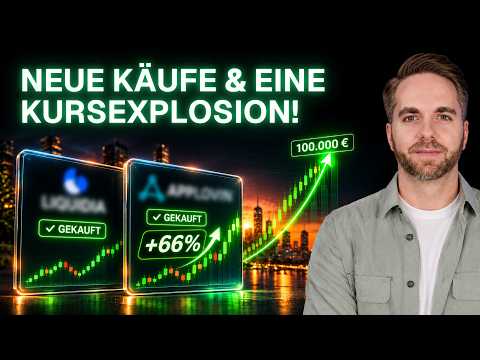
€10,000 → €100,000 Challenge: THIS Stock Exploded Like a Rocket! HERE's What We're Buying NOW!
2 min read

€10,000 → €100,000 Challenge: THIS Stock Exploded Like a Rocket! HERE's What We're Buying NOW!

📊 Portfolio Challenge Update: 23.6% Invested – Battling a Tough Market Environment
  • Current Status: Starting capital of €10,000 at ±0% (slight gains after fees). Benchmark Bitcoin is −15%, so the portfolio is outperforming.
  • New Purchases: AppLovin (bought more after strong earnings, +60% pre-purchase gain), Liquidia (missed earlier entry, now bought in, focusing on biotech turnaround).
  • Existing Positions: ServiceNow (weak quarterly results, turnaround uncertain, Q4 will decide), Circle (in the red due to crypto downturn), Hai Group (small position, Chinese risk, slightly positive).
  • Watchlist & Limits: Chronos (limit order active), Critical Metals (rare earths, high risk, max €250), Uranium Energy (downtrend, waiting), Monday.com (new, under analysis).
  • Strategy: Cash is king – only 23.6% invested. Discussing stop-loss rules (35% vs. 50% for moonshots). AI stocks under watch after the crash, but no purchase yet.
  • Community: New Discord channel for fast updates and exchange. Key upcoming events: Nvidia earnings, Entropic IPO.
  • Conclusion: Despite a challenging environment, the portfolio holds its ground. Next buys will be carefully considered – stay tuned!