Nofinity Logo
Onboarding

Welcome to Nofinity

Your premium hub to transform hours of YouTube video into concise, 5-minute text summaries. Build your custom expert feed!

1. Skip the Video

Save hours of watching. Read compact, AI-powered key takeaways in a premium magazine layout – completely ad-free.

2. Custom Feed

Subscribe to top experts in the Explore area to curate your personal, dynamically updating video feed.

3. Suggest Channels

Propose new YouTube channels. Once approved, our system automatically ingests and summarizes new uploads.

Latest Analyses(6)

3 Factors Determining the Markets in Q4 2026
Dr. Julian Hosp - Finanzen, Business und KI|02. Okt.

3 Factors Determining the Markets in Q4 2026

Three Major Market Forces Collide

The speaker analyzes Q4 2026 as particularly challenging because three factors are acting simultaneously. Depending on which one dominates, the quarter could be extremely bullish or bearish.

1. Geopolitics – Trump in Focus

  • Trump influences numerous issues: Midterms, Iran, Greenland, Ukraine, trade war.
  • Expectation: Trump will act bullishly to protect his midterm chances.
  • Investors should position themselves for Trump tailwinds.

2. Macroeconomics – Fed & Interest Rates

  • Interest rates are central: they affect discounted cash flow analyses and pressure many stocks (e.g., 75% of S&P 500 stocks in a bear market).
  • Important: firms with strong cash flow that can pass on inflation are favored.
  • Oil prices (Iran) and investor appetite also play a role.

3. Microeconomics – Earnings & AI

  • Earnings season kicks off; key question: AI – bubble or solid?
  • Tropic IPO (late November) drains liquidity.
  • Dynamics between chip and software stocks shift (e.g., Meta +40%, Microsoft strong, rotation in August).
  • Key: positioning and the interplay of the three forces.

Bottom line: Those who think through these factors can align their portfolio attractively. Forecasts are uncertain – only in hindsight will we see who was right.

Bitcoin: The Beauty of Mathematics (Part 73)
Benjamin Cowen|02. Okt.

Bitcoin: The Beauty of Mathematics (Part 73)

📉 Current Market Undervaluation
  • The total market cap of the crypto asset class is currently around $2.88 trillion.
  • This is significantly below the logarithmic fair value regression line.
  • The market hasn't been this undervalued since September/October 2010, around the inception of Bitcoin.
🧠 Psychology and Monetary Policy
  • Human psychology during midterm election years is a key factor explaining the current state of undervaluation.
  • Monetary policy heavily dictates whether overvaluation persists in a cycle:
    • Tight policy (last cycle): Dampened expectations, preventing sustained overvaluation.
    • Loose policy (prior cycle): Allowed for longer, more sustained overvaluation.
  • The next cycle could potentially see a longer phase of overvaluation if the monetary policy environment loosens up.
🔮 Future Outlook
  • The asset class is predicted to head towards a market cap of roughly $10 trillion (plus or minus a few trillion).
  • The speaker reflects on the cyclical nature of the market, emphasizing that monetary policy, not just hype, dictates the length of bull runs.
AI Agents Need CRYPTO: The Question is who will AGENTS CHOOSE 🧠💸
InvestAnswers|01. Okt.

AI Agents Need CRYPTO: The Question is who will AGENTS CHOOSE 🧠💸

AI Agents Need CRYPTO – The Key Question: Which Blockchain Will Agents Choose?

This video predicts that AI agents (autonomous bots) will soon rely on cryptocurrencies, especially stablecoins like USDC, for microtransactions. The speaker analyzes data to determine which blockchain is best suited for these requirements.
Why do AI Agents need Crypto?

  • Agents perform hundreds of daily transactions (e.g., purchases, contract negotiations, subscription cancellations).
  • They need absolute speed, instant finality, and fraction-of-a-cent fees.
  • Traditional banks and credit cards are too slow and expensive – blockchains provide the necessary infrastructure.

The X42 Standard and Current Adoption

  • The X42 standard allows agents to sign stablecoin payments without traditional financial rails.
  • Major companies like Amazon, American Express, Visa, Stripe, Shopify, Google, Mastercard, and many crypto platforms have already adopted it.

Scenarios for September 2027 (one year from now)

  • Conservative: 5 million agents, 100 transactions/day, 20% on-chain → 100 million additional on-chain transactions/day.
  • Base case: 25 million agents, 200 transactions/day, 30% on-chain → 1.5 billion transactions/day.
  • Bull case: 150 million agents, 400 transactions/day, 40% on-chain → 24 billion transactions/day.

Current Blockchain Capacity (transactions per second TPS)

  • Solana: 3,200 TPS (currently handling 76.5% of all top-chain transactions).
  • Binance: ~210 TPS, Tron: 138 TPS, Sui: 124 TPS, Base: 37 TPS, XRP: 24 TPS, Bitcoin: 8.6 TPS, Ethereum: 23 TPS, Avalanche: 4.6 TPS.
  • Problem: Even Solana can only handle 18.4% of the projected 1.5 billion daily transactions. All other chains lag far behind.

Finality – Critical for Agents

  • Solana (with Alpenlow): 0.115 seconds (fastest).
  • Aptos: 0.65 s, Sui: 0.7 s, Binance: 1.1 s, Avalanche: 2 s, Tron: 57 s, Cardano: 3 min, Ethereum: 12–17 min, Bitcoin: 1 hour.
  • Comparison: Ethereum is nearly 5,000 times slower, Bitcoin 24,000 times slower than Solana.

Cost Comparison (Fees)

  • Solana is the cheapest.
  • Base: 2.9× more expensive, Binance: 10×, Avalanche: 15×, Tron: 17×, Ethereum: 58×, Bitcoin: 115× more expensive than Solana.

Speaker's Conclusion

  • Solana is currently the product for high-frequency agent payments: lowest fees, fastest finality, high liquidity.
  • However, Solana must drastically increase capacity – developers are working on packing more transactions per block.
  • Private chains (subnets) lack public liquidity and are unsuitable for agents.
  • Bitcoin and Ethereum are too slow/expensive – agents will not choose them.
  • One analyst's forecast: one quadrillion transactions per week by AI agents could be the ultimate ceiling.
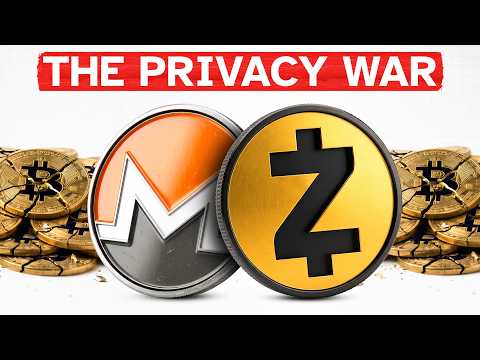
The Crypto Privacy WAR Is Here.
Coin Bureau|01. Okt.

The Crypto Privacy WAR Is Here.

Introduction

The transcript explains the current crypto privacy conflict with a vivid example: A designer gets paid in USDC and can view his client's entire financial history via a block explorer – no hacking required. The core issue: Bitcoin & Co. are not private payment systems but the most transparent financial ledgers in history.

Historical background
  • Early pioneers like David Chaum and the Cypherpunks wanted money that no one could watch.
  • Satoshi's Bitcoin whitepaper only offered pseudonymity, not true privacy – all transactions are publicly readable.
  • Companies like Chainalysis and Elliptic turned address tracking into a business, linking wallets to real identities.
The fight against privacy coins and mixers
  • Monero and Zcash were built as private alternatives but got delisted by major exchanges like Binance, Kraken, and OKX.
  • The US government sanctioned Tornado Cash (2022) – the first time software, not a person, was sanctioned.
  • Developers like Alexey Pertsev (Tornado Cash) and the Samourai Wallet founders faced criminal prosecution; Roman Storm was convicted, but the more serious charges remain open.
  • Courts ruled that immutable smart contracts cannot be owned and thus cannot be sanctioned – but prosecutions of developers continued.
New developments: ZK-proofs and institutional demand
  • Zero-knowledge proofs allow verifying information without revealing it – key for scaling and privacy.
  • Ethereum and Vitalik Buterin are making privacy a core pillar (e.g., the Kohaku framework).
  • Institutions also want privacy: Banks like JPMorgan use private chains such as Canton to avoid exposing trading strategies.
  • The concept of selective disclosure emerges: reveal only what is necessary – e.g., via Privacy Pools or Zcash viewing keys.
Conclusion and open question

The conflict is about who gets privacy: Institutions want protection from competitors but compliance with regulators; Cypherpunks want total privacy. The central question: Should financial privacy be the default on-chain, or something you have to opt into?

NFA Live! Bitcoin in 2026
Benjamin Cowen|01. Okt.

NFA Live! Bitcoin in 2026

Summary: Bitcoin in Q4 2026 - Analysis with Coin Bureau & Co.

In this live discussion, Rob, Guy (Coin Bureau), and Ben analyze the crypto market at the start of Q4 2026. After a strong Q3 with a 50% Bitcoin rally, the question is whether the cycle has been broken. Here are the key points:

Bitcoin Performance & Macro Environment

  • Strong Q3 2026: Bitcoin surged 50%, surpassing the typical 40% rally expected in a mid-cycle year.
  • Cycle Analysis: The July 2026 low was approximately $83,000. As long as Bitcoin holds above this level, the burden of proof is on the bears. Historically, Bitcoin often dipped below its 200-day moving average in the mid-cycle year, which repeated.
  • Surprising Strength: Despite rising long-term yields (30-year bonds at 5.6%), a strong US dollar, and higher energy prices, Bitcoin traded at $83,000. This shows markets don't always conform to expectations.

Dynamic Shift Due to ETFs

  • ETFs as a Game Changer: Spot Bitcoin ETFs (since 2024) have fundamentally altered capital flows into crypto. Capital enters Bitcoin but often stays in regulated wrappers, no longer trickling into altcoins as in previous cycles.
  • Altcoin Market: Instead of a broad rally, there are only selective winners (e.g., Zcash, Near, Quant). The altcoin rally is limited and may be a counter-trend move, as Bitcoin dominance remains high (around 65% excluding stablecoins).

Current Risks & Narratives

  • Macro Risks: The Federal Reserve may hike rates further (potentially three more times by year-end). Rising national debt (over $40 trillion) drives demand for alternative stores of value like Bitcoin and gold.
  • Inflation & Rates: Since the Fed funds rate is below the 2-year yield (currently around 4.9%), monetary policy is less restrictive, aiding altcoins temporarily. However, further rate hikes could reverse this.
  • Key Indicator: The reason for falling bond yields (e.g., late October/early November) is crucial: A growth scare would be bearish, while an end to the Middle East conflict and falling oil prices would be bullish.

Overrated Narratives & Outlook

  • Overrated: Privacy coins (e.g., Zcash) are seen as overhyped since 99.9% of users don't care about anonymity.
  • Recommendations: Dollar-cost averaging (DCA) remains the best strategy for Bitcoin. Altcoin investments should be selective, focusing on projects with real utility.
  • Core Message: Market structure has permanently changed due to ETFs and macroeconomic factors. Patience and fundamentals matter more than ever.

Author of Summary: Content Analyst